
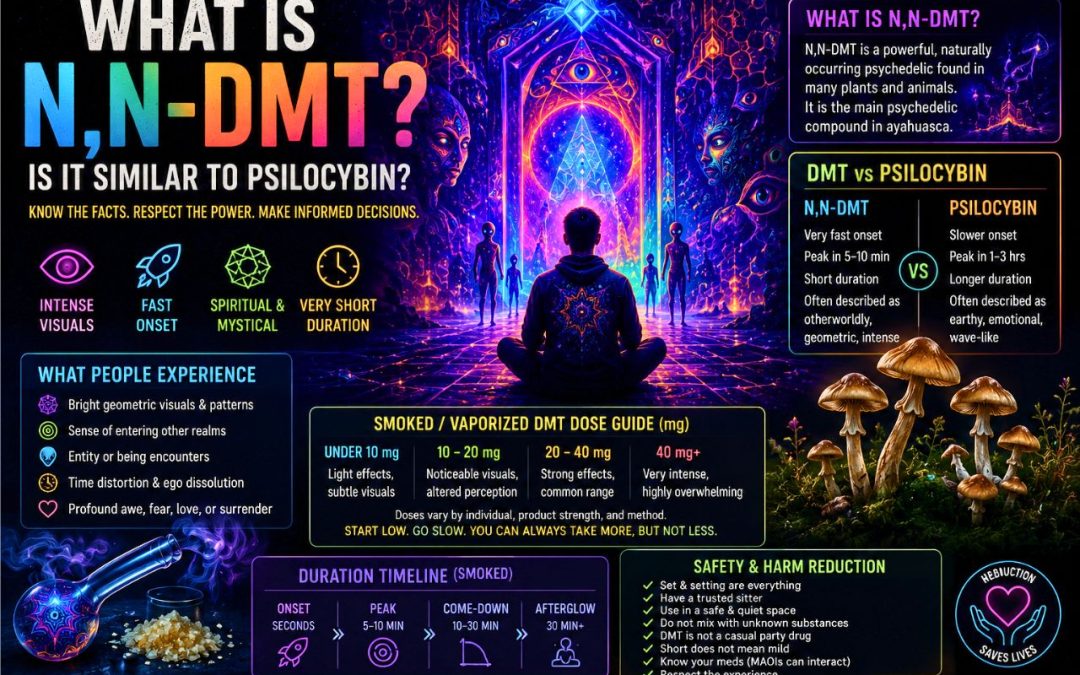
What Is NN-DMT?
N,N-DMT is one of the most powerful and unusual psychedelics people talk about. Some call it DMT. Some call it “the spirit molecule.” Some describe it as a short rocket ship into another world. Others describe it as overwhelming, confusing, spiritual, alien, terrifying, beautiful, or impossible to explain.
DMT is often compared to psilocybin mushrooms because both are classic psychedelics and both can create intense visual, emotional, and spiritual experiences. But they are not the same.
Psilocybin usually unfolds over several hours. DMT can come on within seconds and feel like it launches the person straight into the peak. Psilocybin often feels earthy, emotional, and wave-like. DMT is often described as fast, visual, otherworldly, and extremely intense.
For people in music festival, rave, and psychedelic culture, DMT has a reputation for being short but very powerful. That short duration can make it sound casual, but that can be misleading. A DMT experience may only last minutes, but those minutes can feel massive.
This article is for education and harm reduction. It is not medical advice, and it is not a recommendation to use DMT.
What Is N,N-DMT?
N,N-DMT stands for N,N-dimethyltryptamine. It is a naturally occurring psychedelic compound found in many plants and animals. DanceSafe describes DMT as the main psychedelic ingredient in ayahuasca, the South American brew used by many Indigenous communities for spiritual and medicinal purposes.
DMT can exist as crystals, powder, or a softer clumpy material, and DanceSafe notes that it may appear yellow, orange, or brownish depending on how it was manufactured or extracted.
In Canada, N,N-DMT is listed under Schedule III of the Controlled Drugs and Substances Act, along with substances such as LSD, psilocin, and psilocybin. The Act lists “N,N–Dimethyltryptamine (DMT)” and its salts under Schedule III.
The most important thing to understand is that DMT is not just a shorter version of mushrooms. It is its own experience.
Is N,N-DMT Similar to Psilocybin?
Yes and no.
DMT and psilocybin are similar because both are classic serotonergic psychedelics. They mainly affect serotonin systems involved in mood, perception, cognition, and sensory processing. A 2026 Nature Medicine paper describes DMT as a naturally occurring tryptamine that acts largely as a serotonin 5-HT2A receptor agonist.
That is why DMT and psilocybin can both create:
- Visual changes
- Altered time perception
- Emotional intensity
- Spiritual or mystical feelings
- A changed sense of self
- Deep introspection
- Strange or symbolic imagery
- A feeling of connection to something bigger
But the timeline and intensity are very different.
Psilocybin mushrooms usually build gradually, peak, and then come down over several hours. DMT can come on almost immediately when smoked or vaporized, peak very quickly, and then fade much faster. DMT effects are felt within seconds, with peak effects lasting about 5–10 minutes.
A simple way to explain it is:
Psilocybin often feels like walking into a psychedelic forest. DMT often feels like being launched through a psychedelic portal.
That does not mean DMT is “better.” It means it is faster, stranger, and often more intense.
N,N-DMT vs 5-MeO-DMT: Do Not Confuse Them
N,N-DMT is not the same thing as 5-MeO-DMT.
This matters because people sometimes use the word “DMT” loosely. N,N-DMT is the compound most associated with intense visuals, geometric spaces, “entities,” alien-like imagery, and ayahuasca. 5-MeO-DMT is a different compound that is often associated with ego dissolution, white-out experiences, and the Sonoran Desert toad conversation.
They are related tryptamines, but they are not interchangeable. 5-MeO-DMT has its own safety concerns, potency profile, and medical research. Reviews describe 5-MeO-DMT as a distinct psychedelic with different pharmacology and therapeutic research questions.
For this blog, when we say DMT, we mean N,N-DMT.
What Does DMT Feel Like?
DMT is difficult to describe because many people say it does not feel like ordinary visual hallucination. It can feel like being placed into a completely different environment, even though the person has not physically gone anywhere.
People often report:
- Bright geometric visuals
- Rapidly moving patterns
- Cartoon-like colours
- A sense of entering another space
- Strange rooms, tunnels, or landscapes
- Contact with “beings” or “entities”
- A feeling of receiving information
- Ego dissolution
- Out-of-body sensations
- Intense awe
- Fear or surrender
- A sudden return to normal awareness
DanceSafe describes smaller inhalations as producing mild perceptual changes such as colour enhancement and cartoon-like visuals, while larger experiences can involve profound states such as visiting other worlds or communicating with beings. DanceSafe also notes that “blasting off” refers to a full detachment from ordinary reality, and that this can be inspiring and transformative or overwhelming and terrifying.
This is why DMT has such a strong reputation in psychedelic culture. People may come back from a 10-minute experience and say it felt longer, deeper, or more impossible than anything they have experienced before.
DMT in Festival, Rave, and Psychedelic Culture
DMT is talked about in festival and rave culture, but it does not fit the same role as LSD, MDMA, ketamine, or mushrooms.
LSD can last most of the day or night. MDMA is often used socially for dancing, connection, and music. Mushrooms can be used in nature, camping, concerts, or reflective settings. Ketamine has its own dissociative role in club culture.
DMT is different because it is usually very short and very intense.
At a festival, a DMT experience may not be about dancing through a set. It may be something people do away from the crowd, in a quiet tent, around trusted friends, or in a more intentional setting. The reason is simple: DMT can temporarily disconnect someone from normal surroundings.
That is a major safety point.
A person on DMT may not be able to respond clearly, walk safely, communicate normally, or understand what is happening around them during the peak. Even if the peak is short, those minutes can be extremely disorienting.
For festival culture, the harm-reduction message is:
DMT may be short, but it is not casual. The environment matters. The people around you matter. Your mental state matters.
Common Effects People Report on DMT
Visual Effects
DMT is famous for visual intensity.
People often describe colours and patterns that feel brighter, sharper, faster, and more alien than other psychedelics. Visuals may include:
- Sacred geometry
- Kaleidoscope patterns
- Tunnels
- Fractals
- Faces
- Eyes
- Machines
- Symbols
- Rooms or landscapes
- Beings or figures
- Bright cartoon-like imagery
Some people experience open-eye visuals. Others experience the strongest visuals with eyes closed. Many report that the experience feels more like entering a scene than simply seeing patterns over the real world.
Time Distortion
DMT can strongly distort time.
A few minutes may feel much longer. Some people describe the experience as timeless, as if normal time stops or becomes irrelevant. Total ego dissolution can occur, where time stands still and the user loses their ordinary sense of separateness from the universe.
This can be beautiful, but it can also be frightening. If someone feels like time has stopped during an overwhelming experience, even a short trip can feel endless while it is happening.
Emotional Effects
DMT can bring up intense emotions very quickly.
People may feel:
- Awe
- Fear
- Love
- Wonder
- Confusion
- Gratitude
- Panic
- Peace
- Surrender
- Humility
- Spiritual connection
Because the onset can be so fast, there may be very little time to adjust. With mushrooms or LSD, the person often has a gradual come-up. With DMT, the shift can be abrupt.
This is one of the reasons some people find DMT beautiful and others find it too intense.
Entity or “Being” Experiences
One of the most famous parts of DMT culture is the report of meeting “entities,” “beings,” “guides,” “aliens,” “jesters,” or other presences.
This does not mean those beings are objectively real. It means people commonly report experiences that feel like contact with something intelligent, symbolic, or external.
Some people find this deeply meaningful. Others find it unsettling.
A grounded way to describe it is:
DMT can create experiences that feel like communication with another presence, but those experiences should be understood as subjective psychedelic phenomena, not proof of an external reality.
Body Effects
DMT is often thought of as a mind experience, but it can affect the body too.
People may notice:
- Rapid heartbeat
- Increased blood pressure
- Sweating
- Trembling
- Nausea
- Chest tightness
- Body buzzing
- Heavy limbs
- Loss of coordination
- Difficulty speaking
- Temporary disorientation
A review of DMT pharmacology noted that DMT appears to have limited neurotoxicity in available research, but it can produce intense cardiovascular effects, especially in high-dose intravenous settings.
At a festival, body effects matter because heat, dehydration, exhaustion, other substances, and loud environments can add stress.
How Long Does DMT Last?
DMT is known for being short-acting, especially compared with LSD or psilocybin.
DMT comes on within seconds, with peak effects last about 5–10 minutes, followed by a fairly abrupt return toward baseline.
A general smoked or vaporized DMT timeline may look like this:
| Stage | General Timeline |
|---|---|
| Onset | Seconds to a few minutes |
| Peak | Often around 5–10 minutes |
| Come-down | Often 10–30 minutes |
| After-effects | Some people feel altered, emotional, tired, or reflective afterward |
Clinical research using intravenous DMT also highlights the short-acting nature of the drug. A Nature Medicine paper notes that IV DMT has a short half-life of around 5 minutes, which is one reason researchers are interested in it as a shorter psychedelic therapy model compared with oral LSD or psilocybin.
Short does not mean weak. DMT can be one of the most intense psychedelic experiences a person has.
DMT Dose: What People Need to Know
There is no universally safe recreational DMT dose.
This section is included for education and harm reduction, not as a recommendation to use DMT.
DMT is usually discussed in milligrams, unlike LSD, which is discussed in micrograms. DanceSafe lists a common smoked DMT dose as 10–40 mg, while also warning that many people do not measure their dose and that measuring is a good idea.
A practical harm-reduction explanation looks like this:
| Amount | General Educational Description |
| Under 10 mg | Often described as light or threshold territory |
| 10–20 mg | May produce noticeable visuals and altered perception |
| 20–40 mg | Commonly discussed as a stronger smoked/vaporized range |
| 40 mg+ | May be very intense and more likely to overwhelm |
This is not a recommendation. The main point is that small differences can matter, and unmeasured DMT can become much stronger than expected.
Dose is also harder to judge with DMT vape pens or cartridges because the concentration may be unknown. The effects can depend on the product strength, device, temperature, and how much is actually consumed. When using DMT pens, the intensity depends heavily on how much vapor is taken in and how the product is used.
For harm reduction:
Do not eyeball DMT. Do not assume a vape pen is mild. Do not chase a “breakthrough” because someone online made it sound like the goal. Do not use DMT in a place where falling, wandering, or becoming unresponsive could put someone in danger.
What Is a “Breakthrough” on DMT?
A “breakthrough” is a term people use when the DMT experience becomes so immersive that the person feels fully separated from normal reality.
This may include:
- Feeling transported somewhere else
- Losing awareness of the body
- Losing awareness of the room
- Entity encounters
- Ego dissolution
- Total visual immersion
- A sense of leaving ordinary reality
Some people describe breakthrough experiences as life-changing. Others describe them as terrifying.
The important thing is that a breakthrough should not be treated like a trophy. More intense is not always better. Some people get more value from a lighter, more manageable experience than from being overwhelmed.
DMT, Ayahuasca, and Oral Use
DMT is not orally active by itself in the same way psilocybin mushrooms are. DMT is broken down in the stomach if consumed orally without a monoamine oxidase inhibitor, or MAOI. Ayahuasca traditionally combines a DMT-containing plant with another plant containing MAOI compounds such as harmaline, allowing the DMT to become orally active.
This is also why ayahuasca is a very different experience from smoked or vaporized DMT.
Ayahuasca effects begin within about 20–60 minutes and last 2–6 hours, with lingering after-effects that can last several more hours.
Ayahuasca also carries extra safety considerations because MAOI-containing substances can interact with medications and other drugs. A 2026 review on ayahuasca drug-drug interactions suggested clinically relevant interactions between ayahuasca and SSRIs, with concern that even modest increases in DMT exposure may intensify serotonergic effects.
For a general audience, the safest message is:
Do not treat ayahuasca like smoked DMT. The duration, body load, vomiting risk, medication interactions, and emotional intensity can be very different.
Set and Setting With DMT
Set and setting matter with all psychedelics, but they are especially important with DMT because the onset can be so fast and the peak can be so intense.
Set means the person’s mindset: mood, expectations, stress level, fears, mental health, and emotional state.
Setting means the physical and social environment: where the person is, who is present, whether they feel safe, and whether they can be supported if the experience becomes overwhelming.
Set and setting are very important with DMT and being in a good mental state with trusted people in a supportive environment can reduce the chance of a difficult experience.
In festival culture, a safer setting would usually mean:
- Not being in the middle of a dense crowd
- Not standing near hazards, stairs, water, fire, traffic, or equipment
- Having trusted sober or grounded people nearby
- Having somewhere quiet to sit or lie down
- Avoiding pressure from others
- Avoiding combinations with unknown substances
- Not needing to drive, work, perform, or supervise anyone afterward
DMT can temporarily remove someone’s ability to interact normally with the world. That should be respected.
When DMT Gets Too Intense
Because DMT can come on so quickly, a person may panic before they understand what is happening.
If someone is overwhelmed, the most helpful response is usually calm, simple, and grounded.
Helpful support may include:
- Keeping the environment quiet
- Speaking slowly and calmly
- Reminding them they took DMT and the effects will pass
- Helping them stay seated or lying down
- Avoiding too many people crowding around
- Not arguing with their experience
- Avoiding more substances
- Seeking medical or festival harm-reduction help if needed
Medical help should be taken seriously if someone has chest pain, seizures, severe overheating, breathing problems, loss of consciousness, dangerous behaviour, suicidal thoughts, or remains confused after the expected duration.
Mixing DMT With Other Substances
Mixing DMT with other substances can increase unpredictability.
Cannabis may intensify visuals, anxiety, confusion, or panic.
Alcohol can reduce judgment and make it harder to stay safe.
Stimulants may increase heart rate, blood pressure, and anxiety.
MDMA may add emotional intensity and stimulation.
MAOI-containing substances, including ayahuasca-style combinations, can create medication and drug-interaction risks, especially with serotonergic medications.
The safest general advice is simple:
The more substances involved, the harder it is to know what is happening and the harder it is to respond if something goes wrong.
Is DMT Physically Dangerous?
DMT is usually discussed as having a relatively short duration and limited physical toxicity compared with some other substances, but that does not mean it is harmless.
The risks are often psychological, cardiovascular, environmental, and behavioural.
Possible risks include:
- Panic
- Terror
- Confusion
- Loss of coordination
- Dangerous movement or falling
- Increased heart rate
- Increased blood pressure
- Psychological distress
- Triggering or worsening mental health symptoms
- Difficulty integrating the experience afterward
Rapid onset and extreme intensity of smoked DMT can be overwhelming and people should not be fooled by the short duration, calling DMT one of the most powerful psychedelics on the planet.
People with a personal or family history of psychosis, bipolar disorder, mania, severe panic, or unstable mental health should be especially cautious with psychedelics. DanceSafe specifically notes that people with personal or family histories of mood or psychotic disorders may be at increased risk of psychological upset after smoking DMT.
Are People Reporting Positive Effects From DMT?
Yes. Many people report positive effects from DMT, especially when the experience happens in a safe, intentional setting.
Common positive reports include:
- Spiritual connection
- Awe
- Emotional release
- Feeling less afraid of death
- A sense of meaning
- Feeling connected to the universe
- New perspectives on life
- Gratitude
- Creative inspiration
- Reduced anxiety afterward
- Feeling humbled or reset
A large global sample study described DMT as a strong, intense, short-lived psychedelic high with relatively few negative effects or comedown compared with some other substances, based on user reports.
But positive reports are not guarantees. DMT can also be frightening, destabilizing, or confusing. Some people feel changed in a good way. Others may struggle to make sense of the experience afterward.
The best way to frame it is:
DMT can feel profound, but profound does not always mean easy.
Does DMT Have Medical Benefits?
DMT is being studied for possible therapeutic use, especially because it is short-acting compared with psilocybin or LSD.
A 2026 Nature Medicine phase IIa trial studied a 10-minute IV DMT infusion in adults with moderate-to-severe major depressive disorder. The study used DMT fumarate in a controlled therapeutic environment with trained therapists.
The same paper reported that participants receiving DMT had a significantly greater reduction in depression scores than placebo at two weeks after the first dose, with follow-up assessments continuing up to 3 months and an exploratory follow-up at 6 months.
The paper also summarized earlier evidence, including IV DMT studies and an open-label inhaled DMT study in treatment-resistant depression where 14 patients followed a dose-escalation protocol and showed rapid antidepressant effects that were maintained up to 3 months.
This is promising, but it should not be misunderstood. These were controlled medical research settings with screening, support, dosing accuracy, and follow-up. That is very different from unknown DMT at a party or festival.
The honest medical takeaway is:
DMT may have therapeutic potential, especially because it is fast-acting, but the strongest research context is clinical, screened, supported, and supervised.
N,N-DMT vs Psilocybin: Which One Is Better?
Neither is automatically better. They are different tools, different experiences, and different risks.
| Category | N,N-DMT | Psilocybin |
| Duration | Very short when smoked or vaporized | Usually several hours |
| Onset | Very fast | Gradual |
| Feel | Otherworldly, intense, visual, fast | Earthy, emotional, wave-like |
| Visuals | Geometric, alien, immersive | Organic, flowing, symbolic |
| Body | Can feel intense but brief | Can have nausea/body load |
| Festival Use | Better suited to quiet, supported spaces | More common in nature, camping, music, and reflective settings |
| Risk | Rapid overwhelm and disconnection from surroundings | Longer emotional waves and possible anxiety |
| Medical Research | Emerging for depression | More developed for depression and end-of-life distress |
Psilocybin may be more approachable for some people because the come-up is slower and the experience is easier to understand in real time. DMT may appeal to people who are curious about short, intense, visionary experiences.
But short does not mean beginner-friendly.
The Bottom Line
N,N-DMT is a powerful, short-acting psychedelic that is often compared to psilocybin but feels very different. Psilocybin usually unfolds over hours. DMT can come on within seconds and create an intense, immersive experience that may feel like entering another world.
In festival and rave culture, DMT has a reputation for being short, visual, spiritual, and mysterious. But it is not a casual party drug. During the peak, a person may be unable to communicate clearly, walk safely, or stay connected to normal surroundings.
People report positive effects from DMT, including awe, spiritual connection, emotional insight, reduced fear, and new perspectives. Research is also exploring DMT for depression and other mental health applications.
But DMT can also be overwhelming, frightening, and risky in the wrong setting. Dose matters. Set and setting matter. Mental health history matters. Mixing substances increases unpredictability. And unknown products should never be trusted blindly.
The most honest harm-reduction message is:
DMT may be short, but it can be one of the most intense psychedelic experiences a person can have. Respect the dose, respect the setting, and do not confuse “brief” with “mild.”