
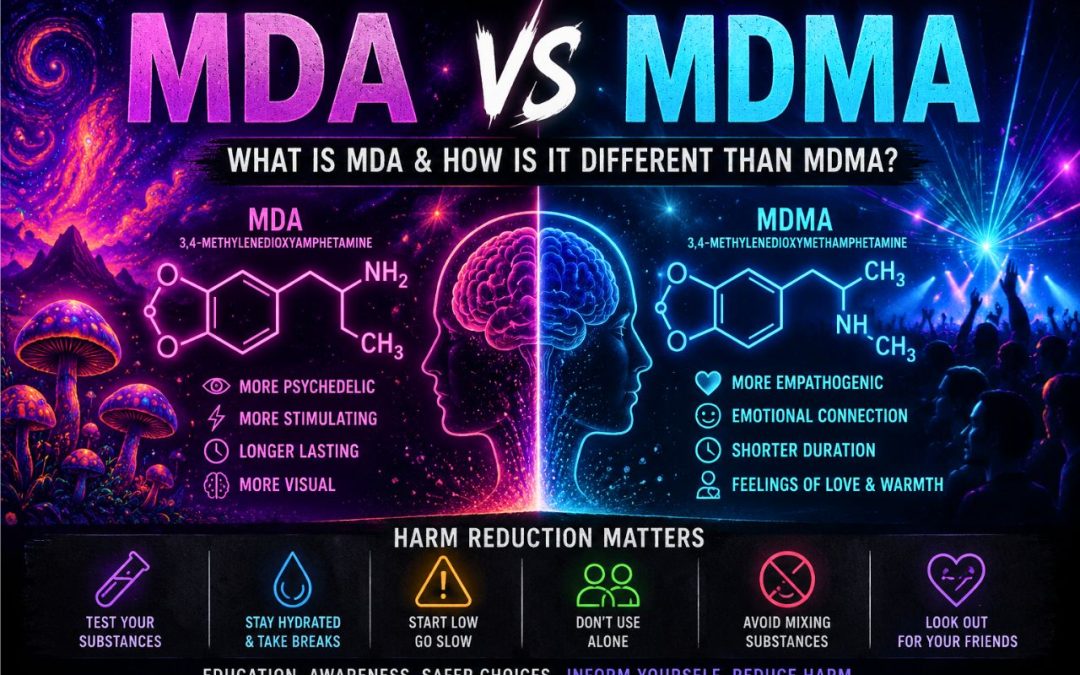
What Is MDA? How Is It Different From MDMA?
MDA and MDMA are often talked about together because they belong to the same general family of substances and can produce overlapping effects: euphoria, emotional openness, energy, body sensations, music appreciation, and a stronger feeling of connection. But they are not the same drug.
MDA stands for 3,4-methylenedioxyamphetamine. MDMA stands for 3,4-methylenedioxymethamphetamine. That small chemical difference matters. MDA is often described as more stimulating, more visual, more psychedelic, longer-lasting, and sometimes heavier on the body than MDMA. MDMA, on the other hand, is more commonly associated with empathy, emotional warmth, closeness, and the classic “molly” or “ecstasy” experience.
What Is MDA?
MDA is an empathogen or entactogen, meaning it can increase feelings of emotional openness, empathy, affection, confidence, and connection. It also has stimulant effects, which can increase energy, alertness, heart rate, blood pressure, sweating, and body temperature. Unlike MDMA, MDA is also more noticeably psychedelic for many people, meaning it may cause stronger changes in perception, visual distortion, altered music perception, time distortion, or hallucination-like effects. The Alcohol and Drug Foundation describes MDA as an empathogen with stimulant and psychedelic effects that works by increasing serotonin, norepinephrine, and dopamine in the brain.
MDA is sometimes called:
- Sass
- Sassafras
- Sally
- Mandy
- Eve
- Love drug
- Tenamfetamine
The nickname “sass” or “sassafras” is where some confusion comes from. MDA is not the sassafras plant itself. Sassafras oil contains safrole, which has historically been used as a precursor in the illegal manufacture of MDMA-like substances. But taking MDA is not the same thing as consuming sassafras tea, sassafras root, or a natural herbal product. “Sass” is just a street name.
Is MDA a Psychedelic?
MDA is not usually placed in the same category as classic psychedelics like psilocybin, LSD, or DMT, but it can have psychedelic-like properties.
A recent pharmacology review explains that MDA and MDMA both release serotonin, norepinephrine, and dopamine, but MDA has stronger activity at the serotonin 5-HT2A receptor than MDMA. That receptor is strongly involved in the effects of classic psychedelics. This helps explain why MDA often feels more visual and psychedelic than MDMA, even though it is still more closely related to MDMA than to psilocybin or LSD.
In simple terms:
MDMA usually feels more emotional and heart-opening.
MDA often feels more visual, stimulating, and psychedelic.
That does not mean MDA is “better.” For some people, the added intensity can feel exciting. For others, it can feel overwhelming, anxious, confusing, or physically uncomfortable.
Set and setting matter with substances that can change mood, perception, and body awareness.
[LINK NOTE: Link “set and setting” to your Set and Setting blog.]
MDA vs MDMA: The Main Differences
| Category | MDMA | MDA |
|---|---|---|
| Full name | 3,4-methylenedioxymethamphetamine | 3,4-methylenedioxyamphetamine |
| Drug type | Empathogen / entactogen with stimulant effects | Empathogen + stimulant + more psychedelic/hallucinogenic effects |
| Typical feel | Warmth, empathy, connection, emotional openness | More visual, more stimulating, sometimes more intense |
| Duration | Often around 3–6 hours | Often longer, commonly discussed around 5–8+ hours |
| Social feel | Usually more “heart-opening” | Can be more “trippy” and less soft/emotional |
| Main risk difference | Overheating, serotonin strain, comedown, unknown pills | Same risks, but longer duration and stronger psychedelic/stimulant edge can catch people off guard |
MDA is commonly reported to last around 5–8 hours, while MDMA is often described as lasting around 3–6 hours. UVic’s Substance Drug Checking resource also describes MDA as more potent relative to MDMA and more psychedelic in effect. Health Canada similarly lists MDMA effects as commonly lasting about 3–6 hours after oral use.
The longer duration is important. A person who expects MDA to behave like MDMA may panic when the effects keep going. They may also redose too early, thinking it “isn’t working” or that the peak is over, when the drug is still building or still active.
How Does MDA Feel?
People often describe MDA as:
- More visual than MDMA
- More “trippy”
- More stimulating
- More body-heavy
- More intense during the peak
- Longer-lasting
- Less emotionally soft than MDMA
- More likely to create jaw tension, sweating, or restlessness
- More likely to feel confusing at higher intensity
Some people report enhanced music, brighter colours, body tingles, emotional confidence, increased laughter, and stronger sensory effects. Others report anxiety, overheating, nausea, difficulty urinating, dizziness, jaw clenching, disorientation, or a rough comedown.
The important thing to understand is that MDA can vary widely from person to person. The same amount can feel manageable to one person and overwhelming to another. Factors like body size, sleep, hydration, mental state, other substances, environment, heat, dancing, health conditions, and product strength all matter.
How Is MDA Usually Taken?
MDA is most often found as a pill, capsule, powder, or crystal. It is usually swallowed, though some people snort it, smoke it, inject it, or use it rectally. Swallowing is the most common route.
MDA Dose and Harm Reduction: What People Need to Know
There is no universally “safe” recreational dose of MDA. That is the most important point. MDA is illegal and unregulated in many places, and products sold as “MDA,” “sass,” “molly,” or “ecstasy” may contain MDA, MDMA, both, or something else entirely. The Alcohol and Drug Foundation notes that pills, powders, capsules, and crystals sold as ecstasy can contain MDA, MDMA, both, or other substances such as amphetamines, caffeine, ketamine, or opioids.
Because of this, dose information should never be treated as a guarantee. A capsule that one person says is “100 mg of MDA” may not actually contain 100 mg of MDA. It may contain less, more, MDMA instead, or a different drug altogether. This is why drug checking, reagent testing, and avoiding unknown pills or powders matters.
What Are People Reporting as a Typical MDA Dose?
Harm-reduction and user-report resources often describe oral MDA amounts in general ranges. Erowid lists approximate oral MDA ranges as light: 40–60 mg, common: 75–125 mg for many people, strong: 150–200 mg, and heavy: 200 mg or more. Erowid also clearly warns that these ranges are not recommendations, that people react differently, and that what is safe for one person can be dangerous for another.
For comparison, UVic Substance Drug Checking describes a common MDMA dose as 75–125 mg, while noting that MDA is about 20% stronger than MDMA and produces more psychedelic effects. UVic also lists MDA as lasting 5–8 hours, compared with MDMA at 3–6 hours.
A simple harm-reduction takeaway is this: MDA should not be treated exactly like MDMA. Even when the milligram amount looks similar, MDA may feel stronger, more visual, more stimulating, longer-lasting, and more physically intense.
First-Time or Unknown-Strength MDA
If someone is going to use MDA despite the risks, the biggest mistake is taking a full amount based on someone else’s tolerance. People vary widely in sensitivity. Body size, medications, sleep, anxiety level, hydration, temperature, other substances, and product strength can all change the experience.
For harm reduction, people commonly say “start low and go slow,” but with MDA that really means: do not assume the substance is what it was sold as, do not eyeball powder, and do not rush into more because it feels slow at first. A proper milligram scale is much safer than guessing by sight, but even a scale does not confirm what the substance actually is.
How Long Should Someone Wait Before Taking More?
The lowest-risk redose is no redose at all. MDA can take time to fully develop, and redosing too early can accidentally stack the effects.
The Alcohol and Drug Foundation says swallowed MDA may be felt within 15–70 minutes, effects may last 5–8 hours, and the peak can last around 2.5–4 hours. Their harm-reduction guidance says to wait at least 2 hours before deciding whether to take more.
If someone takes more before the first amount has fully peaked, they may not realize how strong the total amount is going to become. This is one reason people end up overwhelmed, anxious, overheated, disoriented, or stuck in a longer experience than expected.
Redosing also tends to extend the night, worsen sleep loss, increase jaw tension and body stress, and may make the comedown harder. Chasing the first peak rarely brings the same clean feeling back. For many people, it only adds stimulation, confusion, insomnia, and a rougher next day.
How Long Should Someone Wait Before Trying MDA Again?
There is no proven waiting period that makes MDA safe. But using MDA or MDMA too often increases the chance of tolerance, harsher comedowns, low mood, anxiety, sleep disruption, and losing the positive effects people are looking for.
UVic Substance Drug Checking notes that MDMA/MDA deplete neurotransmitters such as serotonin, dopamine, and norepinephrine, and recommends waiting at least a few days to a few weeks between use so the brain has time to restore its levels.
Other harm-reduction sources are more conservative. Drugs.ie suggests leaving at least 4 weeks between MDMA use, while RollSafe discusses 3–5 weeks as a possible minimum in limited situations and describes the “3-month rule” as a common anecdotal rule of thumb, especially for people who may use more than a few times in their life.
Because MDA is often reported as stronger, longer-lasting, more psychedelic, and potentially harder on the comedown than MDMA, a cautious harm-reduction message would be: think in terms of months, not days. If someone feels the urge to use MDA again right away, that is a sign to pause and look honestly at why.
Quick Harm-Reduction Summary
If someone is going to use MDA:
Do not assume “sass” means natural, clean, or safe.
Do not assume MDA and MDMA doses feel the same.
Test the substance whenever possible.
Do not eyeball powder.
Avoid redosing if possible.
Wait at least 2 hours before even considering whether more is being taken.
Remember that the peak can last 2.5–4 hours and the full experience can last 5–8 hours.
Avoid mixing with alcohol, cocaine, amphetamines, ketamine, opioids, MAOIs, antidepressants, or other serotonin-affecting substances.
Avoid hot crowded environments without cooling breaks.
Sip fluids responsibly; do not chug excessive water.
Do not use alone.
Give the brain and body several weeks to months before considering another experience.
Avoid MDA entirely if you have heart problems, high blood pressure, seizure history, liver or kidney problems, serious anxiety, bipolar disorder, psychosis history, or if you take medications that affect serotonin.
This section should be read as harm reduction, not encouragement. The safest option is not to use unregulated substances. But for people who are going to use them anyway, understanding dose ranges, timing, redosing risk, and recovery time can help prevent avoidable harm.
Why Testing Matters
Testing is one of the most important harm-reduction steps.
A drug sold as MDA may contain MDMA. A drug sold as MDMA may contain MDA. A pill sold as ecstasy may contain caffeine, amphetamines, ketamine, synthetic cathinones, opioids, or other unexpected substances. The Alcohol and Drug Foundation notes that drugs sold as ecstasy may contain MDA, MDMA, both, or other psychoactive substances.
In British Columbia, drug checking services can test a range of substances, including opioids, stimulants, MDMA, benzodiazepines, and other psychoactive drugs. BC government harm-reduction information describes drug checking as a way to identify harmful or deadly contaminants such as fentanyl.
Testing does not make use safe. It simply gives a person more information. Reagent kits, fentanyl test strips, FTIR drug checking, and lab-based checking all have strengths and limitations. A single test may not detect everything, especially if a sample is not mixed evenly. But testing is still much better than guessing.
MDA, MDMA and Overheating
One of the biggest risks with MDA and MDMA is overheating, especially at festivals, raves, clubs, or summer events.
These substances can raise body temperature, increase sweating, reduce awareness of fatigue, and make people dance for hours. At the same time, drinking too much water can also be dangerous. MDMA toxicity deaths are most commonly associated with hyperthermia and hyponatremia, which means dangerously low sodium caused by overhydration or water imbalance.
Harm-reduction basics include:
Take cooling breaks.
Rest between dancing.
Sip water instead of chugging large amounts.
Consider electrolytes if sweating heavily.
Avoid heavy alcohol use.
Avoid combining stimulants.
Watch friends for confusion, collapse, overheating, or unusual behaviour.
Get medical help immediately if someone is extremely hot, confused, fainting, having a seizure, vomiting repeatedly, or becoming unresponsive.
Do not wait to “see if they sleep it off.” Overheating and serotonin-related emergencies can become life-threatening.
Can MDA Cause a Bad Comedown?
Yes. Not everyone gets a bad comedown, but it is common enough that people should be prepared for it.
MDA may leave some people feeling emotionally drained, anxious, depressed, tired, foggy, or irritable. The more someone takes, the more often they redose, the less they sleep, the more they mix substances, and the harder they push their body, the worse the recovery can be.
Recovery is not just about supplements. Sleep, food, hydration, electrolytes, calm environment, and several low-stress days matter. Using more stimulants, alcohol, or cannabis to force a recovery can sometimes make anxiety or mood swings worse.
Can MDA Help With Therapy or Trauma Like MDMA?
Most of the public conversation around therapy has focused on MDMA-assisted therapy, especially for PTSD. MDMA has been studied in clinical settings with screening, medical oversight, trained therapists, controlled dosing, and integration sessions. That is very different from taking an unknown pill or powder at home or at a festival.
MDA has also been discussed in relation to therapeutic potential, but it is much less researched than MDMA. The Alcohol and Drug Foundation notes that MDA is being looked at as an alternative to MDMA in MDMA-assisted therapy, but the long-term effects of MDA are not as well understood as MDMA.
It is also important to understand the current regulatory picture. MDMA-assisted therapy has shown promise in research, but the FDA did not approve MDMA-assisted therapy for PTSD in 2024 and requested further work before approval.
A clinical therapy setting is not the same as recreational use. In therapy research, people are screened for medical and psychiatric risk, monitored during the session, and supported afterward. Without that structure, intense emotional material can surface in ways that feel destabilizing rather than healing.
Final Thoughts: MDA Is Not Just “Different MDMA”
MDA and MDMA are closely related, but they are not interchangeable. MDA is often longer-lasting, stronger, more stimulating, and more psychedelic than MDMA. That can make it appealing to some people, but it can also make it more overwhelming and less forgiving.
For anyone choosing to use MDA despite the risks, harm reduction matters. Test the substance. Do not guess the dose. Do not assume it is natural or safe because someone calls it sass. Avoid mixing substances. Avoid redosing. Take breaks, stay cool, sip fluids responsibly, and give the brain and body real recovery time afterward.
The safest option is not to use unregulated substances. But honest education is still important. People make better decisions when they understand what they are taking, how it differs from similar substances, and what warning signs should never be ignored.