
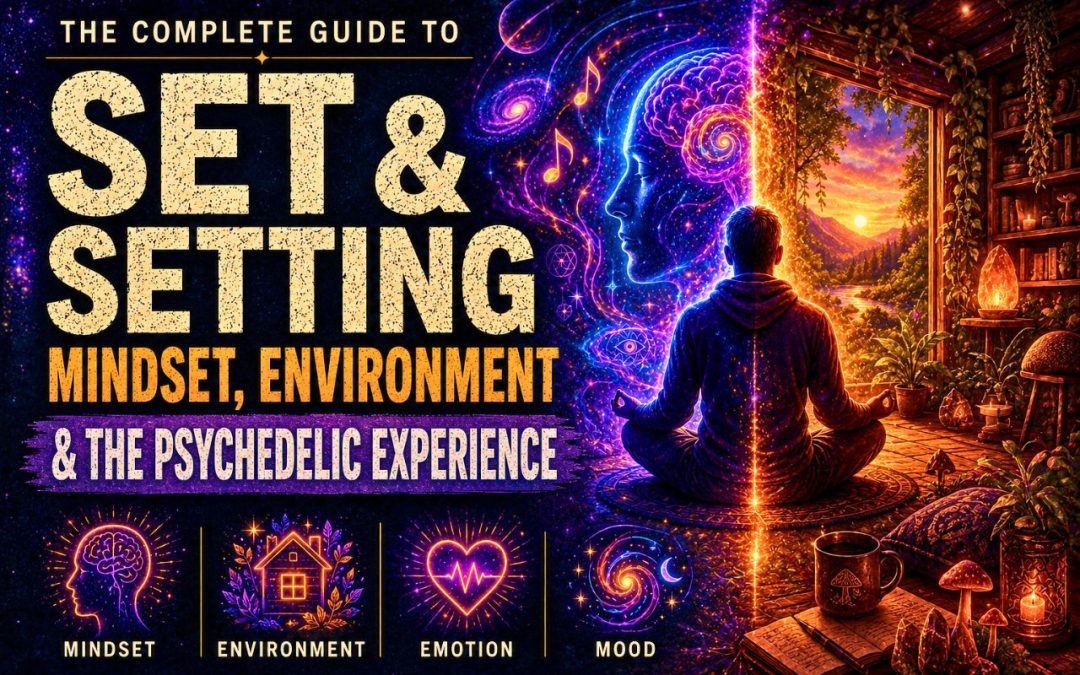
Why Mindset and Environment Matter So Much
Some people think a psychedelic experience is only about the substance itself. They focus on the strain, the strength, the amount, or how experienced someone is. While those things can matter, they are only part of the picture.
Two people can take the same thing and have completely different experiences.
One person may feel relaxed, thoughtful, connected, and emotionally open. Another person may feel uneasy, overstimulated, confused, or uncomfortable. The difference often comes down to something simple but powerful: set and setting.
In psychedelic education, “set and setting” refers to the person’s inner state and outer environment. It is one of the most important concepts to understand because it helps explain why the same experience can feel calm and meaningful in one situation, but intense or difficult in another.
Set = what is happening inside you.
Setting = what is happening around you.
Together, they help shape the tone, direction, and emotional feel of an experience.
What Does “Set” Mean?
“Set” means mindset.
It includes your mood, thoughts, expectations, stress level, emotional state, and the general headspace you are in. It is the mental and emotional baggage you bring with you before the experience begins.
A person who feels calm, grounded, and open may enter the experience very differently than someone who feels rushed, angry, pressured, anxious, or emotionally overwhelmed.
Set can include things like:
- Your current mood
- Your stress level
- Your expectations
- Your intentions
- Your emotional state
- Your confidence or nervousness
- What has been happening in your life recently
- Whether you feel safe, prepared, and supported
This is why mindset matters so much. Psychedelics are often described as amplifiers. They may not simply create a feeling out of nowhere; they can bring attention to what is already sitting under the surface.
If someone is already carrying stress, uncertainty, grief, conflict, or fear, those feelings may become more noticeable. On the other hand, if someone feels peaceful, curious, and emotionally steady, the experience may reflect that as well.
That does not mean a perfect mood guarantees a perfect experience. It also does not mean a difficult day automatically creates a bad one. It simply means the mind is part of the environment too.
What Does “Setting” Mean?
“Setting” means the physical and social environment.
It is where the person is, who they are with, what the space feels like, and what is happening around them.
A quiet room with soft lighting, familiar music, and trusted people creates a very different atmosphere than a crowded, loud, unpredictable space. The environment can either support calmness or create tension.
Setting can include:
- The room or outdoor location
- Lighting
- Music
- Temperature
- Comfort
- Privacy
- Noise level
- The people nearby
- Whether the space feels familiar or unfamiliar
- Whether interruptions are likely
- The overall emotional tone of the environment
A good setting does not need to be fancy. It does not need to look like a movie scene with tapestries, candles, and perfect music. What matters most is whether the space feels safe, comfortable, and easy to relax into.
Sometimes the smallest details make the biggest difference. A harsh light, a messy room, an unexpected visitor, a loud TV, or someone with stressful energy can change the feeling of the experience quickly.
Why Set and Setting Can Change the Whole Experience
Psychedelic experiences are often deeply influenced by perception. The mind becomes more sensitive to emotions, surroundings, sounds, body sensations, and social cues.
That means the environment is not just background noise. It becomes part of the experience.
Music may feel more emotional. A conversation may feel more meaningful. A cluttered room may feel overwhelming. A peaceful outdoor view may feel beautiful in a way that is hard to explain.
This is why set and setting matter so much. They influence the direction the mind naturally moves toward.
A calm setting may make it easier to settle in. A chaotic setting may make it harder to relax. A supportive mindset may make challenging emotions easier to process. A fearful mindset may make uncertainty feel heavier.
The experience is not only about what is taken. It is also about the mental and physical world surrounding it.
The Role of Expectations
Expectations are a major part of set.
Someone who expects a psychedelic experience to be fun, colourful, and easy may feel caught off guard if it becomes emotional or introspective. Someone who expects it to be scary may become overly focused on every unusual feeling.
Expectations can create pressure.
A person may think, “This has to be amazing,” or “I hope nothing goes wrong,” or “What if I feel weird?” Those thoughts can influence the tone before anything even begins.
A healthier mindset is usually more open-ended.
Instead of expecting one specific type of experience, it can help to understand that psychedelic experiences may be emotional, reflective, strange, funny, beautiful, uncomfortable, or quiet. Not every experience needs to be dramatic to be meaningful.
Some are bright and visual.
Some are thoughtful and internal.
Some are gentle and mellow.
Some bring up emotions that were already waiting for attention.
The less pressure someone puts on the experience to be a certain way, the easier it may be to stay grounded if things unfold differently than expected.
The People Around You Matter
One of the most important parts of setting is the people involved.
The energy of other people can strongly affect the experience. A trusted, calm, respectful person can help create a sense of safety. A loud, careless, intense, or unpredictable person can do the opposite.
This is why people often talk about being around people they trust.
It is not just about having company. It is about whether the people nearby help the space feel safe or make it feel harder to relax.
Good support does not always mean someone has to talk a lot. Sometimes the best presence is quiet, steady, and non-judgmental. Someone who can stay calm, offer reassurance, and respect the person’s space may be more helpful than someone trying to control the experience.
The wrong company can make a person feel watched, judged, rushed, or misunderstood. That can create tension quickly.
When it comes to setting, people are part of the room.
Music Can Shape the Mood
Music is one of the most powerful parts of setting.
The right music can make a space feel warm, emotional, peaceful, or inspiring. The wrong music can feel sharp, chaotic, distracting, or uncomfortable.
During a psychedelic experience, music may feel more immersive than usual. A song might seem to carry emotion more strongly. A slow instrumental track may feel calming. A song with aggressive lyrics or sudden changes may feel unsettling.
This does not mean there is one perfect playlist for everyone. Music is personal. What feels relaxing to one person may feel strange to another.
The key idea is that music should match the kind of atmosphere someone wants to create. Gentle, familiar, or calming music is often easier to settle into than something intense, unpredictable, or emotionally heavy.
Music can become part of the emotional landscape.
That is why it should be chosen with care.
Indoor vs Outdoor Settings
Both indoor and outdoor settings can have very different effects.
An indoor setting may feel controlled, private, and comfortable. It can be easier to manage lighting, temperature, music, and interruptions. A familiar room can provide a sense of safety and predictability.
An outdoor setting may feel open, beautiful, and connected to nature. Trees, sky, water, and fresh air can feel calming or meaningful. However, outdoor spaces can also be less predictable. Weather, people, noise, bugs, traffic, or getting too far from a comfortable place can change the mood quickly.
Neither is automatically better.
The best setting is the one that feels safe, manageable, and appropriate for the person and situation.
A peaceful backyard is very different from a busy public trail. A quiet living room is very different from a crowded party. The details matter more than the category.
Why Public Places Can Be Difficult
Public places can be unpredictable.
Even if someone feels confident at first, busy environments can become overwhelming. Strangers, noise, bright lights, traffic, security, crowded rooms, or unexpected conversations may become harder to process.
This is one reason many educational discussions around psychedelics emphasize calm, private, controlled environments.
A public setting can add pressure. The person may feel like they need to “act normal,” respond to people, make decisions, or navigate situations they were not prepared for. That can create unnecessary stress.
Psychedelic experiences can make ordinary surroundings feel more intense. A grocery store, busy street, concert, or crowded event may not feel the same as it normally would.
A setting that seems fine while sober may feel very different during an altered state.
Emotional Weather: What You Bring With You
One of the most interesting parts of set is that it does not only include how someone feels in the moment. It can also include what has been building over time.
A stressful week, relationship tension, grief, lack of sleep, major life changes, or unresolved emotions can all affect mindset.
This does not mean difficult emotions should be ignored. In fact, some people report that emotional material can come up in a way that feels important. But there is a big difference between entering an experience with awareness and entering one while feeling completely overwhelmed.
Your emotional state is like weather.
Clear skies may make the journey easier. Heavy clouds do not always mean disaster, but they can change the conditions. If the emotional weather is already stormy, it may not be the best time to step into something unpredictable.
Set and Setting Are Not About Controlling Everything
One common misunderstanding is that set and setting are about trying to control the entire experience.
They are not.
No one can fully control a psychedelic experience. Trying too hard to control it may actually create more tension. Set and setting are more about creating supportive conditions.
Think of it like planting a garden.
You cannot force the plant to grow in a specific shape, but you can prepare the soil, choose the location, remove unnecessary stress, and give it a better chance to develop well.
Set and setting work the same way. They do not guarantee a certain outcome, but they can influence whether the experience feels supported or chaotic.
When the Experience Becomes Challenging
Even with a good mindset and a calm environment, challenging moments can still happen.
This is important to understand. A difficult moment does not automatically mean something has gone wrong. Sometimes emotions rise. Sometimes thoughts become intense. Sometimes the person may feel uncertain, uncomfortable, or overwhelmed.
In many cases, the setting can help soften those moments.
A calmer room, a trusted person, gentle music, lower lighting, or a simple change in environment may help the experience feel less intense. Reassurance can also matter. Hearing that the feeling will pass and that the person is safe can be grounding.
The key point is that set and setting can act like anchors. They give the person something stable to return to when the experience feels bigger than expected.
For more support-focused education, how to deal with a bad trip is another important topic that connects directly to set and setting.
Why the Same Dose Can Feel Different on Different Days
One of the biggest reasons set and setting matter is because they help explain why the same amount can feel different from one day to another.
A person may have one experience that feels light, social, and easy. Another time, something similar may feel deeper, heavier, or more emotional.
That can be confusing if someone only thinks in terms of dose or potency.
But the body and mind are not machines. Sleep, stress, food, mood, expectations, environment, and social comfort can all change the experience.
This is why education matters. Psychedelic experiences are not only chemical. They are psychological, emotional, and environmental.
For beginners, understanding how much magic mushrooms should I take is only one part of the bigger picture.
Set and Setting in Microdosing Conversations
Set and setting are usually discussed around larger psychedelic experiences, but they can also matter in microdosing conversations.
With microdosing, the goal is often subtle. People may be looking for focus, mood support, creativity, or a different relationship with their day. Because the effects are intended to be mild, people sometimes forget that mindset and environment still matter.
A stressful day, lack of sleep, too much pressure, or a chaotic environment can influence how someone interprets even subtle effects.
This is why microdosing discussions often include journaling, intention, routine, and self-awareness. The experience may be small, but the context still matters.
For those learning the basics, what is microdosing is a helpful place to start.
Why This Concept Is So Important for Beginners
Set and setting are especially important for beginners because they shift the focus away from chasing effects.
Instead of asking only, “What will happen?” a better question is, “What kind of conditions am I creating?”
That question is more useful.
It encourages people to think about their mindset, surroundings, emotional state, and support system. It also helps people understand that a psychedelic experience is not something to treat casually or impulsively.
A beginner may not know exactly what to expect, and that uncertainty can create nervousness. Learning about set and setting gives them a framework. It helps explain why preparation, comfort, and environment matter.
It also encourages respect.
Psychedelics are not just about visuals or intensity. They can affect perception, emotion, memory, thought patterns, and the way someone relates to themselves and the world around them. That is not something to rush into without thought.
A Simple Way to Remember It
The easiest way to understand set and setting is this:
Set is the inner world.
Setting is the outer world.
Set asks:
“How am I feeling?”
“What am I bringing into this?”
“Am I calm, stressed, curious, nervous, grounded, or overwhelmed?”
Setting asks:
“Where am I?”
“Who is around me?”
“Does this space feel safe?”
“Is the environment calm, comfortable, and predictable?”
When the inner world and outer world both feel supportive, the experience may have a better foundation.
Common Mistakes People Make With Set and Setting
One common mistake is treating the environment as an afterthought. People may focus so much on the product, strain, or strength that they forget the room, music, and people around them can shape the experience just as much.
Another mistake is entering the experience while emotionally unsettled, but pretending everything is fine. Psychedelics can make it harder to avoid what is already there.
A third mistake is being around the wrong people. Someone may assume any friend is fine to be around, but not every friend creates a calm or supportive environment.
Another mistake is choosing a setting that requires too much responsibility. If someone has to answer messages, deal with strangers, make plans, travel, or manage unexpected interruptions, the experience can become more stressful than it needs to be.
Set and setting are about reducing unnecessary pressure before it begins.
Final Thoughts: Set and Setting Are the Foundation
Set and setting are not just side notes in psychedelic education. They are the foundation.
Mindset shapes how the experience is interpreted. Environment shapes how safe, calm, or intense the experience feels. Together, they can influence the emotional tone, comfort level, and overall direction of the journey.
This is why the same mushroom, amount, or strain may feel different depending on the person, the day, the room, the music, and the people involved.
Understanding set and setting helps bring more respect and awareness to the conversation. It reminds us that psychedelic experiences are not only about what someone takes. They are also about where they are, who they are with, what they are feeling, and what kind of space they create around the experience.
In the simplest terms:
Set is the mind. Setting is the space. Both matter.
FAQs
What does set and setting mean?
Set and setting refer to mindset and environment. “Set” is the person’s inner state, including mood, emotions, expectations, and stress level. “Setting” is the outer environment, including location, people, music, lighting, comfort, and privacy.
Why is set and setting important?
Set and setting are important because they can strongly influence how a psychedelic experience feels. A calm mindset and comfortable environment may support a more grounded experience, while stress, chaos, or the wrong people can make things feel more difficult.
Can set and setting change the effects?
Set and setting may not change the substance itself, but they can change how the experience is felt and interpreted. The same amount may feel very different depending on mood, environment, people, music, and expectations.
What is an example of a good setting?
A good setting is usually calm, familiar, private, and comfortable. It may include soft lighting, relaxing music, trusted people, and minimal interruptions. The best setting is one that feels safe and easy to relax in.
Can a bad setting cause a bad experience?
A stressful or chaotic setting can contribute to discomfort, anxiety, or overwhelm. Public places, loud environments, strangers, conflict, or unpredictable situations may make the experience harder to settle into.
Is mindset more important than environment?
Both matter. Mindset affects the inner emotional tone, while environment affects the outside atmosphere. A calm mindset in a stressful place can still feel difficult, and a peaceful space may not fully balance an overwhelmed emotional state.