
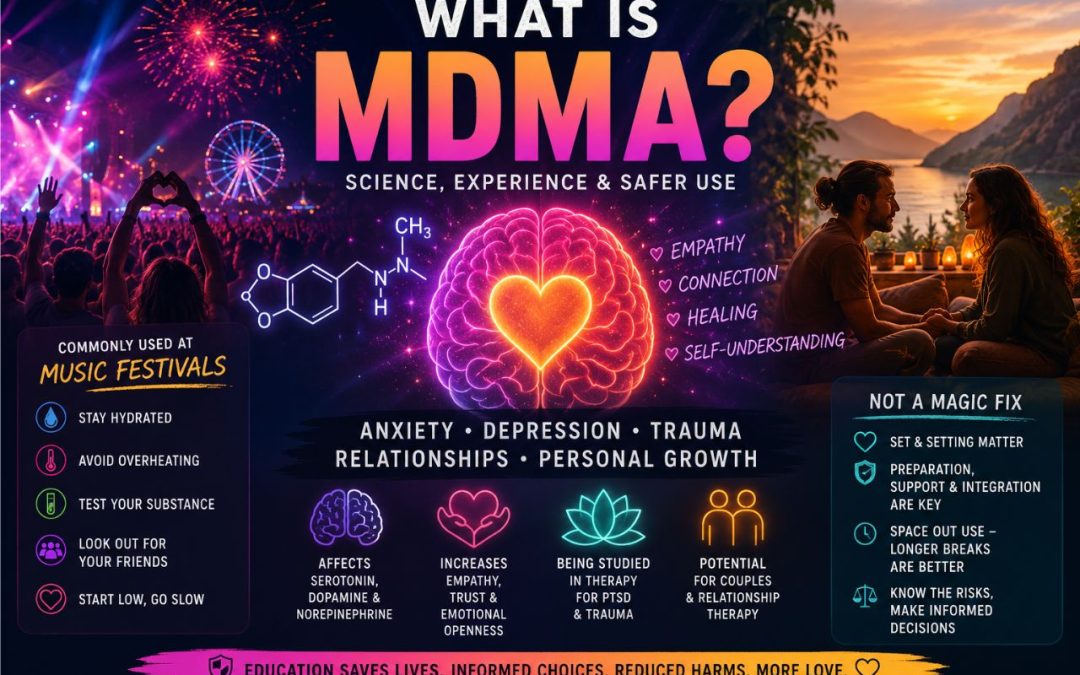
What Is MDMA?
MDMA is one of the most talked-about substances in the world of mental health, trauma therapy, music festivals and relationship healing. Some people know it as ecstasy. Others call it molly, MD, E or mandy. In medical research, it is usually referred to as MDMA, short for 3,4-methylenedioxymethamphetamine.
MDMA is not the same thing as psilocybin, LSD or DMT. It is usually described as an entactogen or empathogen, meaning it can increase emotional openness, empathy, closeness and self-reflection. It also has stimulant effects and mild psychedelic-like qualities. Some people place it under the larger “psychedelic therapy” umbrella, but scientifically, it is different from classic psychedelics like psilocybin mushrooms or LSD. MDMA mainly affects serotonin, dopamine and norepinephrine systems, while also influencing fear, connection and emotional processing.
MDMA is also a controlled substance in many places. In Canada, MDMA is a Schedule I controlled substance, and Health Canada states there are currently no approved therapeutic products containing MDMA in Canada, although MDMA can sometimes be accessed through the Special Access Program in specific medical situations.
This article is for education and harm reduction only. It is not medical advice, legal advice, or encouragement to use MDMA. The safest way to avoid MDMA-related harm is not to use it. But because many people will use it anyway, honest education can help people make more informed and safer decisions.
Learn more about how environment affects psychedelic experiences in our guide to set and setting.
What Does MDMA Feel Like?
People commonly report that MDMA can create feelings of warmth, openness, trust, emotional softness and connection. Music may feel more meaningful. Touch may feel more pleasant. Conversations may feel easier. People often describe feeling more love for themselves, their partner, their friends, or even strangers.
Common reported effects include:
- Increased empathy and emotional closeness
- Euphoria or a strong sense of well-being
- More energy and alertness
- Increased appreciation for music
- Reduced fear around difficult emotions
- Greater willingness to talk openly
- Jaw clenching, sweating, nausea or body tension
- Increased heart rate, blood pressure and body temperature
Many people describe MDMA as feeling “heart-opening.” Some say it helped them talk about things they normally avoid. Others report feeling forgiveness, compassion or emotional release. But not every experience is positive. Some people feel anxious, overwhelmed, physically uncomfortable, emotionally exposed, or depressed afterward.
Is MDMA a Psychedelic?
MDMA is often discussed alongside psychedelics, but it is not a classic psychedelic in the same way psilocybin or LSD are.
Classic psychedelics tend to strongly alter perception, imagery, sense of self, time, meaning and consciousness. MDMA can cause mild visual effects for some people, especially at higher doses, but its main effect is usually emotional rather than visionary. It is more commonly described as an empathogen or entactogen because it can make people feel emotionally open, connected and willing to explore inner material.
That is why MDMA has attracted interest in trauma therapy. It does not simply create “hallucinations.” Its therapeutic interest comes from its ability to reduce fear, increase trust and make difficult memories feel more approachable in a supportive setting. Research on MDMA-assisted therapy suggests it may influence fear memory reconsolidation, fear extinction, openness and prosocial behaviour.
How Is MDMA Normally Taken?
MDMA is most commonly swallowed as a tablet, capsule, crystal or powder.
When swallowed, effects often begin around 30–60 minutes after use, and the main effects may last roughly 3–6 hours. Some unpleasant after-effects can last longer, including fatigue, low mood, trouble sleeping, irritability or difficulty concentrating.
Some people snort MDMA, but this can be harsher on the nose and may increase the chance of a fast, uncomfortable or overwhelming onset. Injecting or smoking unregulated substances carries additional serious risks and should be avoided.
Is MDMA Commonly Used at Music Festivals?
Yes. MDMA has a long connection with dance music, raves, nightlife and festival culture.
This setting creates a unique risk profile. MDMA raises body temperature, increases energy and can make people dance for hours. Crowded environments, hot weather, alcohol, poor sleep and lack of electrolytes can all increase the chance of overheating, dehydration or overhydration.
One major mistake is thinking water alone solves the risk. Drinking too little can be dangerous, but drinking too much water without electrolytes can also be dangerous because it can dilute sodium levels in the body causing an electrolyte imbalance.
Can MDMA Help With Anxiety, Depression or Past Trauma?
From a scientific standpoint, MDMA is most strongly researched for PTSD, not general anxiety or depression on its own.
In clinical studies, MDMA is not used as a take-home medication. It is used in structured therapy with preparation, medical screening, trained therapists, supervised dosing sessions and integration afterward. In one phase 3 trial for moderate to severe PTSD, participants received three supervised 8-hour dosing sessions spaced about one month apart, along with preparation and integration therapy. The MDMA-assisted therapy group showed significantly greater improvement in PTSD symptoms than the placebo-with-therapy group. By the end of the study, 37 of 52 participants in the MDMA-assisted therapy group no longer met DSM-5 criteria for PTSD, compared with 20 of 42 in the placebo-with-therapy group.
That does not mean recreational MDMA is proven to treat trauma. The clinical setting matters. The therapy, preparation, screening, dose accuracy, emotional support and integration are part of the treatment model.
For depression and anxiety, the picture is more complicated. Some people report feeling relief, emotional clarity or a temporary “reset” after MDMA. Others report the opposite: increased anxiety, panic, low mood, irritability, insomnia or depression in the days after. MDMA can temporarily increase serotonin activity, but after the experience, some people feel emotionally depleted or mentally flat. Health Canada lists depression, confusion, panic attacks, anxiety and trouble concentrating as possible effects when MDMA wears off.
So the most honest answer is this: MDMA may have therapeutic potential for trauma and PTSD when used in a carefully controlled therapy setting, but it is not a guaranteed cure, and unsupervised use can worsen mental health for some people.
For people comparing different substances being studied for mental health, see our article on what ketamine is and how it works.
What People Say MDMA Has Helped Them With
People often describe MDMA as helping them access emotions that normally feel blocked. Some report crying, forgiving themselves, talking through grief, opening up about childhood trauma, or feeling love toward parts of themselves they usually reject.
People also commonly report that MDMA can make conversations feel safer. Someone who normally shuts down, gets defensive or avoids emotional topics may feel more able to listen. Someone carrying shame may feel more compassion toward themselves. Someone who struggles to express affection may feel more able to say what they actually feel.
However, anecdotal reports are not the same as proof. MDMA can make something feel deeply meaningful in the moment, but lasting healing usually depends on what happens afterward. Reflection, therapy, lifestyle changes, honest communication and integration matter. Without integration, an emotional breakthrough can fade or become confusing.
Some people also report difficult outcomes. They may overshare, make impulsive decisions, reconnect with unsafe people, confuse drug-induced closeness with real compatibility, or feel emotionally raw afterward. MDMA can open doors, but it does not automatically tell someone which doors are healthy to walk through.
MDMA and Relationship Therapy: Can It Help Couples?
MDMA has been talked about for decades in the context of relationship therapy and couples work. The reason is obvious: MDMA can increase empathy, emotional openness, trust and willingness to talk.
There is also early scientific research in this area. A small pilot study looked at Cognitive Behavioral Conjoint Therapy for PTSD combined with MDMA. Six couples participated, with one partner having PTSD. Both partners reported improvements in areas such as post-traumatic growth, relational support and social intimacy, while partners also reported reduced conflict and behavioural accommodation. The researchers were clear that the study was very small and uncontrolled, so it cannot prove effectiveness on its own, but it does suggest why larger controlled studies are worth exploring.
For couples, anecdotal reports often include:
- More honest conversations
- Less defensiveness
- More affection and warmth
- Easier discussion of painful topics
- A feeling of “remembering why we love each other”
- More compassion for each other’s wounds
But there are risks. MDMA is not a magic fix for toxic relationship patterns. It can temporarily soften fear and defensiveness, but it does not replace trust, accountability or professional help. In relationships with manipulation, coercive control, abuse or major unresolved betrayal, MDMA could make someone feel temporarily bonded to a situation that is not actually safe.
For couples, the safest context is professional support, clear consent, no pressure, no hidden agendas and no expectation that one experience will solve everything.
What Dose Do People Commonly Use?
The following is not a recommendation to use MDMA. It is information about what people commonly report and what harm-reduction sources discuss for people who are already determined to use it.
For pure MDMA powder or crystal, common oral-use discussions often fall around 75–125 mg. Some harm-reduction sources advise keeping a total session below about 120 mg, especially because higher doses tend to increase side effects without necessarily improving the experience. RollSafe, a harm-reduction education source, discusses 75–120 mg as a common range for experienced users and suggests 80 mg or less for a first experience.
In clinical PTSD research, doses were measured and supervised. In one phase 3 trial, the first MDMA session used 80 mg followed by a 40 mg supplemental half-dose, while later sessions used 120 mg followed by a 60 mg supplemental half-dose, given 1.5–2 hours after the first dose. These were medically screened, supervised therapy sessions, not recreational use.
A major issue with street pills is that the dose is often unknown. Health Canada warns that tablets vary in the amount of drug they contain and that logos or colours do not prove safety. The European Union Drugs Agency reported that some ecstasy tablets containing 300 mg or more of MDMA remain available in Europe, which is far above many common-use discussions and can increase risk.
Practical Harm-Reduction Dose Principles
If someone is going to use MDMA, the safer approach is:
- Avoid unknown pills whenever possible
- Test substances through a drug-checking service where available
- Use a milligram scale if using powder or crystal
- Avoid “finger dipping” because it is impossible to dose accurately
- Do not assume a pill is safe because of its logo
- Avoid chasing a stronger effect with repeated redoses
- Avoid mixing with alcohol, stimulants or other drugs
- Stop using if the body feels overheated, confused or unwell
If redosing happens, harm-reduction sources commonly discuss keeping it to no more than half the original amount and waiting until the original dose has clearly taken effect. Bristol Drugs Project states that if someone is going to redose, it should be no more than half the original dose and taken 2–3 hours in.
The safest redose is no redose. Redosing can extend the experience, but it can also increase jaw tension, overheating, anxiety, insomnia, next-day depression and cardiovascular strain.
How Long Should Someone Wait Before Using MDMA Again?
There is no perfect research-based answer for recreational use. But there are a few useful reference points.
In clinical MDMA-assisted therapy trials, dosing sessions were spaced about one month apart, and the number of sessions was limited.
In recreational harm-reduction communities, many people talk about the “three-month rule.” This is not a guaranteed scientific law, but it is a cautious rule of thumb: wait around three months between sessions and avoid using MDMA more than a few times per year. RollSafe notes that 3–5 weeks may be a minimum spacing reference in limited lower-dose situations, while three months is a commonly used anecdotal rule for people who may use more than a few times in their lifetime.
Using MDMA too often can increase the risk of tolerance, worse comedowns, mood problems and “losing the magic,” where the positive emotional effects become weaker or disappear. People sometimes respond by taking higher doses, which increases risk even more.
A cautious harm-reduction message would be: the longer the break, the better. Avoid frequent use, avoid back-to-back weekends, and do not increase the dose to force the same feeling.
Who Should Avoid MDMA?
Some people are at higher risk and should avoid MDMA, especially outside medical supervision.
MDMA may be especially risky for people with:
- Heart disease
- High blood pressure
- History of stroke
- Liver or kidney problems
- Epilepsy or seizure history
- Diabetes
- Bipolar disorder, mania or psychosis history
- Severe anxiety or panic disorder
- Current suicidal thoughts
- Pregnancy
- A history of substance use disorder
- Use of antidepressants, MAOIs, stimulants, some HIV medications, tramadol, lithium or other serotonergic drugs
Health Canada warns that MDMA increases heart rate and blood pressure and may be especially harmful for people with diabetes, epilepsy, liver, heart or kidney problems. It also notes risks with antidepressants and other medications, including serotonin syndrome.
Serotonin syndrome can be life-threatening. Warning signs may include agitation, confusion, high fever, sweating, diarrhea, tremors, muscle rigidity, rapid heart rate or seizures. Emergency medical help is needed immediately if these symptoms appear.
Festival and Recreational Harm Reduction
MDMA risk often comes from a combination of factors: unknown dose, overheating, dehydration, overhydration, mixing substances, poor sleep, and using in a loud crowded environment.
A safer-use checklist includes:
- Test the substance whenever possible
- Use a measured dose, not a guess
- Avoid redosing repeatedly
- Avoid mixing with alcohol, cocaine, amphetamines, ketamine, opioids or other substances
- Take cooling breaks from dancing
- Sip fluids instead of chugging water
- Include electrolytes or salty food if sweating heavily
- Stay with trusted people
- Do not use alone
- Avoid sex or major emotional decisions unless sober consent is clear
- Have a plan to get home safely
- Seek medical help early if something feels wrong
Call emergency services if someone has chest pain, fainting, seizure, severe overheating, confusion, extreme agitation, blue lips, loss of consciousness, severe headache, repeated vomiting or cannot be woken up.
Scientific Summary vs Anecdotal Summary
Scientifically, MDMA is a powerful psychoactive substance with stimulant, empathogenic and mild psychedelic properties. The strongest clinical research is for MDMA-assisted therapy for PTSD, where it is used with preparation, trained therapists, supervised dosing and integration. The results are promising, but regulatory approval has been complicated. In 2024, the U.S. FDA declined to approve Lykos Therapeutics’ MDMA-assisted therapy application and requested additional late-stage evidence, citing concerns around trial conduct, design and safety documentation.
Anecdotally, many people report that MDMA helped them feel love, empathy, forgiveness, emotional release or connection. Some say it helped them open up about trauma, grief or relationship issues. Others report anxiety, depression, confusion, impulsive decisions, rough comedowns or feeling emotionally drained afterward.
Both sides matter. Dismissing people’s experiences is not helpful, but neither is pretending MDMA is risk-free. The most responsible position is honest: MDMA can create powerful emotional experiences, may have real therapeutic potential, and also carries real physical, psychological and legal risks.
Final Thoughts: MDMA Is Not a Shortcut, But It Is Worth Understanding
MDMA sits in a complicated place. It is used recreationally at festivals and parties. It is being studied seriously for PTSD and trauma. It is talked about in relationship therapy and couples healing. It can create feelings of empathy, love and emotional openness that some people find life-changing.
But MDMA is not automatically therapy. The substance may open emotional material, but what happens before, during and after the experience matters. Dose matters. Testing matters. Spacing matters. Set and setting matter. Mental health history matters. Integration matters.
For people who choose not to use MDMA, that is the safest decision. For people who are going to use it anyway, the goal should be to reduce harm: use less, use less often, avoid mixing, test substances, stay cool, stay hydrated without overdoing water, take long breaks, and never ignore warning signs.
MDMA deserves honest education — not fear-based exaggeration, and not reckless promotion. The more people understand what it is, how it works, why it can feel therapeutic, and where the risks are, the better decisions they can make.