
Psilocybin vs Psilocin: The Active Compounds Found in Magic Mushrooms?
Magic mushrooms are often called “psilocybin mushrooms,” but psilocybin is only part of the story. The effects people associate with magic mushrooms come mainly from the relationship between two closely connected compounds: psilocybin and psilocin.
They sound similar, and they are closely related, but they are not the same thing.
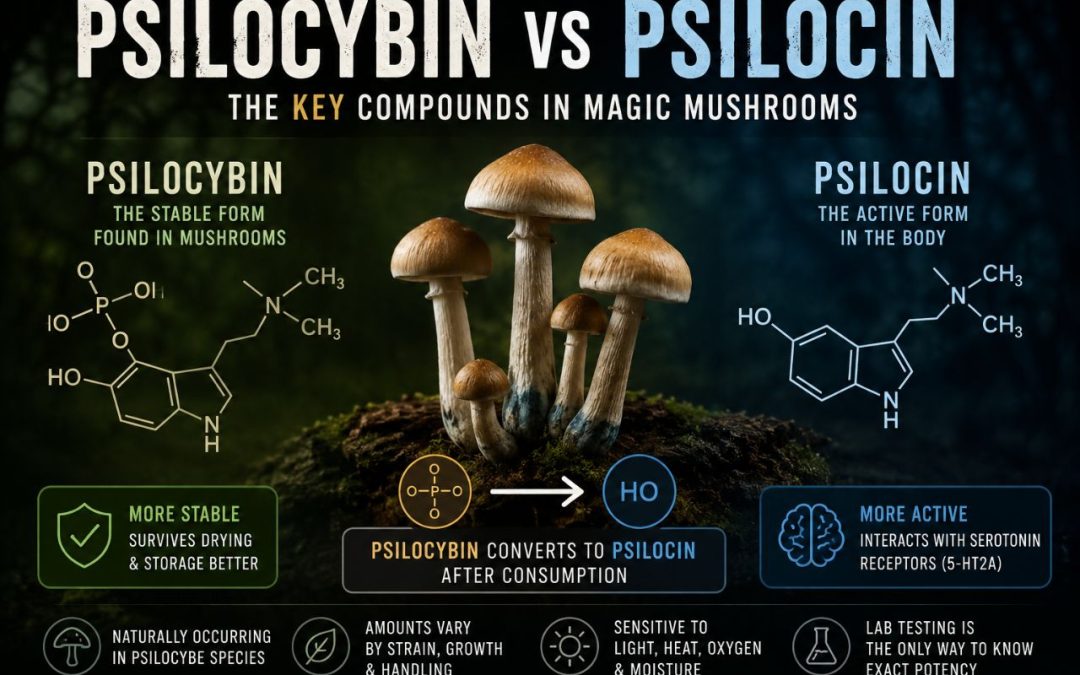
Psilocybin is usually the main compound discussed when people talk about dried magic mushrooms. It is more stable and can remain present in mushrooms after drying and storage. Psilocin is the more directly active compound in the body. After psilocybin is consumed, the body converts much of it into psilocin.
That conversion is one of the most important pieces of mushroom chemistry. It helps explain why magic mushrooms can affect perception, mood, body sensation, emotion, and thought patterns. It also helps explain why mushroom potency is not always perfectly predictable by weight, appearance, bruising, or strain name alone.
Understanding the difference between psilocybin and psilocin gives readers a clearer picture of what is actually happening inside the mushroom and inside the body.
What Is Psilocybin?
Psilocybin is one of the main naturally occurring psychedelic compounds found in many species of magic mushrooms.
Chemically, psilocybin is a tryptamine compound with a phosphate group attached to it. That phosphate group is important because it makes psilocybin more stable than psilocin. This is one reason psilocybin is usually the dominant compound found in dried magic mushrooms.
Psilocybin is often described as a prodrug. A prodrug is a compound that becomes more active after the body changes it into another compound. In this case, the body converts psilocybin into psilocin.
That does not make psilocybin unimportant. Psilocybin is the main starting point. It is the compound most often measured when people talk about the strength of dried mushrooms, and it is the compound that eventually becomes psilocin after digestion and metabolism.
A simple way to think about it is this:
Psilocybin is the more stable form found in the mushroom. Psilocin is the more active form used by the body.
What Is Psilocin?
Psilocin is the compound more directly responsible for the psychedelic activity of magic mushrooms.
Once psilocybin is converted into psilocin, psilocin can interact with serotonin receptors in the brain, especially the 5-HT2A receptor. This receptor is strongly connected to the classic psychedelic effects people associate with mushrooms, including changes in perception, emotional awareness, visual intensity, and the way thoughts feel or connect.
Psilocin is structurally similar to serotonin, one of the body’s natural neurotransmitters. Serotonin plays a role in mood, sleep, appetite, emotion, and perception. Because psilocin resembles serotonin in certain ways, it can bind to some of the same receptor systems and produce noticeable changes in consciousness.
Psilocin can also exist naturally inside mushrooms before they are consumed. However, it is more fragile than psilocybin. It can break down more easily when exposed to oxygen, heat, light, moisture, rough handling, or poor storage.
This is why dried mushrooms usually contain more psilocybin than psilocin.
Psilocybin vs Psilocin: The Main Difference
The main difference is simple:
Psilocybin is the more stable compound. Psilocin is the more directly active compound.
Psilocybin is better at surviving inside dried mushroom material. Psilocin is more active in the body but less stable outside the body.
| Compound | Main Role | Stability | Commonly Found In |
|---|---|---|---|
| Psilocybin | Converts into psilocin after consumption | More stable | Usually higher in dried mushrooms |
| Psilocin | More directly active in the body | Less stable | Often lower in dried mushrooms |
This difference matters because two mushroom samples can contain different amounts of each compound. One batch may have more preserved psilocybin, while another may have lost more psilocin during drying or storage.
A mushroom’s active compound content is not based on strain name alone. It is shaped by biology, environment, harvest timing, drying, storage, and handling.
How Psilocybin Converts Into Psilocin
After psilocybin is consumed, the body converts it into psilocin through a process called dephosphorylation.
That word sounds complicated, but the idea is simple. Psilocybin has a phosphate group attached to it. During digestion and metabolism, the body removes that phosphate group. Once it is removed, psilocybin becomes psilocin.
This conversion can happen through enzymes in the digestive system, bloodstream, and liver. After conversion, psilocin can circulate through the body and interact with serotonin receptors.
This helps explain why the effects of mushrooms are not always immediate. The mushroom material needs to be broken down, the compounds need to be absorbed, and psilocybin needs to be converted into psilocin.
Onset can vary from person to person. It can also be affected by stomach contents, mushroom material, preparation method, metabolism, and individual sensitivity.
Why Psilocybin Is More Stable
Psilocybin is generally more stable because of its chemical structure. The phosphate group attached to psilocybin helps protect it from breaking down as quickly as psilocin.
This is one reason psilocybin can remain present in dried mushrooms when they are handled and stored properly.
However, stable does not mean permanent. Psilocybin can still degrade over time, especially when mushrooms are exposed to poor conditions. Heat, light, moisture, oxygen, and repeated handling can all affect quality.
Dried mushrooms are still natural biological material. They are not perfectly uniform, and their chemistry can change over time.
Why Psilocin Is Less Stable
Psilocin is more fragile than psilocybin. It is more likely to oxidize, which means it can react with oxygen and begin to break down.
This is one reason mushroom handling matters. When mushroom tissue is bruised, cut, damaged, or exposed to air, chemical reactions can happen inside the tissue. These reactions are connected to the blue bruising often seen in psilocybin-containing mushrooms.
Blue bruising is interesting, but it is not a reliable potency test.
A mushroom that bruises dark blue is not automatically stronger than one that bruises lightly. Bruising can be influenced by moisture, tissue damage, age, handling, enzyme activity, and exposure to oxygen.
Blue bruising tells you that chemical reactions are happening. It does not tell you the exact amount of psilocybin or psilocin inside the mushroom.
Fresh Mushrooms vs Dried Mushrooms
Fresh and dried mushrooms are not directly comparable by weight.
Fresh mushrooms contain a large amount of water. After drying, most of that water is removed, which makes dried mushrooms much lighter and more concentrated by weight.
Fresh mushrooms may also contain more psilocin than dried mushrooms because psilocin exists in living mushroom tissue. However, psilocin is less stable and may degrade during drying, handling, or storage.
Dried mushrooms are usually discussed in terms of psilocybin because psilocybin is more stable and tends to remain more consistently present after drying.
This is why dried mushroom potency is usually estimated by psilocybin content, even though psilocin is the compound more directly active in the body.
How Much Psilocybin and Psilocin Are Found in Mushrooms?
Magic mushrooms can contain both psilocybin and psilocin, but the exact amount varies from one mushroom to another.
In dried mushrooms, psilocybin is usually found in higher amounts than psilocin because it is more stable. Psilocin is more fragile and can break down more easily during drying, storage, and handling.
The amount of each compound can depend on the species, strain, genetics, growing conditions, harvest timing, drying method, storage conditions, and age of the mushrooms.
This is why mushroom potency cannot be judged perfectly by weight, appearance, bruising, or strain name alone. Lab testing is the only way to know the exact psilocybin and psilocin content in a specific sample.
For readers who want a practical breakdown, the next question is usually: how many milligrams of psilocybin are in one gram of dried mushrooms?
Why Mushroom Potency Can Vary
Magic mushrooms are natural organisms, not standardized tablets. Even mushrooms with the same strain name can vary in active compound content.
Several factors can influence psilocybin and psilocin levels, including:
- Species
- Genetics
- Strain variation
- Flush
- Harvest timing
- Growing conditions
- Substrate
- Drying method
- Storage conditions
- Mushroom age
- Heat, light, oxygen, and moisture exposure
This is why strain names should be treated as general guides, not exact chemical guarantees.
For example, one batch of Golden Teacher may not have the same potency as another batch of Golden Teacher. The same idea applies to Penis Envy, Blue Meanie, Tidal Wave, Albino Jedi Mind Fuck, or any other strain.
The name can give a general expectation, but it cannot replace testing.
Caps vs Stems: Do They Contain Different Amounts?
Caps and stems can contain different amounts of psilocybin and psilocin, but the difference is not always consistent enough to make a simple rule.
Some samples may show higher concentrations in the caps. Other samples may be closer between caps and stems. The difference can depend on genetics, growth stage, mushroom size, and the individual sample being tested.
For the average reader, the most useful takeaway is this:
Caps and stems can vary, but the entire mushroom should be treated as variable unless it has been lab tested.
Trying to judge potency based only on whether a piece is cap or stem is not reliable.
Does Blue Bruising Mean a Mushroom Is Stronger?
Blue bruising is one of the most recognizable features of many magic mushrooms. It often appears when mushrooms are handled, picked, cut, pressed, or dried.
The blue colour is connected to chemical reactions involving psilocybin, psilocin, enzymes, and oxidation. But bruising is not a strength meter.
A mushroom that bruises heavily may not be stronger than one that bruises lightly. A lightly bruised mushroom may still be potent. Bruising depends on more than just active compound content.
Moisture level, freshness, pressure, tissue damage, age, and handling can all change how much blue bruising appears.
Blue bruising can be a clue that certain mushroom chemistry is present, but it cannot tell you exact potency.
Why Drying and Storage Matter
Drying and storage can make a major difference in how well mushrooms preserve their active compounds.
Psilocin is especially sensitive, but psilocybin can also degrade over time if mushrooms are stored poorly.
Dried mushrooms are best protected from:
- Moisture
- Heat
- Light
- Oxygen
- Repeated opening and handling
A cool, dry, dark, airtight environment helps protect dried mushrooms better than leaving them exposed to air, sunlight, humidity, or heat.
Powdered mushrooms may be more vulnerable than whole dried mushrooms because grinding increases surface area. More surface area means more contact with oxygen. This can make powdered mushroom material more sensitive to long-term storage conditions.
Are Psilocybin and Psilocin the Only Compounds?
Psilocybin and psilocin are the two best-known compounds in magic mushrooms, but they are not the only ones.
Other related tryptamines may include:
- Baeocystin
- Norbaeocystin
- Aeruginascin
- Norpsilocin
These compounds are usually found in smaller amounts and are still being studied. Researchers are continuing to explore how these minor compounds may contribute to the overall mushroom experience.
For most readers, psilocybin and psilocin are the two most important compounds to understand first. They explain the basic relationship between mushroom chemistry, body conversion, stability, and effects.
Why This Difference Matters
Understanding psilocybin and psilocin helps explain why magic mushrooms can be difficult to judge by appearance alone.
It explains why dried mushrooms are usually discussed by psilocybin content.
It explains why psilocin is more fragile.
It explains why storage and drying matter.
It explains why fresh and dried mushrooms are not the same by weight.
It also explains why two batches with the same strain name can still feel different.
Magic mushrooms are complex natural material. Their effects are influenced by chemistry, biology, storage, preparation, mindset, setting, and individual response.
Knowing the difference between psilocybin and psilocin does not make mushroom potency perfectly predictable, but it gives readers a much clearer understanding of what is actually being discussed.
Psilocybin vs Psilocin: Simple Summary
Psilocybin and psilocin are closely connected, but they play different roles.
Psilocybin is the more stable compound commonly found in dried magic mushrooms. After consumption, the body converts psilocybin into psilocin.
Psilocin is the more directly active compound that interacts with serotonin receptors and produces many of the classic psychedelic effects associated with magic mushrooms.
Dried mushrooms usually contain more psilocybin than psilocin because psilocybin is more stable. Psilocin is more fragile and can degrade through oxidation, heat, light, moisture, and poor handling.
This is why mushroom potency is not perfectly predictable by weight alone. A gram of dried mushrooms can give a general idea of amount, but it does not reveal the exact milligrams of psilocybin or psilocin unless the mushrooms are lab tested.
Final Thoughts
Psilocybin and psilocin are two of the most important compounds to understand when learning about magic mushrooms.
Psilocybin is the stable starting point. Psilocin is the active form the body uses. Together, they explain why magic mushrooms can vary in strength, why drying and storage matter, and why potency is more complicated than just weighing dried mushrooms.
For anyone learning about magic mushrooms from an educational or harm-reduction perspective, this difference is one of the best places to start.