
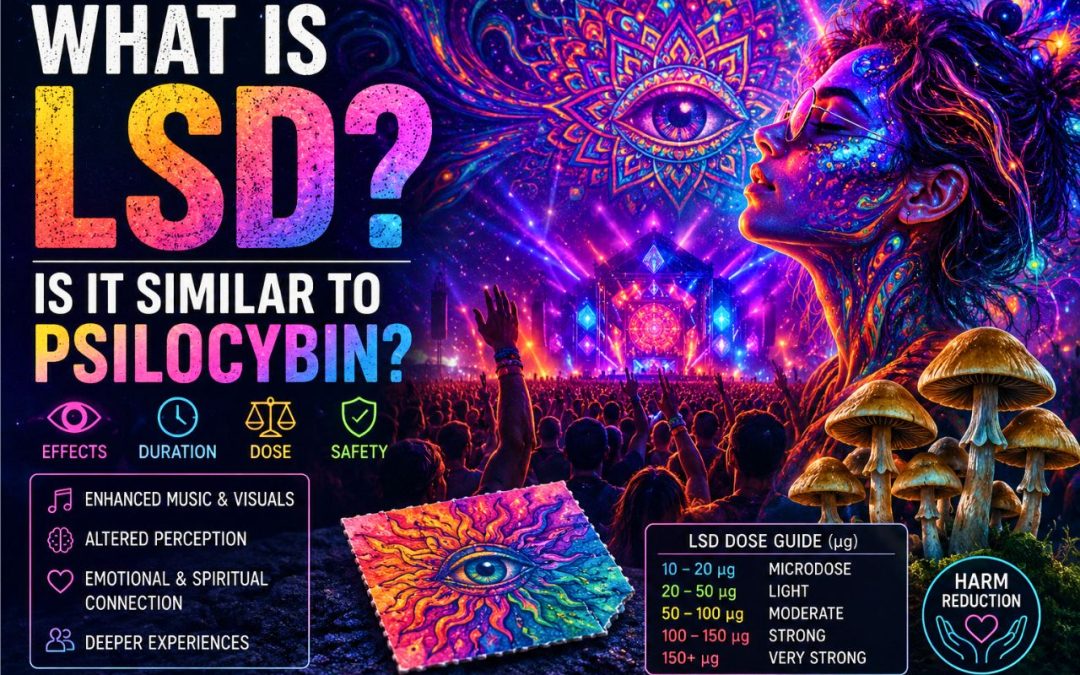
What Is LSD?
LSD is one of the most well-known psychedelics in the world. Some people know it as “acid.” Others know it from music festivals, rave culture, old-school psychedelic stories, or conversations about mental health and consciousness.
For some, LSD is described as colourful, electric, emotional, creative, spiritual, and deeply eye-opening. For others, it can feel overwhelming, confusing, too intense, or mentally exhausting. Like psilocybin mushrooms, LSD can create powerful changes in perception, thought, emotion, music appreciation, and the way a person experiences time and reality.
But LSD is not the same as psilocybin.
LSD is usually longer-lasting, more stimulating, and more mentally “wired” than mushrooms. Psilocybin is often described as more earthy, emotional, body-based, and wave-like. Both can be meaningful. Both can be fun. Both can also be unpredictable.
This article is for education and harm reduction. It is not medical advice, and it is not a recommendation to use LSD.
What Is LSD?
LSD stands for lysergic acid diethylamide. It is a potent classic psychedelic, meaning it can strongly alter perception, emotion, thought patterns, and sensory experience.
LSD is active in extremely tiny amounts. Unlike mushrooms, which are usually talked about in grams, LSD is measured in micrograms, written as µg or mcg. One microgram is one-millionth of a gram.
That matters because LSD is incredibly powerful by weight. A tiny amount can create a very strong experience. This is also why dosing can be so unpredictable when LSD comes from an unregulated source.
LSD is commonly found on small pieces of blotter paper called tabs, in liquid form, or occasionally on candies, gelatin squares, or other absorbent materials. In Canada, LSD is a controlled illegal drug unless specifically authorized for medical or research purposes. Health Canada describes LSD as a potent hallucinogenic drug made from lysergic acid, which comes from a fungus that grows on rye and other grains.
Is LSD Similar to Psilocybin?
Yes, LSD and psilocybin are similar in the sense that they are both classic psychedelics. They both affect serotonin systems in the brain, especially receptors involved in altered perception and psychedelic effects.
That is why LSD and psilocybin can both create:
- Visual changes
- Brighter colours
- Music enhancement
- Emotional openness
- Deep thoughts
- Altered time perception
- Spiritual or mystical feelings
- A stronger connection to nature, people, or surroundings
- Changes in how the body feels
- A sense that ordinary things feel new or meaningful
But the overall feeling can be very different.
Psilocybin mushrooms often feel more natural, emotional, introspective, and body-heavy. Many people describe mushrooms as coming in waves. The experience may feel dreamy, earthy, warm, and sometimes unpredictable emotionally.
LSD is often described as more electric, clear, stimulating, visual, and mentally active. Some people say LSD feels like the mind is turned up, while mushrooms feel like the heart and body are turned up.
A simple way to explain it is:
Psilocybin often feels more organic and emotional. LSD often feels more electric and mentally energized.
That is not true for everyone, but it is a common way people describe the difference.
What Does LSD Feel Like?
The LSD experience can vary a lot depending on dose, mindset, setting, sleep, stress level, people around you, music, and whether other substances are involved.
In a positive setting, people may experience:
- Enhanced music
- Brighter colours
- Moving patterns
- Tracers or light trails
- Laughter
- Euphoria
- Deep conversations
- Creative thoughts
- Emotional release
- A sense of connection
- A feeling that everything is meaningful
- Increased appreciation for nature, lights, art, and sound
In controlled research, LSD has been shown to produce pronounced changes in consciousness, including visual effects, audiovisual synesthesia, and increases in feelings such as happiness, closeness to others, openness, and trust.
At a music festival or rave, this can be part of the appeal. Lights may look more alive. Bass may feel physical. Lyrics may seem deeper. A crowd may feel like one moving organism. Colours, lasers, visuals, costumes, and stage designs can become much more intense.
That is why LSD has such a strong connection with music culture, psychedelic art, rave culture, and festival scenes.
But the same things that make LSD feel magical can also make it feel overwhelming.
LSD at Music Festivals and Raves
Festival and rave environments can be beautiful, but they can also be intense. Loud sound, flashing lights, heat, crowds, strangers, long walking distances, lineups, dehydration, and lack of sleep can all shape the experience.
On LSD, the brain may become more sensitive to everything around it. That can be amazing when the setting feels safe, but difficult when the setting feels chaotic.
A festival can make LSD feel:
- More visual
- More energetic
- More social
- More music-focused
- More exciting
- More unpredictable
- More physically tiring
- More emotionally intense
Someone may feel deeply connected to the crowd one moment and then suddenly need space the next. They may love the music at one stage and feel overstimulated at another. They may feel social and open, then suddenly become quiet and internal.
This is normal with psychedelics. The experience can shift.
For festival culture, the biggest thing people need to understand is that LSD is not a casual “party drug” in the same way alcohol or a stimulant might be used socially. LSD changes perception and judgment. It can make the environment feel larger, louder, brighter, stranger, and more emotionally charged.
That can be fun, but it also requires respect.
Common Effects People Report on LSD
Visual Effects
Visual effects are one of the most commonly discussed parts of LSD.
People may notice:
- Colours becoming brighter
- Patterns moving or breathing
- Walls, clouds, grass, or lights appearing to shift
- Geometric visuals
- Light trails
- Enhanced stage visuals
- Faces looking unusual
- Objects seeming more detailed
- Closed-eye visuals
At festivals, lights and stage screens may become much more immersive. Some people describe it as seeing music or feeling like visuals and sound are connected.
Music Enhancement
Music can feel completely different on LSD.
People often report that music feels deeper, wider, more emotional, or more physically present. Bass may feel like it moves through the body. Melodies may feel layered. Lyrics may feel personal. A song someone has heard 100 times may suddenly feel brand new.
This is one of the main reasons LSD is so strongly connected to rave culture, jam bands, electronic music, psychedelic rock, and festival experiences.
Time Distortion
LSD can strongly change time perception.
A few minutes may feel like an hour. A single song may feel like a full journey. The night may feel like it has different chapters. The peak may feel like it lasts forever, especially if the experience becomes uncomfortable.
This is important because LSD lasts a long time. If someone takes too much or feels overwhelmed, they may not be able to “just wait it out” quickly. The experience can continue for many hours.
Emotional Effects
LSD can bring up strong emotions.
People may feel:
- Joy
- Love
- Gratitude
- Excitement
- Awe
- Vulnerability
- Sadness
- Anxiety
- Nostalgia
- Fear
- Relief
- Emotional openness
Some people laugh for hours. Some cry in a good way. Some feel deeply connected to friends. Others may suddenly think about their life, relationships, choices, trauma, or future.
This is one reason LSD can feel meaningful, but it is also why it can be risky in the wrong mindset or setting.
Thought Changes
LSD can make thoughts feel faster, deeper, stranger, or more connected.
People may experience:
- Big-picture thinking
- New perspectives
- Creative ideas
- Pattern recognition
- Philosophical thoughts
- Spiritual ideas
- Loops or repetitive thinking
- Overanalysis
- Confusion
- Difficulty explaining thoughts
Thought loops are common with psychedelics. A person may keep returning to the same idea again and again. If the thought is positive, this may feel fascinating. If the thought is anxious, it can become uncomfortable.
Body Effects
LSD is not only mental. It can also affect the body.
People may notice:
- Energy or restlessness
- Jaw tension
- Sweating
- Chills
- Trembling
- Nausea
- Tight stomach
- Dilated pupils
- Increased heart rate
- Increased blood pressure
- Difficulty sleeping
- Temperature sensitivity
In a dose-response study, LSD moderately increased blood pressure and heart rate, and higher doses increased both duration and intensity of effects.
At festivals, body effects matter because dancing, heat, dehydration, poor sleep, and long hours can add stress to the body.
How Long Does LSD Last?
LSD usually lasts much longer than psilocybin.
A general timeline may look like this:
Onset
Effects often begin around 30–90 minutes after taking LSD. Some people may feel early changes sooner, but it can also take longer.
Come-Up
The come-up is when effects build. This can feel exciting, strange, funny, anxious, or physically uncomfortable. Some people feel butterflies, restlessness, nausea, or nervous energy.
Peak
The peak is usually the most intense part. Visuals, thoughts, emotions, music enhancement, and time distortion may be strongest here.
Main Experience
The main LSD experience often lasts around 8–12 hours, with residual stimulation sometimes lasting longer. StatPearls lists LSD’s duration of action as about 8–12 hours, and a pharmacology review notes that acute psychological effects can last around 6–10 hours depending on dose.
After-Effects
Even after the main effects fade, some people may still feel wired, sensitive, tired, emotional, or unable to sleep.
This is one of the biggest differences between LSD and mushrooms. Mushrooms are often a 4–6 hour experience. LSD can take up the entire day or night.
LSD Dose: What People Need to Know
There is no universally safe recreational LSD dose.
This section is not a recommendation. It is included because people do use LSD in real life, especially in festival and rave settings, and informed decisions are safer than guessing.
LSD is measured in micrograms, not milligrams.
A major issue with LSD is that tabs are often unreliable. A person may be told a tab is 100 µg, 150 µg, or 200 µg, but unless it has been professionally tested, they do not actually know. Erowid notes that a single blotter tab often contains around 30–100 µg, but the amount can vary greatly between batches.
Clinical research has used controlled LSD doses such as 25, 50, 100, and 200 µg, but those are known pharmaceutical doses given in controlled research settings, not unknown street tabs.
A general educational breakdown often looks like this:
| LSD Amount | General Description |
|---|---|
| Below 20 µg | Often discussed as a microdose or very low dose |
| 20–50 µg | Light effects may be noticeable |
| 50–100 µg | Moderate psychedelic effects may occur |
| 100–150 µg | Stronger classic LSD experience for many people |
| 150–200 µg+ | Strong experience with higher risk of anxiety, confusion, ego dissolution, and overwhelm |
Again, this is not a dosing recommendation. The main point is that LSD strength can be difficult to verify, and small differences can feel large.
In one controlled study, subjective effects increased with doses from 25–200 µg, with average duration increasing from 6.7 to 11 hours. The 200 µg dose caused more ego dissolution than 100 µg and was associated with significant anxiety.
For festival harm reduction, the safest message is:
Do not assume a tab is the dose someone claims it is. Do not assume two tabs are safe because one tab felt manageable before. Do not eyeball liquid LSD. Do not redose just because the come-up feels slow.
Why Redosing LSD Can Be a Problem
LSD can take time to fully come on. Someone may think it is not working, take more, and then realize the first amount was still building.
This can lead to a much stronger experience than intended.
Redosing also becomes complicated because LSD lasts so long. Taking more later in the night may extend the experience, disrupt sleep, and increase exhaustion the next day.
At a festival, this can become a problem if someone still has to travel, find their tent, deal with crowds, ride home, work the next day, or manage responsibilities.
LSD and Set and Setting
Set and setting are everything with LSD.
Set means the person’s mindset: mood, stress level, expectations, fears, emotional state, and mental health.
Setting means the environment: where they are, who they are with, how safe they feel, the music, the crowd, the temperature, and whether they can leave or rest.
A festival can be a great setting for some people and a terrible setting for others. The same lights, bass, and crowd energy that feel magical to one person may feel overwhelming to another.
A safer festival setting usually includes:
- Trusted friends
- A sober or more grounded person nearby
- Access to water
- Access to shade or warmth
- A quiet place to decompress
- No pressure from others
- A clear way to get home safely
- No driving
- No major responsibilities
- No mixing with unknown substances
KnowYourStuffNZ describes set and setting as major factors that can influence psychedelic experiences and reduce the chance of an unexpected negative experience.
When LSD Gets Too Intense
A difficult LSD experience does not always mean something has gone medically wrong. Sometimes the person is overwhelmed, overstimulated, anxious, dehydrated, too hot, too tired, or stuck in a thought loop.
Helpful steps may include:
- Moving to a quieter place
- Sitting down
- Lowering stimulation
- Having a calm trusted person nearby
- Slowing the breathing
- Drinking small amounts of water
- Avoiding more substances
- Reminding the person they took LSD and the feeling will pass
- Going to the medical tent or harm-reduction space if needed
Medical help should be taken seriously if someone has chest pain, severe confusion, overheating, fainting, seizures, extreme agitation, dangerous behavior, suicidal thoughts, or cannot be calmed or oriented.
LSD and Mixing Substances
Mixing LSD with other substances can make the experience harder to predict.
Cannabis can intensify LSD for many people. Sometimes that feels good, but it can also increase paranoia, confusion, thought loops, and panic.
Alcohol can lower judgment and make it harder to stay grounded.
Stimulants can increase heart rate, anxiety, overheating, and restlessness.
MDMA and LSD is a combination some people talk about in rave culture, but it can be physically and emotionally intense. It may increase stimulation, dehydration risk, overheating risk, and the chance of a hard crash afterward.
In general, the more substances involved, the harder it becomes to know what is happening and how to respond if things go wrong.
Is LSD Safer Than Other Party Drugs?
LSD is different from many party drugs because its biggest risks are usually psychological, behavioral, and environmental rather than classic overdose toxicity.
That does not mean it is harmless.
LSD can impair judgment. It can cause panic. It can make someone wander off, misread danger, become confused, or feel unable to handle the environment. At a festival, those risks matter.
The long duration also makes LSD different. A person may be altered for most of the night and still feel unable to sleep after the music ends.
So LSD may not carry the same physical overdose profile as some substances, but it can still lead to serious problems when the dose, mindset, setting, or substance combinations are wrong.
Positive Effects People Report From LSD
Many people report positive LSD experiences, especially when the setting feels safe and the dose is not overwhelming.
Common positive reports include:
- Music feeling more beautiful
- Stronger connection to friends
- Feeling more open and loving
- Laughing easily
- Seeing life from a new perspective
- Feeling creative
- Feeling spiritually connected
- Feeling more connected to nature
- Understanding personal problems differently
- Feeling emotionally lighter afterward
Some people describe LSD as fun and social. Others describe it as spiritual. Others describe it as creative or therapeutic. At festivals, many people are drawn to LSD because it can make music, lights, art, dancing, and connection feel more intense and meaningful.
But the positive effects are not guaranteed. The same substance that makes one person feel connected and inspired can make another person feel anxious, overstimulated, or emotionally exposed.
Does LSD Have Medical Benefits?
LSD is being researched again for possible medical and therapeutic benefits, especially around anxiety and mental health.
A 2025 JAMA phase 2b clinical trial studied MM120, a pharmaceutical form of LSD, in adults with moderate-to-severe generalized anxiety disorder. The trial studied 25, 50, 100, and 200 µg doses and reported dose-dependent anxiety reductions, with 100 µg selected for later research. This was a controlled medical trial, not a recreational setting.
LSD has also been studied historically for alcohol use disorder. A 2012 meta-analysis of six randomized controlled trials found that a single LSD dose had a significant beneficial effect on alcohol misuse at early follow-up, although these were older studies and more modern research is needed.
Some people also report that LSD helped them process fear, grief, depression, anxiety, trauma, or life direction. These reports can be meaningful, but personal stories are not the same as medical proof.
The safest way to understand LSD’s medical potential is this:
LSD may have therapeutic value, but the strongest benefits in research come from controlled, screened, supported settings — not unknown tabs in unpredictable environments.
LSD vs Psilocybin: Which One Is Better?
Neither is automatically better. They are different.
Psilocybin may be better suited for people who want a shorter, more inward, emotional, earthy experience. LSD may appeal more to people looking for a longer, more energetic, visual, music-enhancing, mentally stimulating experience.
A simple comparison:
| Category | LSD | Psilocybin |
| Duration | Often 8–12 hours | Often 4–6 hours |
| Feel | Electric, clear, stimulating | Earthy, emotional, body-based |
| Music | Often highly enhanced | Often emotional and immersive |
| Visuals | Geometric, bright, sharp, patterned | Organic, flowing, earthy |
| Body Load | Can feel wired or restless | Can feel heavier or more nauseating |
| Festival Use | Long-lasting and stimulating | Shorter but often more emotional |
| Risk | Long difficult experience if overwhelmed | Shorter but still intense |
Both require respect. Both can create beautiful experiences. Both can also become difficult.
The Bottom Line
LSD is a powerful classic psychedelic that can feel colourful, electric, emotional, visual, social, spiritual, and deeply connected to music. That is why it has such a strong place in festival culture, rave culture, psychedelic art, and live music scenes.
LSD is similar to psilocybin because both are classic psychedelics, but LSD usually lasts much longer and often feels more stimulating, mental, and energetic. Psilocybin usually feels shorter, more organic, emotional, and body-based.
People report many positive effects from LSD, including music enhancement, creativity, connection, emotional insight, and new perspectives. Research is also exploring LSD for anxiety and other mental health conditions.
But LSD is not something to treat casually. Unknown tabs can be unpredictable. Small dose differences can feel big. A bad experience can last many hours. Crowds, heat, lack of sleep, and mixing substances can increase the risk of overwhelm.
The most honest harm-reduction message is:
LSD can be powerful, beautiful, and meaningful, but it can also be intense, long-lasting, and unpredictable. Dose, mindset, setting, trusted people, and not mixing substances matter.