
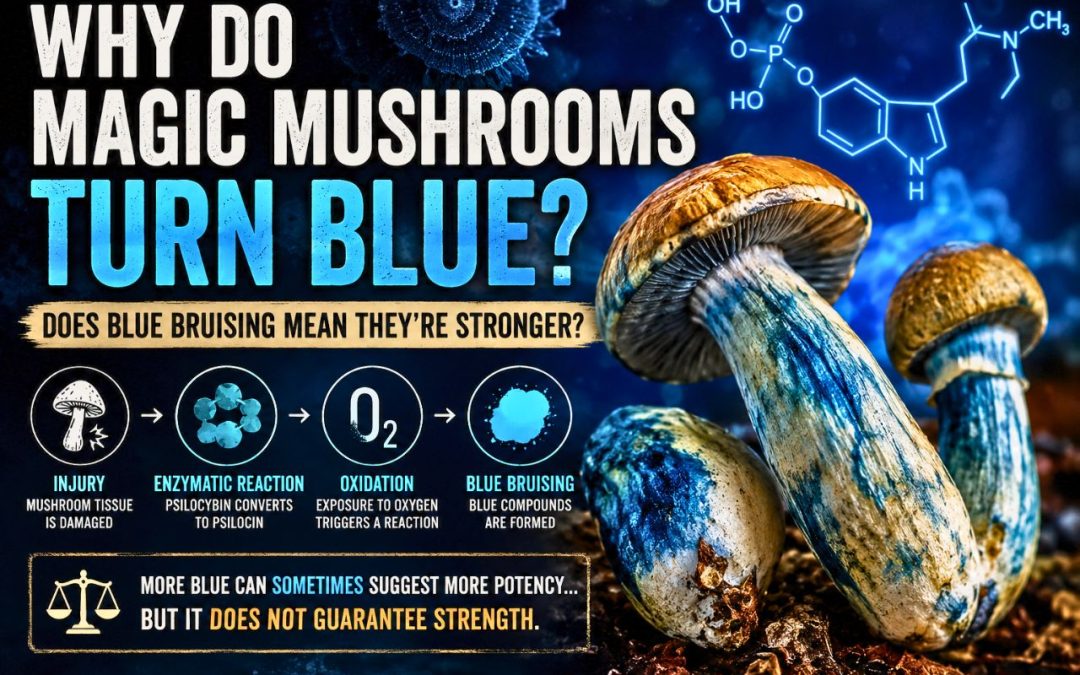
Why Do Magic Mushrooms Turn Blue?
Blue bruising is one of the most recognizable features people notice on magic mushrooms. A stem gets handled, a cap gets pressed, a mushroom dries with darker marks, and suddenly blue-green colouring appears across the surface. For many people, that blue colour feels mysterious. Is it mold? Is it a sign of potency? Does it mean the mushroom is stronger? Or is it just normal bruising?
The simple answer is this: magic mushrooms turn blue because of a natural chemical reaction that happens when the mushroom tissue is damaged. The blue colouring is connected to psilocybin and psilocin chemistry, which is why people often associate it with potency. In many cases, a very active mushroom may be more likely to show noticeable blue bruising than a very weak one.
But there is an important catch.
Blue bruising is not a perfect strength meter. More blue can sometimes suggest more active mushroom chemistry, but it does not guarantee that one mushroom is stronger than another. Handling, drying, moisture, age, oxygen exposure, and natural variation can all affect how much blue appears.
That is what makes this topic so interesting. Blue bruising can tell you something, but it cannot tell you everything.
What Is the Blue Colour on Magic Mushrooms?
The blue colour seen on many magic mushrooms is usually called blue bruising or blueing. It often appears when the mushroom is handled, pressed, cut, dried, transported, or otherwise damaged.
This colour can show up in different ways. Sometimes it looks deep blue. Sometimes it appears blue-green, grey-blue, dark teal, or almost black in certain areas. It may be especially visible on the stem, near the base of the mushroom, around broken edges, or anywhere the mushroom has been touched or compressed.
Blue bruising is not the same thing as blue dye, artificial colouring, or mold. In many psilocybin-containing mushrooms, it is part of a natural reaction inside the mushroom tissue.
A helpful way to think about it is similar to how an apple turns brown after it is sliced. The apple has not suddenly become a different fruit. The colour change happens because the inside of the fruit is exposed to air, enzymes, and oxidation. Magic mushrooms are different chemically, but the basic idea is similar: damage to the tissue can trigger a visible colour change.
Why Do Magic Mushrooms Turn Blue?
Magic mushrooms turn blue because of an injury-triggered chemical reaction involving psilocybin, psilocin, enzymes, and oxidation.
Psilocybin is one of the best-known compounds found in many magic mushrooms. When mushroom tissue is damaged, enzymes can begin changing psilocybin-related compounds. Research on Psilocybe cubensis has shown that specific enzymes help convert psilocybin toward psilocin, and then help oxidize that psilocin into blue-coloured compounds.
Scientific research on Psilocybe cubensis has found that blue bruising is caused by an injury-triggered enzyme reaction involving psilocybin, psilocin, and oxidation.
In plain language, the mushroom is reacting to injury.
When the cells are damaged, compounds that were previously separated inside the tissue can interact. Enzymes become active. Oxygen becomes involved. The result is the blue bruising people see.
This is why blue colour often shows up after handling, drying, trimming, breaking, or pressing the mushrooms. The more physical stress the mushroom goes through, the more opportunity there is for bruising to appear.
Does More Blue Usually Mean More Potency?
Sometimes, but not always.
Blue bruising is connected to the same chemistry that makes magic mushrooms active, so it makes sense that very potent mushrooms may often show stronger blue bruising than weaker ones. If a mushroom contains more psilocybin and psilocin-related compounds, there may be more material available for the blueing reaction when the tissue is damaged.
That is why people are not completely wrong when they associate heavy blue bruising with strength. In the real world, many highly potent mushrooms do show strong blue bruising, especially when they are handled, broken, or dried.
However, blue bruising is not a lab test. It cannot tell you exact potency, and it should not be used as the only way to judge strength.
A very blue mushroom may be potent, but it may also simply be heavily bruised. A less-blue mushroom may still be strong if it was handled gently, dried carefully, or did not suffer much tissue damage.
The most accurate way to think about blue bruising is this:
More blue can sometimes suggest more active mushroom chemistry, but it does not guarantee more strength.
Why Blue Bruising Is an Imperfect Potency Clue
The problem with using blue colour as a strength test is that too many other factors affect the bruising.
A mushroom does not turn blue only because it is potent. It turns blue because the tissue was damaged and the chemistry inside the mushroom reacted. That reaction can be influenced by several things besides potency.
Handling
A mushroom that has been squeezed, pressed, packed tightly, or moved around a lot may show more blue bruising than one that was handled gently.
This means a heavily bruised mushroom may look stronger simply because it went through more physical stress.
Drying
Drying can make bruising more noticeable. As moisture leaves the mushroom, blue and blue-green marks can darken or become easier to see.
Two mushrooms with similar potency may look different after drying depending on how much bruising happened before or during the drying process.
Moisture
Fresh mushrooms and dried mushrooms do not always show colour in the same way. Moisture level can affect how visible the bruising appears.
A fresh mushroom may show vivid blue marks quickly after being touched, while a dried mushroom may show darker, more muted blue-grey areas.
Oxygen Exposure
Oxidation is part of the blueing process. If more tissue is exposed to air, the reaction may become more visible.
A broken stem or damaged cap may turn much bluer than an untouched section of the same mushroom.
Natural Variation
Mushrooms are natural organisms. They are not perfectly identical. Even mushrooms from the same general batch can vary in size, shape, colour, density, and how easily they bruise.
Some mushrooms simply show blue colour more dramatically than others.
Why Some Strong Mushrooms May Not Look Very Blue
This is where the myth gets confusing. People often expect strong mushrooms to always look deeply blue, but that is not always how it works.
A potent mushroom may show little visible bruising if it was handled carefully. If the mushroom tissue was not damaged much, the blueing reaction may not have been strongly triggered.
Lighting also matters. Blue bruising may look obvious in person but subtle in a photo. It may look dark grey under one light and blue-green under another.
Drying style can also affect appearance. Some mushrooms dry lighter, some dry darker, and some show bruising more clearly once fully dried.
This is why appearance alone can be misleading. Blue bruising can be interesting and useful to notice, but it should never be treated as a guaranteed potency reading.
Why Some Weaker Mushrooms May Still Look Very Blue
A weaker mushroom can still show strong bruising if it has been handled roughly or damaged heavily.
For example, a mushroom that gets pressed during packaging, broken during drying, or squeezed at the stem may develop strong blue marks. That blue colour may look impressive, but it does not automatically mean the mushroom is extremely potent.
This is the difference between a clue and a conclusion.
Blue bruising is a clue that active mushroom chemistry may be present and reacting. It is not a final answer about exact strength.
Is Blue Bruising the Same as Mold?
No, blue bruising and mold are not the same thing.
Blue bruising is usually part of the mushroom tissue itself. It tends to appear where the mushroom has been touched, pressed, broken, or damaged. It often looks like the colour is inside the tissue or staining the surface.
Mold is different. Mold may look fuzzy, powdery, web-like, or dusty. It may appear white, grey, green, black, or other colours depending on the type. Mold can also have an unpleasant smell or grow across the surface in a way that looks separate from the mushroom tissue.
A simple way to describe the difference:
Blue bruising usually looks like staining within the mushroom.
Mold often looks like something growing on the mushroom.
This distinction matters because people sometimes panic when they see blue marks and assume the mushrooms are bad. At the same time, it is important not to dismiss every strange colour as harmless bruising. If something looks fuzzy, smells off, appears slimy, or seems unusual, it should be treated with caution.
Can Blue Bruising Identify Magic Mushrooms?
Blue bruising alone should never be used as the only way to identify a mushroom.
This is very important.
Some psilocybin-containing mushrooms bruise blue, but blue staining by itself is not enough to safely identify a mushroom. Other types of mushrooms can also show blue or blue-green colour changes for completely different chemical reasons.
Mushroom identification is complex. Shape, cap colour, gill structure, spore print, habitat, region, stem texture, and many other details matter. A single colour reaction is not enough.
The safest educational takeaway is this:
Blue bruising can be one clue, but it should never be treated as proof of identity, safety, or potency.
Does More Blue Mean Better Quality?
Not necessarily.
This is another common misunderstanding. People sometimes see deep blue colouring and assume the mushroom must be premium, fresh, powerful, or high quality. But blue colour is not a full quality score.
More blue may simply mean the mushroom was handled more, bruised more, dried differently, or exposed to more physical stress.
Good quality is better judged by the overall condition of the mushroom. Things like proper drying, clean appearance, normal smell, careful storage, and lack of contamination are more meaningful than blue colour alone.
A mushroom can have heavy blue bruising and still be poorly stored. Another mushroom can have minimal blue bruising and still be well dried and carefully handled.
Blue is interesting, but it is not the whole story.
Why Blue Bruising Is Still Interesting
Even though blue bruising is not a perfect strength test, it is still one of the most fascinating features of magic mushrooms.
It is a visible sign that real chemistry is happening inside the mushroom. The colour change is not random. It is tied to the compounds that make Psilocybe mushrooms unique.
For many people, this is part of what makes mushrooms so interesting from an educational and scientific perspective. They are not just visually unusual; they are biologically complex. The same mushroom can change colour depending on touch, oxygen, time, moisture, and tissue damage.
That blue mark on the stem is not just a stain. It is a small window into the chemistry of the mushroom.
Fresh Mushrooms vs Dried Mushrooms: Why the Colour Can Look Different
Blue bruising can look different depending on whether mushrooms are fresh or dried.
Fresh mushrooms often show blue colour shortly after being handled or damaged. The tissue still contains moisture, and the bruising can appear more vivid or spread more visibly through the stem.
Dried mushrooms may show darker blue, grey-blue, or greenish-blue areas. Because the mushroom has lost moisture, the colours can become more concentrated or muted. Sometimes blue bruising on dried mushrooms looks almost black in certain lighting.
This is one reason photos can be misleading. The same mushroom may look pale tan in one photo and dark blue-grey in another depending on lighting, camera settings, moisture level, and how it was dried.
What Blue Bruising Can Tell You
Blue bruising can tell you that the mushroom tissue has been damaged and that a chemical colour reaction has occurred.
In psilocybin-containing mushrooms, blue bruising is often associated with psilocybin and psilocin chemistry.
It can also suggest that a mushroom may contain active compounds related to the blueing reaction.
It may sometimes line up with higher potency, especially when comparing very active mushrooms to very weak ones.
That is useful information, but it is limited.
What Blue Bruising Cannot Tell You
Blue bruising cannot accurately tell you the exact potency of a mushroom.
It cannot tell you whether the mushroom is safe.
It cannot tell you whether the mushroom was stored properly.
It cannot tell you whether the mushroom is fresh.
It cannot replace proper identification.
It cannot prove that one mushroom is stronger than another.
This is the key message people need to understand. Blue bruising is a useful clue, not a certificate.
Common Myths About Blue Magic Mushrooms
Myth 1: The Bluer the Mushroom, the Stronger It Is
This is partly understandable, but not fully reliable. Blue colour is connected to psilocybin and psilocin chemistry, so strong mushrooms may often bruise noticeably. But blue colour is also influenced by handling, drying, moisture, oxidation, and natural variation.
Myth 2: No Blue Means No Psilocybin
Not necessarily. A mushroom may show little visible bruising and still contain psilocybin-related compounds. Lack of obvious blue colour does not automatically mean lack of potency.
Myth 3: Blue Colour Means the Mushroom Is Moldy
Blue bruising is not the same as mold. Bruising usually looks like staining in the mushroom tissue. Mold often looks fuzzy, powdery, or like something growing on the surface.
Myth 4: Blue Bruising Is Enough for Identification
This is unsafe. Blue bruising should never be used as the only identification method. Mushroom identification requires much more than colour.
Myth 5: Heavy Bruising Means Higher Quality
Heavy bruising may simply mean heavy handling. Quality depends more on proper drying, clean appearance, storage, and overall condition.
How Storage Affects Colour and Appearance
Storage can affect how magic mushrooms look over time. Light, air, moisture, and heat can all influence quality and appearance. Poor storage may cause mushrooms to darken, soften, smell unusual, or become contaminated.
Blue bruising itself is not automatically a storage problem, but sudden changes in smell, texture, or visible surface growth should be taken seriously.
For educational purposes, the main storage idea is simple: mushrooms are sensitive natural materials, and appearance can change when they are exposed to moisture, oxygen, heat, or rough handling.
To learn more about preserving mushroom quality, read our guide on how long magic mushrooms last and the best way to store them.
The Bottom Line: Blue Is a Clue, Not a Guarantee
Blue bruising is one of the most recognizable and misunderstood features of magic mushrooms. It happens when mushroom tissue is damaged and natural compounds inside the mushroom react through enzyme-driven oxidation.
That blue colour is connected to the chemistry of psilocybin-containing mushrooms, which makes it fascinating. It can sometimes suggest that active mushroom chemistry is present, and highly potent mushrooms may often bruise more noticeably than weaker ones.
But blue bruising should not be treated as a perfect sign of strength, freshness, safety, or quality.
The most accurate way to understand blue bruising is this:
Blue can be a clue, but it is not a guarantee.
For anyone learning about magic mushrooms, this is an important distinction. The blue colour is interesting, but it is only one piece of the larger picture. Mushroom appearance, proper identification, storage, handling, and education all matter.
If you are interested in learning more about the science behind magic mushrooms, start with what psilocybin is and how it works.
You can also read our beginner-friendly guide on what magic mushrooms are for a broader overview of their history, appearance, and active compounds.
FAQ: Blue Bruising on Magic Mushrooms
Why do magic mushrooms turn blue?
Magic mushrooms turn blue because of a natural chemical reaction that happens when the mushroom tissue is damaged. Enzymes, oxygen, psilocybin, and psilocin-related compounds are involved in the colour change.
Does blue bruising mean magic mushrooms are stronger?
Sometimes blue bruising can suggest more active mushroom chemistry, but it does not guarantee strength. Strong mushrooms may often bruise blue, but handling, drying, moisture, and tissue damage also affect how much blue appears.
Is blue bruising mold?
Usually no. Blue bruising looks like staining in the mushroom tissue. Mold often looks fuzzy, powdery, web-like, or like something growing on the surface.
Can blue bruising prove a mushroom is magic?
No. Blue bruising alone should never be used to identify a mushroom. Some non-psilocybin mushrooms can also show blue staining or colour changes.
Why do some magic mushrooms bruise more than others?
Bruising can vary because of handling, moisture, drying, mushroom structure, age, potency, and natural variation. Some mushrooms simply show blue colour more easily than others.
Are dried mushrooms supposed to have blue marks?
Blue marks can appear on dried mushrooms, especially if they were handled or bruised before or during drying. Blue bruising can be normal, but unusual smell, fuzzy growth, sliminess, or strange texture should be treated with caution.
Does blue bruising mean better quality?
No. Blue bruising does not automatically mean better quality. Proper drying, clean appearance, normal smell, and careful storage are more useful quality indicators.