
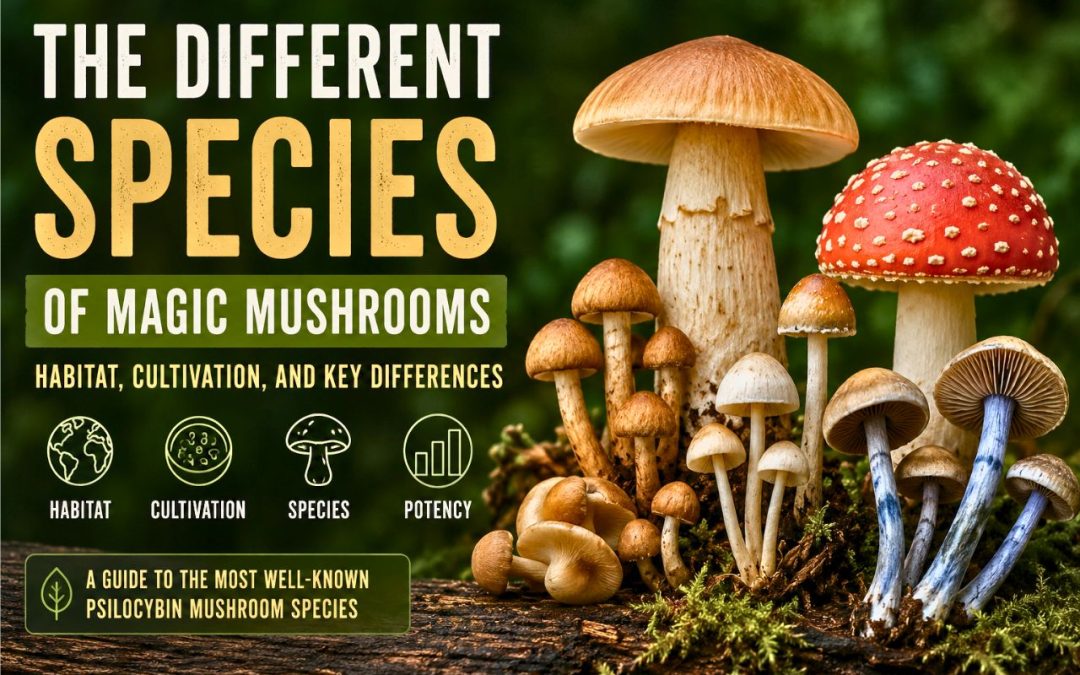
Magic mushrooms are often spoken about as if they are a single type of mushroom, but that’s far from the truth. Scientists have identified more than 200 mushroom species that naturally produce psilocybin, the compound responsible for the psychedelic effects associated with these fungi.
While these species share the ability to produce psilocybin, they can differ in where they grow, their appearance, their typical potency, and how commonly they are cultivated. Understanding these differences can help you better appreciate the incredible diversity found within the world of psilocybin mushrooms.
In this guide, we’ll introduce the most well-known species, explain why Psilocybe cubensis is by far the most common, and answer some of the questions people often have about these fascinating fungi.
What Is a Mushroom Species?
A species is a scientific way of grouping organisms that share common characteristics and genetics.
An easy way to think about it is dogs. A Labrador and a German Shepherd are different breeds of the same species. Magic mushrooms work similarly.
For example, Golden Teacher, Penis Envy, B+, Tidal Wave, and Trinity are all different varieties (often called strains) of the same species: Psilocybe cubensis.
Although these mushrooms can vary in appearance, growth characteristics, and average potency, they all belong to the same species.
How Many Species of Magic Mushrooms Are There?
Researchers have identified more than 200 species of mushrooms that naturally contain psilocybin or related compounds, and new species continue to be described as mycology advances.
Fortunately, you don’t need to learn all 200. Only a relatively small number are commonly discussed, studied, or encountered.
Here’s a quick comparison of some of the best-known species.
| Species | Natural Habitat | Commonly Cultivated | General Potency |
|---|---|---|---|
| Psilocybe cubensis | Tropical and subtropical regions | Yes | Moderate |
| Psilocybe semilanceata | Grasslands | Rarely | Moderate to high |
| Psilocybe cyanescens | Wood chips and forests | Occasionally | High |
| Psilocybe azurescens | Coastal forests | Rarely | Very high |
| Psilocybe mexicana | Central America | Occasionally | Moderate |
| Panaeolus cyanescens | Tropical pastures | Occasionally | Very high |
The Most Well-Known Psilocybin Mushroom Species
Psilocybe cubensis
This is the species most people are familiar with and the one most commonly available through educational resources and legal markets where applicable.
It naturally grows in warm, humid climates, often in areas where grazing animals are present. Thanks to its adaptability and reliable growth, Psilocybe cubensis has become the world’s most widely cultivated psilocybin mushroom.
Many popular varieties belong to this species, including Golden Teacher, Penis Envy, B+, Blue Meanie (Cubensis), Trinity, Albino Penis Envy, and Tidal Wave.
Psilocybe semilanceata (Liberty Caps)
Liberty Caps are among the most widespread wild psilocybin mushrooms in the world.
Unlike P. cubensis, they typically grow in grassy fields and pastures rather than directly on dung. They are naturally found throughout parts of Europe, North America, and other temperate regions.
Because they are difficult to cultivate, they are usually encountered in the wild rather than grown commercially.
Psilocybe cyanescens (Wavy Caps)
Recognizable by their distinctive wavy cap edges, these mushrooms thrive in wood chips, mulch, and forested environments.
They are commonly found in the Pacific Northwest and parts of Europe and are generally considered more potent than the average Psilocybe cubensis mushroom.
Psilocybe azurescens
Often regarded as one of the most potent naturally occurring psilocybin mushroom species, Psilocybe azurescens grows along coastal regions of the Pacific Northwest, particularly near Oregon and Washington.
Its exceptional potency has made it well known among experienced enthusiasts, although it is far less commonly cultivated than P. cubensis.
Psilocybe mexicana
This species holds an important place in psychedelic history. Indigenous communities in Mexico have traditionally used it in ceremonial settings for generations, and it played a role in the early scientific study of psilocybin.
Although smaller than many other species, its historical significance makes it one of the most important mushrooms in modern psychedelic research.
Panaeolus cyanescens
Often confused with the Cubensis variety known as “Blue Meanie,” Panaeolus cyanescens is an entirely different species.
It typically grows in tropical and subtropical climates and is widely regarded as being more potent than the average Psilocybe cubensis mushroom.
What About Amanita muscaria?
The famous red mushroom with white spots is often associated with “magic mushrooms,” but Amanita muscaria is not a psilocybin mushroom.
Instead of psilocybin, it contains the psychoactive compounds muscimol and ibotenic acid, which produce a very different experience. Although both are considered psychoactive mushrooms, they belong to different families, contain different active compounds, and have very different effects.
We’ll explore Amanita muscaria in much greater detail in a dedicated guide.
Where Do Magic Mushrooms Grow Naturally?
Different species have adapted to different environments around the world.
Some prefer tropical climates, while others thrive in cool coastal forests or open grasslands.
Depending on the species, naturally occurring psilocybin mushrooms may be found in:
- Tropical and subtropical regions
- Grasslands and meadows
- Forests
- Wood chips and mulch
- Coastal environments
- Areas with abundant seasonal rainfall
Because each species has evolved for different conditions, their natural habitats can vary considerably.
Why Is Psilocybe cubensis So Popular?
Although there are hundreds of psilocybin-producing species, Psilocybe cubensis dominates the conversation for several reasons.
It grows reliably, adapts well to cultivation, produces relatively large mushrooms, and includes hundreds of recognized varieties. This combination has made it the species most people encounter first when learning about psilocybin mushrooms.
Its popularity has also led to decades of research, selective breeding, and community knowledge, making it one of the best-understood species available today.
How Are Psilocybin Mushrooms Cultivated?
While every species has different requirements, the overall life cycle follows the same basic pattern.
Spores germinate and develop into a network of microscopic threads called mycelium. As the mycelium grows through a nutrient-rich growing medium, it eventually produces mushroom fruiting bodies under the right environmental conditions.
The harvested mushrooms are then carefully dried to preserve their quality.
The exact techniques used to cultivate mushrooms vary widely between species and are beyond the scope of this guide.
Are Some Species Stronger Than Others?
Yes. Different species tend to produce different average concentrations of naturally occurring psilocybin and psilocin.
However, species is only one factor.
Potency can also vary based on genetics, growing conditions, harvest timing, drying methods, storage, and even individual mushrooms from the same batch.
For this reason, potency should always be viewed as a general trend rather than a guarantee.
Can You Identify Wild Magic Mushrooms?
Many wild mushrooms closely resemble one another, and some poisonous species can look surprisingly similar to psilocybin-containing mushrooms.
For that reason, it is never safe to identify mushrooms based solely on internet photos or general descriptions.
Proper mushroom identification requires experience, careful examination, and often expert confirmation. If there is any uncertainty, wild mushrooms should never be consumed.
Frequently Asked Questions
How many species of magic mushrooms are there?
Researchers have identified more than 200 species that naturally contain psilocybin or related compounds.
What is the most common species?
Psilocybe cubensis is by far the most widely cultivated and recognized species.
Are Golden Teacher and Penis Envy different species?
No. Both are varieties of Psilocybe cubensis.
Which species is considered the strongest?
Species such as Psilocybe azurescens and Panaeolus cyanescens are generally regarded as among the most potent, although potency varies considerably.
Can magic mushrooms grow in Canada?
Yes. Several psilocybin-producing species naturally occur in parts of Canada, particularly in regions with suitable climates and habitats.
Final Thoughts
The world of magic mushrooms is far more diverse than many people realize. Although Psilocybe cubensis has become the best-known and most widely cultivated species, it represents just one branch of a much larger family of psilocybin-producing fungi.
Learning about the different species helps build a better understanding of their natural history, habitats, and unique characteristics. Whether you’re simply curious or looking to expand your knowledge, understanding the diversity of these remarkable mushrooms is an excellent place to start.