
Can Magic Mushrooms From the Same Strain Look Different?
It is very common for people to expect a mushroom strain to look exactly the same every time. If someone has seen Golden Teacher, Penis Envy, Blue Meanie, Tidal Wave, or another strain before, they may assume the next batch should match the last one perfectly.
But mushrooms are not manufactured products. They are living organisms.
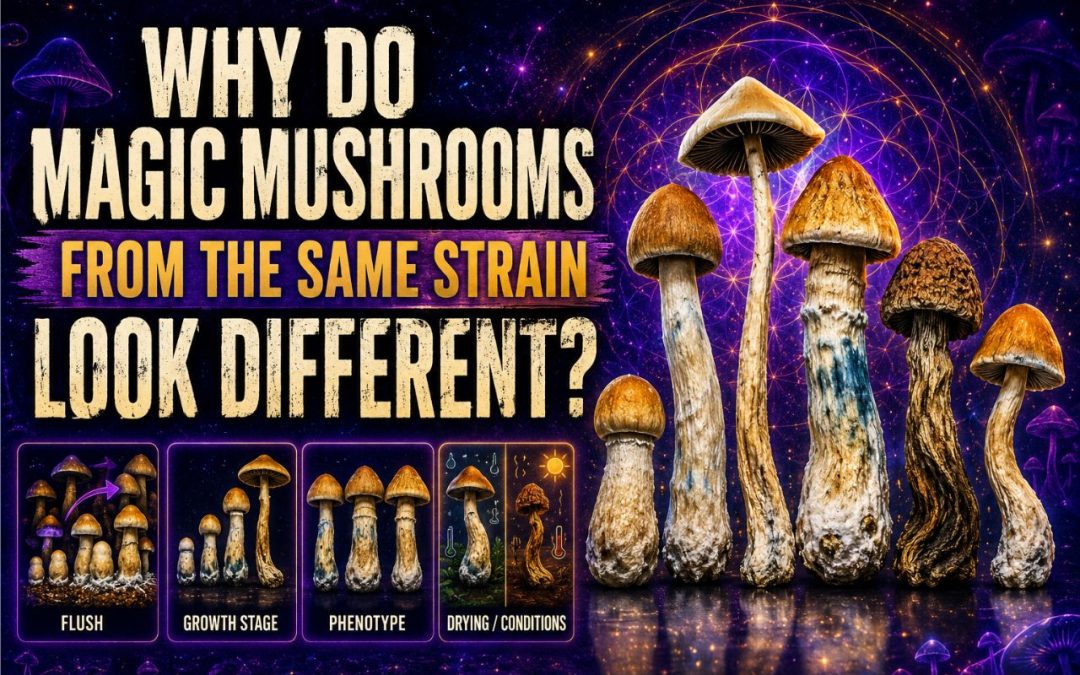
Even within the same strain, mushrooms can vary in size, shape, colour, cap structure, stem thickness, bruising, and overall appearance. One batch might have thick stems and small caps. Another batch of the same strain might have longer stems, wider caps, stronger blue bruising, lighter colouring, or a completely different visual personality.
This does not automatically mean the strain is wrong. It also does not automatically mean one batch is better or stronger than another. Mushroom appearance is influenced by genetics, maturity, phenotype, flush, environment, handling, moisture, drying, and many other natural factors.
In mycology, this type of visible variation is normal. Fungi can show noticeable changes in appearance because both genetic and environmental factors influence how their fruiting bodies develop. Research on macroscopic fungi has described this as phenotypic plasticity, meaning the same organism type can show different physical traits under different conditions.
Same Strain Does Not Always Mean Same Look
A strain name gives a general idea of the mushroom’s genetic background, but it does not guarantee that every mushroom will look identical.
Think of it like apples from the same tree or dogs from the same breed. They may share recognizable traits, but they are not perfect copies of each other. Some are larger, some are smaller, some are darker, some are lighter, and some show features more strongly than others.
Mushrooms are similar. A strain may have common traits, but individual mushrooms can still vary a lot.
Some common differences include:
Stem thickness
Cap size
Cap colour
Amount of blue bruising
Overall height
Density
Shape
Dry texture
Colour after drying
How open or closed the caps are
How uniform the batch looks
This is why two bags of the same strain can look noticeably different while still being the same variety.
Growth Stage Makes a Big Difference
One of the biggest reasons mushrooms look different is the stage of growth when they are harvested.
Younger mushrooms often look denser, rounder, and more compact. Their caps may still be closed or only partly opened. The stems may look thicker compared to the cap size, and the overall mushroom may look more solid.
More mature mushrooms usually look more open. The caps may flatten out, widen, or curl slightly. The gills may appear darker, and the mushroom may look taller, thinner, or more spread out.
For Psilocybe cubensis, cap shape and colour can change as the mushroom matures. Caps are often more rounded when young and can become broader or flatter with age. Gills also darken as spores mature, which changes the underside appearance.
This means the exact same strain can look very different depending on whether it was picked early, at peak maturity, or slightly later.
Flush Can Affect Appearance
Another major factor is the flush.
A flush is a round of mushroom fruiting. The first round, second round, and later rounds from the same genetics can sometimes produce mushrooms that look slightly different from each other.
Some flushes may produce larger mushrooms. Others may produce smaller but denser mushrooms. Sometimes later flushes can have more unusual shapes or less uniform sizing.
This is one reason a strain can look different even when it comes from the same genetic line. The mushrooms are developing at different times, under slightly different conditions, and sometimes with different levels of available resources.
Phenotypes and Genetic Variation
Another important word is phenotype.
A phenotype is the visible expression of genetics. In simple terms, it is how the mushroom actually looks on the outside.
A strain may have a general genetic identity, but there can still be different expressions within that strain. These expressions can show up as different cap shapes, stem structures, colours, thicknesses, or growth patterns.
This is why one version of a strain might look short and thick while another looks taller and more slender. Both may still belong to the same strain family, but different traits are showing more strongly.
This is especially noticeable with strains that have unstable or mixed genetics. Some batches may lean closer to one parent trait, while another batch may express something different.
Growing Conditions Can Change the Final Look
Growing conditions can also influence mushroom appearance.
This does not mean people need to know the exact growing process, but it is useful to understand that mushrooms respond to their environment. Conditions such as moisture, airflow, light exposure, temperature, and available nutrition can all affect the way fungal fruiting bodies form. Scientific literature on fungi notes that nutrients, temperature, humidity, light, and pH can influence the development of mushroom fruiting structures.
The same strain grown under different conditions may not look identical.
One batch may have longer stems. Another may have thicker stems. One may be pale and golden. Another may be darker, more bruised, or more compact.
That does not automatically mean the strain is different. It means mushrooms are highly responsive living organisms.
Drying Can Change Colour and Shape
Fresh mushrooms and dried mushrooms can look very different.
As mushrooms dry, they lose water and shrink. Their colour can darken, fade, or become more golden, beige, blue, grey, or tan depending on the strain and condition of the mushroom.
Stems may become thinner and more twisted. Caps may curl or flatten. Bruising may become more noticeable in some areas and less obvious in others.
A mushroom that looked large, pale, and smooth when fresh may look much darker, smaller, and more textured after drying. This is completely normal.
Because mushrooms contain a high amount of water, drying changes their appearance dramatically. Psilocybe cubensis fruiting bodies are commonly described as being mostly water, which helps explain why dried mushrooms shrink so much compared to their fresh form.
Blue Bruising Can Vary
Blue bruising is one of the most talked-about visual traits in magic mushrooms. Some mushrooms show heavy blue bruising, while others show only a little.
The amount of blue can depend on handling, freshness, moisture, age, drying, and the individual mushroom itself. Blue bruising happens after mushroom tissue is damaged and certain compounds react chemically. Research on Psilocybe mushrooms has shown that injury-triggered blueing involves enzyme-driven chemical changes after tissue damage.
But blue bruising should not be treated as a perfect potency meter.
A mushroom with more blue is not automatically stronger than one with less blue. A mushroom with less blue is not automatically weak. Bruising is only one visual clue, and it can be affected by many factors.
This is an important point to include because people often overjudge mushrooms by colour alone.
Larger Mushrooms Are Not Always Stronger
Another common misunderstanding is that bigger mushrooms are automatically stronger.
Size does not guarantee potency.
A large mushroom may look impressive, but that does not mean it contains more active compounds by percentage. A smaller mushroom may be dense and visually less dramatic but still be comparable in strength.
This is why judging mushrooms only by size can be misleading. Appearance can tell part of the story, but it does not tell the whole story.
Colour Alone Does Not Confirm Quality
Colour can vary naturally.
Some mushrooms may look golden, tan, pale, greyish, blue-tinted, or darker brown depending on strain, maturity, moisture, drying, and bruising. Caps can also change colour as they dry or mature.
This is especially true with mushrooms that are hygrophanous, meaning the cap colour changes depending on moisture. Psilocybe cubensis caps are commonly described as changing colour as they mature and dry.
Because of that, colour alone should not be used to judge whether a mushroom is good, strong, weak, or correctly named.
Why Strain Photos Online Can Be Misleading
Photos online can create unrealistic expectations.
A person might search a strain name and see one perfect-looking photo. Then they assume every mushroom from that strain should look exactly like that.
But online photos are usually selected because they look impressive. They may show the best-looking mushroom from a batch, the largest fruit, the most colourful cap, or the strongest bruising.
Real batches are more varied. Some mushrooms look picture-perfect. Others look twisted, small, pale, dark, thick, thin, or oddly shaped.
That does not automatically make them bad. It just means they are real mushrooms.
Why This Matters
This topic matters because people often compare what they receive to what they have seen before.
Someone may say:
“This Golden Teacher looks different than last time.”
“This batch is smaller.”
“These caps are lighter.”
“This one has more blue.”
“These stems are thinner.”
“This does not look like the photo I saw online.”
These are fair observations, but they do not always mean something is wrong.
Understanding natural variation helps people avoid judging mushrooms by one visual trait alone. Differences in size, colour, bruising, cap shape, or stem thickness do not automatically mean something is wrong.
Appearance Does Not Replace Proper Identification
This is also where safety matters.
Mushroom appearance can be useful, but looks alone are not enough for proper identification. Many mushrooms can share similar colours, shapes, or bruising patterns. Identification should never rely on a single feature such as blue bruising, cap colour, or stem shape. Multiple characteristics matter, and wild mushroom misidentification can be dangerous.
Final Thoughts
Magic mushrooms from the same strain can look different for many reasons. Flush, maturity, phenotype, genetics, growing conditions, drying, moisture, bruising, and handling can all affect the final appearance.
A strain name gives a general idea of what to expect, but it does not guarantee that every mushroom will look the same every time.
This is part of what makes mushrooms so interesting. They are natural, living organisms, not factory-made products. Variation is normal, and appearance alone should never be used to judge potency, safety, or identity.
For anyone comparing one batch to another, the most important thing to understand is this:
The same strain can still look different from batch to batch, and that does not automatically mean anything is wrong.