
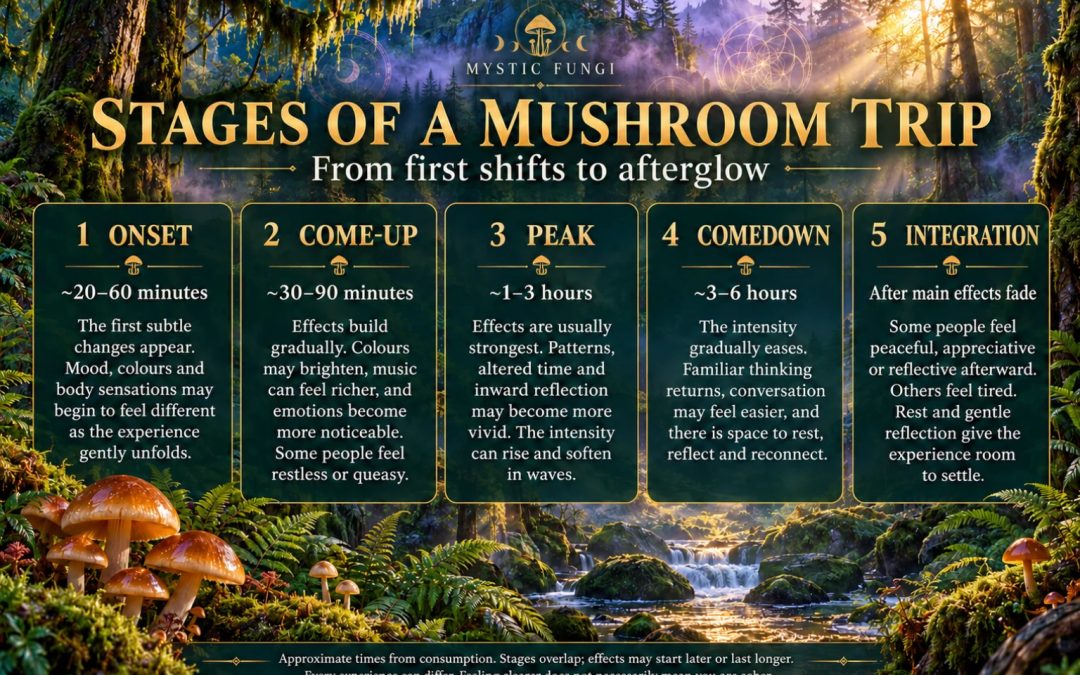
Have you ever noticed a similar pattern to your psilocybin trips? After a few fun experiences you begin to know what to expect.
For those of you who aren’t quite there yet.. we’ve created this 5 stage layout into a blog, just for you.
There can be a moment when the familiar starts to feel quietly extraordinary.
Music seems to have more room inside it. A pattern catches your attention. A thought you would normally pass over becomes something worth sitting with.
People describe the stages of a mushroom trip in many ways, but a useful map follows five phases: onset, come-up, peak, comedown and afterglow. Each has its own texture, from the first subtle changes to the quieter reflections that may follow.
At Mystic Fungi, we believe curiosity deserves thoughtful information. Understanding the shape of an experience can make its changing sensations easier to recognise.
Think of this as a map with soft edges. Every experience can differ from the previous one, and nobody needs to feel every sensation described here.
The five stages at a glance
These are approximate windows measured from consumption, rather than five durations to add together. The phases overlap, and effects can arrive earlier, start later or last longer.
| Phase | Approximate timing | What people may notice |
|---|---|---|
| Onset | Often around 20–60 minutes; sometimes later | Subtle changes in mood, senses or bodily sensations |
| Come-up | Often develops through the first 30–90 minutes and may continue beyond this | Increasing sensory changes, emotion and shifts in thought |
| Peak | Commonly within about 1–3 hours | The strongest changes in perception and headspace |
| Comedown | Often becomes noticeable around 3–6 hours | Effects gradually soften; ordinary thinking becomes easier |
|
Afterglow/ Integration |
After the main effects subside, sometimes extending into the following day or days | Possible warmth, reflection or renewed appreciation, some report feeling well rested. |
A pooled analysis of controlled studies found average onset around 36 minutes, peak effects around two hours and effects lasting about five and a half hours, with substantial variation, sometimes caused by medications.
The table combines that research with common experience-report descriptions. It is an orientation, not a validated five-stage medical model or a countdown to being sober. Food, preparation, potency and individual differences can shift the timing.
1. Onset: the first little shifts
The onset is the threshold: the space between waiting and noticing.
Early changes may be easy to miss. Something feels different before it is easy to explain what. Attention turns toward a sound, a colour or a sensation in the body. A little laughter may arrive without much of a reason.
People also report yawning, tingling, warmth, coolness or a change in how heavy their body feels. Some notice their stomach first.
There is no single correct opening scene.
In Shroomery’s onset, peak and finish discussion, contributors describe markedly different starting times. Some notice changes quickly; others report a much longer wait. These are individual accounts, but they offer a useful reminder: someone else’s clock cannot tell you exactly what yours will do.
A slower start is not a reliable reason to take more. Effects can still be building before they feel obvious, and adding more can make the later experience unexpectedly intense.
For this first chapter, simplicity helps: a comfortable place to sit, familiar surroundings and no pressure to make anything happen.
2. The come-up: the experience begins to open
During the come-up, the subtle shifts become more noticeable.
Colours may seem richer. Familiar textures can appear unusually intricate. Music may feel more absorbing, while thoughts move along unexpected paths. Some people become playful and talkative; others want quiet and a blanket.
This transition can carry a flutter of anticipation. Excitement and nervousness can feel surprisingly similar in the body. Queasiness or restlessness can also accompany the changing sensations.
A 2025 study of mushroom experience reports found that bodily discomfort and anxious anticipation appeared more often during the come-up, while later accounts more often described relief and pleasant feelings. Because the study analysed selected, self-reported accounts, it cannot predict how any individual experience will unfold.
A gentle approach is to make the immediate moment easier.
Lower the music if it feels busy. Sit somewhere supported. Ask a trusted sober companion for reassurance. Breathe comfortably, without forcing deep breaths, and let attention return to something familiar.
A helpful phrase might be: I’m noticing a change. I can take this one moment at a time.
You can ask for company, more space or a quieter room. Comfort does not have to be earned by pushing through discomfort.
3. The peak: the fullest part of the experience
The peak is when changes in perception and awareness are usually strongest.
People describe shifting patterns, vivid imagery behind closed eyes and a different relationship with time. A few minutes can seem expansive. A piece of music may feel emotionally rich, and an ordinary memory can take on fresh significance.
Some experiences centre on laughter and sensory wonder. Others turn inward, toward relationships, emotions or the feeling of being alive.
Many users describe experiencing strong emotions, vivid images, altered time perception and changes in the sense of self among reported effects.
For some, the boundary between themselves and their surroundings may feel softer. This is often called ego dissolution. It is one possible experience, rather than a stage everyone reaches or a measure of how meaningful a trip is.
The peak may arrive in waves. A quiet stretch can give way to another rise in intensity. In an r/shrooms discussion about the comedown, a contributor describes alternating between feeling almost ordinary and feeling the effects return. Such accounts help explain why a brief clear moment does not necessarily mean the experience has finished.
During this part, a safe, settled environment matters. Stay away from roads, water, heights and other hazards. A trusted sober person can help with practical needs so there is less to navigate.
And if something feels deeply important, it can wait to be understood. A thought can be written down and revisited when you are rested and sober.
4. The comedown: familiar ground returns
The return often happens gradually.
Patterns become less insistent. Conversation may feel easier. Attention starts moving back toward ordinary things: the room, a favourite song, the feeling of a blanket.
Some people describe this part as spacious and tender. There may be gratitude, a desire to talk, or simply the pleasure of sitting quietly.
The experience-report study identified peacefulness, reflection, insight and enjoyable social connection among recurring comedown themes. That describes a pattern in the selected reports, rather than a guaranteed landing.
Give the return room to unfold. Rest, modest sips of water and a light snack if comfortable can meet ordinary needs without adding another task.
Feeling clearer is encouraging, but it does not establish that judgment and coordination have fully returned. Keep driving, cycling, machinery and demanding responsibilities off the agenda. Arrange transport as part of preparation.
5. The afterglow: what may linger
After the main effects fade, some people notice a softer emotional light around familiar life.
A conversation feels more precious. Everyday details hold their attention. There may be a wish to spend time outdoors, reconnect with someone or treat themselves more kindly.
On Shroomery, in “How do you guys feel mentally after a shrooms trip?”, member Soulstice describes feeling peaceful and connected afterward. Other contributors describe feeling refreshed or clearer. These are unverified personal reflections, not evidence of a predictable benefit.
The afterglow is not the same as continued intoxication, though the boundary can be hard to judge while residual effects remain. It is a community term for possible feelings afterward, rather than a compulsory final phase.
There is no need to chase it or worry if your own landing feels ordinary. Sleep, food and a quiet day can be enough.
Integration: bringing a little meaning home
Integration means giving the experience a place in everyday life.
You do not need to decode every image or turn every thought into a revelation. Start with what you remember and what still feels worthwhile once you are sober.
Integration is the process of making sense of a mushroom experience once you’ve returned to your usual headspace. As memories and emotions settle, you can gently explore what stood out and whether it holds meaning in your everyday life. There’s no need to find an answer in everything.
Writing a few notes, talking with someone you trust or taking a quiet walk can give those impressions room to unfold. Revisit them when you’re rested and clear-minded, allowing anything useful to become a small, thoughtful change rather than a decision you need to rush.
Here are a couple of questions you can ask yourself to help reflect on the experience and what new insights it could have brought you:
- What moments or feelings stayed with me most?
- Did anything help me see myself or a relationship differently?
- What felt meaningful, and does it still resonate now that I’m rested?
- Is there anything I’d like to explore further without needing an answer right away?
- What would I like to make more space for in my life?
- What small, practical step could honour something I learned?
Perhaps an appreciation for connection becomes an unhurried conversation. Perhaps a moment of wonder becomes more time outdoors. Perhaps the useful response is simply to rest.
Let major decisions wait. Meaning has time to become clearer.
A little care around the journey
Preparation gives an experience more support. Choose a familiar, comfortable environment, leave plenty of time without responsibilities, and have a trusted sober person present, especially when the experience is unfamiliar. These precautions reduce avoidable hazards; they cannot make an experience risk-free.
Potency can vary considerably, even between mushrooms of the same strain. Avoid mixing with alcohol, cannabis or other drugs, which can make effects less predictable. Never consume wild mushrooms based on a photograph or an uncertain identification.
If a moment becomes difficult, reduce stimulation, stay with a calm sober person and ask for help. Distress, confusion or sleep disruption that persists after the experience deserves professional support.
A map with room for your own experience
The stages of a mushroom trip offer a language for something that can otherwise be difficult to describe: the first shift, the opening, the fullest intensity, the return and whatever feelings remain.
For people who find the experience meaningful, what stays with them may be surprisingly simple—a little more appreciation for a familiar song, a loved person or an ordinary afternoon.
At Mystic Fungi, our approach is curiosity with care: clear information, respect for individual differences and room to reflect.
Sources and editorial notes
The supplied five-phase graphic informed the structure. Timings were clarified as overlapping windows measured from consumption, with wider variation acknowledged. The article uses original wording.
Research and health information:
- Safety pharmacology of acute psilocybin administration in healthy participants
https://pmc.ncbi.nlm.nih.gov/articles/PMC12244205/ - A qualitative analysis of the psychedelic mushroom come-up and come-down
https://www.nature.com/articles/s44184-024-00095-6 - Shroomery — Psilocybin Onset/Peak/Finish Poll
https://www.shroomery.org/forums/showflat.php/Number/28206481/fpart/all - Reddit — How fast is comedown?
https://www.reddit.com/r/shrooms/comments/lxw1gv/ - Shroomery — How do you guys feel mentally after a shrooms trip?
https://www.shroomery.org/forums/showflat.php/Number/24810660