
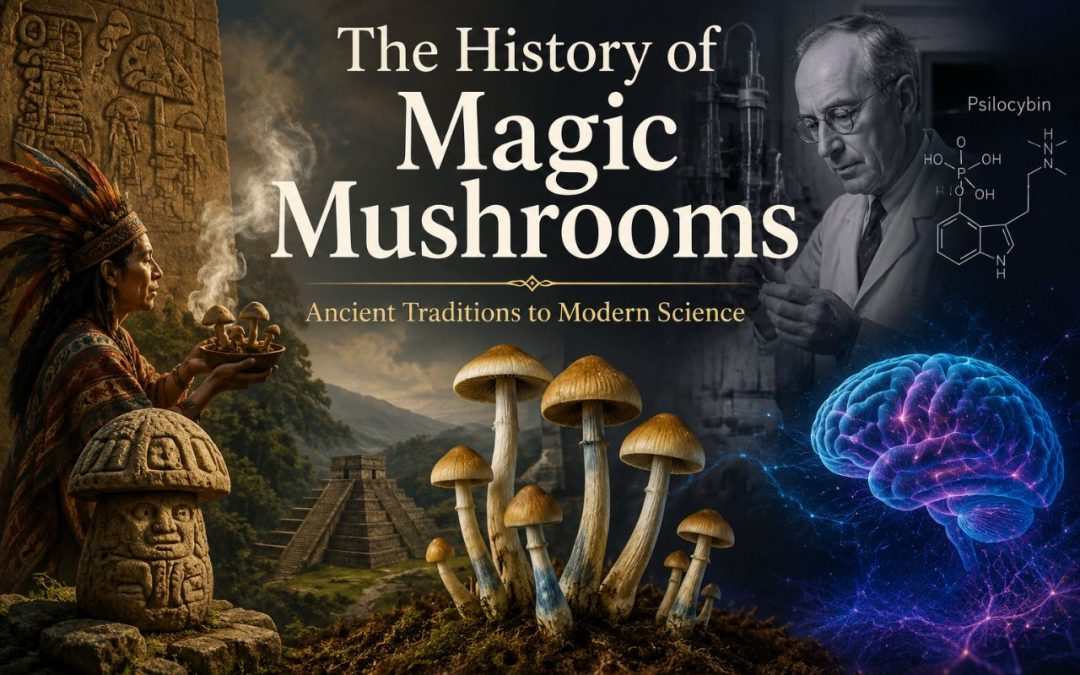
The History of Magic Mushrooms
Magic mushrooms have captured human curiosity for thousands of years. Long before scientists isolated psilocybin in laboratories or researchers began studying its effects on the brain, cultures across the world had already developed relationships with these unique fungi.
Today, magic mushrooms are the subject of growing scientific research, documentaries, books, and public discussion. Yet their story did not begin in modern laboratories—it began centuries, and perhaps millennia, ago.
The history of magic mushrooms is a story that weaves together spirituality, medicine, culture, exploration, prohibition, and scientific discovery. Understanding this history provides valuable context for the renewed interest in psilocybin that we see today.
What Are Magic Mushrooms?
Magic mushrooms are fungi that contain naturally occurring compounds known as psilocybin and psilocin. These compounds interact with serotonin receptors in the brain and are responsible for the altered states of consciousness associated with many species of psychedelic mushrooms.
More than 200 species of mushrooms are known to contain psilocybin, though some are more widely recognized than others. Species within the genus Psilocybe are among the most studied and commonly discussed.
While modern science has helped explain how these compounds work, humans likely encountered psilocybin-containing mushrooms long before written history.
Ancient Human Relationships With Psychoactive Plants and Fungi
Throughout history, humans have used plants and fungi for food, medicine, ritual, and spiritual purposes. Archaeological evidence suggests that many ancient cultures developed complex relationships with naturally occurring substances capable of altering perception and consciousness.
Researchers continue to debate exactly how long humans have used psilocybin mushrooms. Organic materials rarely preserve well over thousands of years, making direct evidence difficult to obtain. However, archaeological discoveries, oral traditions, and historical accounts suggest that psychoactive mushrooms may have played important roles in certain cultures for centuries.
This relationship with the natural world was not unique to mushrooms. Around the globe, societies incorporated various plants and fungi into ceremonies, healing practices, and rites of passage. In many traditions, these substances were treated with reverence rather than recreation.
The story of magic mushrooms is therefore part of a much larger story: humanity’s long-standing search for healing, meaning, connection, and understanding.
Ancient Mesoamerican Use of Psilocybin Mushrooms
Some of the strongest historical evidence for ceremonial mushroom use comes from Mesoamerica, particularly regions that are now part of modern-day Mexico and Central America.
Spanish chroniclers arriving in the Americas during the 16th century documented Indigenous peoples using sacred mushrooms during ceremonies. Several accounts described mushrooms being consumed during religious events and spiritual practices.
The Aztecs used the Nahuatl word teonanácatl, often translated as “flesh of the gods” or “divine mushroom.” Historians continue to discuss the exact interpretation of the term, but it is widely recognized as evidence of ceremonial mushroom use.
For many Indigenous communities, mushrooms were not simply substances to consume—they were part of broader spiritual and cultural traditions involving community, healing, and ritual.
Even today, some Indigenous groups continue practices that have been preserved through generations.
The Mystery of Mushroom Stones
Archaeologists have uncovered carved stone artifacts known as “mushroom stones” in parts of Guatemala and surrounding regions. Some researchers believe these artifacts may represent evidence of ancient mushroom ceremonies dating back more than 2,000 years.
These stone carvings often resemble mushrooms and have sparked decades of debate among historians and archaeologists.
While interpretations vary, the existence of these artifacts suggests that mushrooms may have held symbolic or ceremonial importance for certain ancient cultures.
As with many aspects of ancient history, definitive conclusions remain difficult due to the limited archaeological record. Nevertheless, mushroom stones remain one of the most intriguing pieces of evidence in the history of psychedelic fungi.
Sacred Knowledge and Indigenous Traditions
The history of magic mushrooms cannot be told without recognizing the Indigenous communities who preserved traditional knowledge despite centuries of cultural disruption.
Throughout history, sacred practices involving mushrooms were often passed down orally rather than through written texts. This means that much of this knowledge was carried through generations of healers, elders, and ceremonial leaders.
Colonial suppression of Indigenous spiritual practices caused many traditions to become hidden or practiced in secrecy. Despite these pressures, some communities maintained their relationships with sacred mushrooms over centuries.
Modern discussions about psychedelics increasingly acknowledge the importance of respecting the cultures that preserved this knowledge long before scientific interest emerged.
Understanding this history encourages a more complete and respectful view of psychedelic traditions.
The Western Rediscovery of Magic Mushrooms
For much of the Western world, magic mushrooms remained relatively unknown until the mid-20th century.
In the 1950s, amateur mycologist and banker R. Gordon Wasson traveled to Mexico and participated in traditional mushroom ceremonies conducted by Mazatec healer María Sabina.
In 1957, Wasson published an article in Life magazine describing his experiences. The article introduced many Western readers to the existence of sacred mushroom ceremonies and sparked widespread interest in psychedelic fungi.
While the publication brought global attention to psilocybin mushrooms, it also raised important ethical discussions about cultural preservation, privacy, and the effects of outside attention on Indigenous communities.
The story serves as a reminder that scientific curiosity and cultural respect should go hand in hand.
The Discovery of Psilocybin
The next major chapter in mushroom history came through chemistry.
Swiss chemist Albert Hofmann—also known for synthesizing LSD—successfully isolated and identified psilocybin and psilocin in the late 1950s.
This breakthrough allowed scientists to begin studying the compounds in controlled settings.
For the first time, researchers could examine the chemistry behind experiences that Indigenous cultures had recognized for generations.
Modern neuroscience continues to build upon this foundation as scientists investigate how psilocybin interacts with the brain.
The Psychedelic Research Boom of the 1950s and 1960s
Interest in psychedelics grew rapidly during the 1950s and 1960s.
Researchers explored potential applications in psychology, psychiatry, and consciousness studies. Universities and medical institutions conducted numerous studies investigating psychedelic compounds.
At the same time, psychedelic substances became increasingly associated with broader cultural movements involving art, music, spirituality, and social change.
As public attention grew, perceptions of psychedelics became increasingly polarized. Some viewed them as tools for exploration and research, while others expressed concerns regarding safety and social impacts.
This period helped shape many of the conversations about psychedelics that continue today.
Prohibition and the Decline of Research
By the late 1960s and early 1970s, changing laws dramatically altered the landscape of psychedelic research.
Many psychedelic substances, including psilocybin, became highly restricted in numerous countries. Research slowed considerably, and scientific investigations became much more difficult to conduct.
For several decades, relatively little formal research took place compared with earlier years.
Despite legal restrictions, public interest in psychedelics never completely disappeared. Communities of researchers, mycologists, and enthusiasts continued studying fungi and preserving knowledge.
This quieter period would eventually set the stage for a renewed scientific interest decades later.
The Modern Psychedelic Renaissance
Over the last two decades, interest in psilocybin research has grown significantly.
Universities, research centers, and scientists have begun conducting new studies exploring how psychedelic compounds affect the brain and human experience.
Institutions such as Johns Hopkins Center for Psychedelic and Consciousness Research have contributed to expanding scientific knowledge in this field.
This renewed interest is often referred to as the “psychedelic renaissance.”
In parallel with scientific research, public awareness has also increased through books, podcasts, documentaries, and news coverage. As a result, more people are asking questions about mushrooms than ever before.
Some individuals interested in psychedelics also explore practices such as microdosing.
Magic Mushrooms in Popular Culture
Magic mushrooms have influenced art, literature, music, and popular culture for decades.
References to altered states of consciousness appear throughout human history, and modern culture continues to explore themes of perception, creativity, and consciousness.
As discussions surrounding psychedelics become more mainstream, public understanding continues to evolve.
At the same time, growing interest has increased the importance of education, harm reduction, and evidence-based information.
A better understanding of history helps place modern conversations into context.
What the Future of Psilocybin May Hold
The story of magic mushrooms is still being written.
Researchers continue studying psilocybin, laws continue to evolve in some regions, and public attitudes toward psychedelics continue to shift.
Although much remains to be learned, one thing is clear: magic mushrooms have played a role in human history for far longer than many people realize.
From ancient ceremonies in Mesoamerica to modern neuroscience laboratories, these remarkable fungi have traveled through cultures, generations, and scientific eras.
Their history is ultimately a story about human curiosity—a desire to understand ourselves, our minds, and our place in the world.
Frequently Asked Questions
How old is the use of magic mushrooms?
Researchers believe the ceremonial use of psilocybin mushrooms may date back centuries or even thousands of years, though precise timelines remain difficult to confirm due to limited archaeological evidence.
Who discovered magic mushrooms?
Indigenous peoples used psilocybin mushrooms long before Western documentation. In the West, widespread awareness increased after R. Gordon Wasson’s publications in the 1950s.
What does the word teonanácatl mean?
The Nahuatl term is commonly translated as “flesh of the gods” or “divine mushroom,” though historians continue to debate its precise meaning.
When was psilocybin discovered?
Psilocybin was isolated and identified by Albert Hofmann in the late 1950s.
Why are scientists studying psilocybin today?
Modern researchers are interested in understanding how psilocybin affects the brain, consciousness, and human experience.
Conclusion
The history of magic mushrooms stretches across continents, cultures, and centuries. Their story includes ancient ceremonies, scientific breakthroughs, cultural shifts, and renewed research that continues today.
By understanding where these fungi came from and how different societies have interacted with them, we gain a deeper appreciation for both their cultural significance and their scientific importance.
As modern research continues to evolve, the history of magic mushrooms reminds us that humanity’s relationship with the natural world is often far older—and more complex—than we first imagine.