
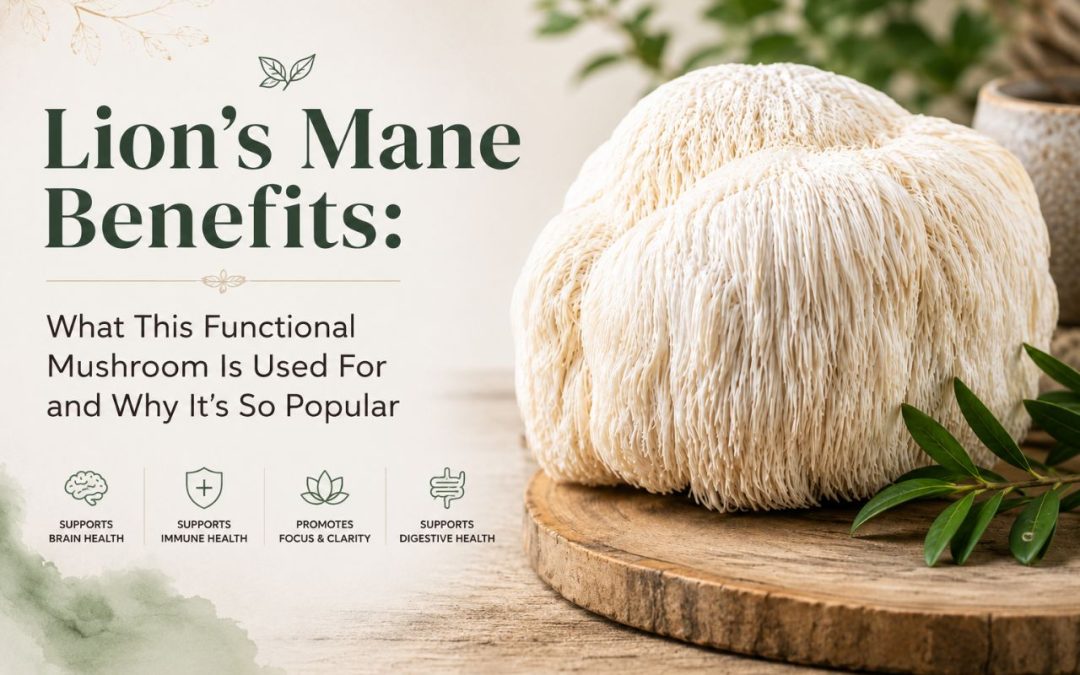
Lion’s Mane Benefits: What This Functional Mushroom Is Used For and Why It’s So Popular
Lion’s Mane mushroom has become one of the most talked-about functional mushrooms in the wellness world. Known for its unique appearance, long history of traditional use, and growing popularity among students, professionals, entrepreneurs, older adults, and health-conscious people, Lion’s Mane is most often associated with focus, memory, mental clarity, and cognitive support.
Unlike many mushrooms that look like caps and stems, Lion’s Mane has a white, shaggy, almost fur-like appearance. Its long cascading spines resemble a lion’s mane, which is where the mushroom gets its common name. Its scientific name is Hericium erinaceus.
Today, Lion’s Mane is commonly used in powders, capsules, teas, coffees, tinctures, and functional mushroom blends. Many people take it as part of a daily routine, similar to how they might use vitamins, omega-3s, magnesium, or other wellness supplements. While Lion’s Mane has a long history of traditional use, modern research is now looking more closely at its unique compounds and how they may support the brain, nervous system, gut, and overall wellness.
This guide explains what Lion’s Mane is, its history, potential benefits, common uses, the difference between powders and extracts, and how it compares to other popular functional mushrooms like Cordyceps, Reishi, Turkey Tail, and Chaga.
What Is Lion’s Mane Mushroom?
Lion’s Mane is an edible and functional mushroom that grows naturally on hardwood trees. It is found in parts of North America, Europe, and Asia. It has been used as both a food and a traditional wellness mushroom, especially in Asian cultures.
Lion’s Mane is different from many other functional mushrooms because it is especially associated with the brain and nervous system. While mushrooms like Reishi are often linked with calm and relaxation, Cordyceps with energy and endurance, Turkey Tail with immune support, and Chaga with antioxidant support, Lion’s Mane is most commonly connected with focus, memory, and cognitive wellness.
The mushroom contains several groups of naturally occurring compounds that have attracted scientific attention, including polysaccharides, beta-glucans, hericenones, and erinacines. Researchers are especially interested in how some of these compounds may influence nerve growth factor, inflammation, oxidative stress, and brain health pathways. Current research is promising, but it is still developing, and larger human studies are needed before strong medical claims can be made.
A Brief History of Lion’s Mane
Lion’s Mane has been used for centuries as both a culinary mushroom and a traditional wellness ingredient. In traditional Asian food culture, it has been valued for its seafood-like texture and mild flavour. When cooked, Lion’s Mane can have a texture sometimes compared to crab or lobster.
In traditional wellness practices, Lion’s Mane was often associated with digestion, vitality, and mental sharpness. Over time, interest in Lion’s Mane expanded beyond traditional use and into modern supplement culture.
Today, it is one of the most popular functional mushrooms in North America. People commonly use Lion’s Mane powder or capsules in the morning, before work, before studying, or as part of a daily supplement stack.
Why Is Lion’s Mane So Popular?
Lion’s Mane has become popular because it fits naturally into modern wellness goals. Many people are looking for ways to support focus, productivity, memory, learning, and long-term cognitive health without relying only on stimulants.
Unlike caffeine, Lion’s Mane is not typically used for a quick stimulant effect. Instead, many people use it consistently over time as part of a daily routine. This makes it especially popular among people who want gentle, long-term cognitive support rather than a short burst of energy.
Lion’s Mane is also easy to use. It can be taken as a capsule, mixed into coffee, blended into smoothies, or added to warm drinks. A concentrated extract powder is especially convenient for people who want a stronger serving in a smaller amount.
Potential Lion’s Mane Benefits
Before going deeper, it is important to be clear: Lion’s Mane is not a cure, treatment, or guaranteed solution for any medical condition. Research is still developing, and human studies are limited compared to the amount of interest around this mushroom.
That said, Lion’s Mane is being studied for several areas of wellness.
1. Cognitive Support
The most common reason people use Lion’s Mane is for cognitive support. This includes focus, memory, clarity, learning, and mental performance.
Some early human studies have explored Lion’s Mane in relation to cognitive function. One study in adults with mild cognitive impairment found improvements after 16 weeks of Lion’s Mane intake, although the benefits appeared to decline after stopping use. Another study in healthy young adults suggested Lion’s Mane may help with speed of performance and subjective stress, but the authors described the findings as tentative and needing more research.
This is why Lion’s Mane is often described as a mushroom of interest for cognitive wellness rather than a proven medical treatment.
Practical takeaway
Lion’s Mane may be worth considering for people who want daily support for focus and mental clarity, especially as part of a broader routine that includes sleep, exercise, hydration, good nutrition, and stress management.
2. Memory and Learning Support
Lion’s Mane is often discussed in relation to memory because of its potential effects on pathways connected to nerve health and brain function.
Researchers are interested in compounds found in Lion’s Mane, including hericenones and erinacines, because of their possible neurotrophic and neuroprotective effects. Neurotrophic support refers to processes involved in the growth, maintenance, and repair of nerve cells. Reviews have highlighted Lion’s Mane as a mushroom of interest for the nervous system, although much of the evidence still comes from preclinical studies, animal research, and small human trials.
Practical takeaway
People interested in memory support often choose Lion’s Mane because it is one of the functional mushrooms most closely associated with brain and nerve health.
3. Focus and Mental Clarity
Many Lion’s Mane users describe taking it for focus, productivity, and mental clarity. This is one of the reasons it has become popular among students, business owners, shift workers, gamers, writers, and people with mentally demanding jobs.
Lion’s Mane does not usually feel like a stimulant. It is not the same as drinking coffee or taking a high-caffeine supplement. Instead, it is generally used consistently over time.
This makes Lion’s Mane a good fit for people who want to support mental performance without adding more caffeine to their day.
Practical takeaway
Lion’s Mane is commonly used in the morning or early afternoon as part of a focus-support routine.
4. Nervous System Support
Lion’s Mane is especially interesting because of its relationship with the nervous system. The nervous system includes the brain, spinal cord, and nerves throughout the body.
Research reviews have examined Lion’s Mane for its potential neuroprotective and nerve-supporting properties. Scientists are studying whether its compounds may influence nerve growth factor, inflammation, oxidative stress, and other biological pathways related to nervous system health.
This area is one of the main reasons Lion’s Mane stands apart from other functional mushrooms. While many mushrooms contain beta-glucans and antioxidant compounds, Lion’s Mane has become especially known for its brain and nerve-related research.
Practical takeaway
Lion’s Mane is often chosen by people who want a functional mushroom focused more on brain and nervous system support than immune or energy support.
5. Mood and Stress Support
Lion’s Mane is not only discussed for cognition. Some research has also looked at mood, stress, and emotional wellness.
A 2023 study reported that Lion’s Mane may reduce subjective stress in healthy young adults, while also suggesting possible benefits for cognitive performance speed. However, the researchers were careful to describe the results as early and not final.
Some people use Lion’s Mane alongside calming mushrooms like Reishi or adaptogenic-style products. For example, someone might use Lion’s Mane in the morning for focus and Reishi in the evening as part of a wind-down routine.
Practical takeaway
Lion’s Mane may be useful for people building a daily wellness routine that supports both mental performance and general balance.
6. Gut and Digestive Wellness
Lion’s Mane has also been traditionally associated with digestion. Like other mushrooms, it contains polysaccharides and dietary fibres that may interact with gut health.
Modern research has explored mushroom polysaccharides for their biological activity, including immune and gut-related effects. Lion’s Mane polysaccharides are one of the groups of compounds being studied for potential wellness applications.
While Lion’s Mane is most famous for brain health, it should not be viewed only as a “brain mushroom.” Functional mushrooms often have multiple overlapping areas of interest because they contain many different natural compounds.
Practical takeaway
People interested in gut-brain wellness may find Lion’s Mane especially interesting because it connects two major areas of health: digestion and cognition.
7. Antioxidant and Inflammation Support
Like many functional mushrooms, Lion’s Mane contains compounds that are being studied for antioxidant and anti-inflammatory activity. Oxidative stress and inflammation are two areas that researchers often examine when studying long-term wellness and healthy aging.
Chaga is usually the functional mushroom most strongly associated with antioxidant support, but Lion’s Mane also contains compounds of interest in this area. Reishi, Turkey Tail, Cordyceps, and Chaga all have their own unique antioxidant or immune-related research profiles, which is why many people rotate or combine functional mushrooms.
Practical takeaway
Lion’s Mane can be part of a broader functional mushroom routine that includes other mushrooms for complementary support.
Who Uses Lion’s Mane?
Lion’s Mane is used by a wide range of people. Common users include:
- Students looking for study support
- Professionals with mentally demanding work
- Entrepreneurs and business owners
- Older adults interested in cognitive wellness
- People who want non-caffeinated focus support
- Wellness-focused individuals building a daily supplement routine
- People interested in functional mushrooms and natural health
Lion’s Mane is often selected by people who want support for the brain and nervous system specifically. Someone looking for energy might choose Cordyceps first. Someone looking for calm might choose Reishi. Someone focused on immune support may choose Turkey Tail. Someone focused on antioxidant support may choose Chaga. But for focus, memory, and mental clarity, Lion’s Mane is usually the first mushroom people ask about.
How Is Lion’s Mane Commonly Used?
Lion’s Mane is commonly used in several forms.
Lion’s Mane Capsules
Capsules are the easiest option for consistency. They are convenient, portable, and pre-measured. This makes them a good choice for people who do not want to measure powder or mix anything into drinks.
Capsules are often preferred by people who want a simple daily routine.
Lion’s Mane Powder
Powder is flexible. It can be mixed into coffee, tea, smoothies, protein shakes, oatmeal, or warm water. Powder is a good option for people who like to customize their serving size or combine functional mushrooms together.
Lion’s Mane powder is also useful for people who already have a morning drink routine.
Lion’s Mane Extract
A Lion’s Mane extract is more concentrated than regular mushroom powder. For example, a 10:1 extract means that approximately 10 parts of raw mushroom material are used to create 1 part of finished extract.
This is one reason many people prefer extracts. They allow a person to consume a more concentrated mushroom product without needing a large serving size.
Lion’s Mane in Mushroom Blends
Lion’s Mane is often included in blends with other mushrooms. A common functional mushroom blend might include Lion’s Mane, Cordyceps, Reishi, Turkey Tail, Chaga, or Shiitake.
Blends are useful for people who want broad wellness support rather than focusing on one mushroom.
Lion’s Mane Extract vs Regular Mushroom Powder
One of the most important things to understand is the difference between regular mushroom powder and extract powder.
Regular Mushroom Powder
Regular mushroom powder is usually dried mushroom that has been ground into a powder. It may contain the whole mushroom, but it is less concentrated than an extract.
Regular powder can still be useful, especially as a food-based ingredient, but the serving size may need to be larger.
Extract Powder
Extract powder goes through an extraction process designed to concentrate certain beneficial compounds. Many functional mushroom extracts are made using hot water extraction, alcohol extraction, or dual extraction depending on the mushroom and desired compounds.
For Lion’s Mane, extraction matters because people often want a more concentrated product for daily use. A 10:1 Lion’s Mane extract is much more concentrated than basic dried mushroom powder.
Why 10:1 Extracts Are Popular
A 10:1 extract is popular because it is easy to understand and easy to use. In simple terms, 60 grams of a 10:1 extract represents roughly 600 grams of raw mushroom starting material before extraction.
This does not mean you need to take huge amounts. It simply helps customers understand why extract powders can be more potent and convenient than regular mushroom powder.
Lion’s Mane vs Other Functional Mushrooms
Lion’s Mane is powerful as a standalone mushroom, but it also fits into a larger functional mushroom category. Comparing it with other mushrooms helps customers understand which product best fits their goals.
Lion’s Mane vs Cordyceps
Lion’s Mane is most commonly used for focus, memory, and cognitive support.
Cordyceps is more commonly used for energy, stamina, performance, and endurance. Many people take Cordyceps before workouts, physical work, or busy days.
A person may choose Lion’s Mane for mental energy and Cordyceps for physical energy.
Lion’s Mane vs Reishi
Lion’s Mane is often used during the day.
Reishi is often used in the evening because it is commonly associated with calm, relaxation, and sleep-support routines.
A simple routine could be Lion’s Mane in the morning and Reishi in the evening.
Lion’s Mane vs Turkey Tail
Lion’s Mane is most often selected for brain and nervous system support.
Turkey Tail is best known for immune support and its naturally occurring beta-glucans.
People building a daily wellness routine may use Lion’s Mane for cognitive support and Turkey Tail for immune-focused support.
Lion’s Mane vs Chaga
Lion’s Mane is known for focus and cognition.
Chaga is commonly associated with antioxidant support and general wellness.
A person interested in healthy aging may be interested in both, but for different reasons.
When Is the Best Time to Take Lion’s Mane?
Many people take Lion’s Mane in the morning because they use it for focus, productivity, or mental clarity. It can also be taken in the early afternoon.
Because Lion’s Mane is not usually considered a sedative mushroom, most people do not specifically save it for bedtime. However, everyone responds differently. Some people may prefer morning use, while others may be fine taking it later in the day.
Common routine examples
Morning focus routine:
Lion’s Mane powder or capsules with breakfast, coffee, or tea.
Workday routine:
Lion’s Mane capsules before a mentally demanding workday.
Study routine:
Lion’s Mane powder in a smoothie before studying.
Mushroom stack routine:
Lion’s Mane in the morning, Cordyceps before activity, Reishi in the evening, and Turkey Tail or Chaga as part of a general wellness routine.
How Long Does Lion’s Mane Take to Work?
Lion’s Mane is generally used as a consistency-based supplement, not a quick stimulant. Some people report feeling benefits quickly, while others use it daily for several weeks before noticing changes.
In research settings, some studies have used Lion’s Mane daily over multiple weeks. For example, one mild cognitive impairment study looked at 16 weeks of use.
For practical purposes, many people think of Lion’s Mane as something to use consistently for at least several weeks.
What Should You Look for in a Lion’s Mane Product?
Not all Lion’s Mane products are the same. Quality matters.
Here are a few things to look for:
1. Mushroom Extract Instead of Basic Powder
A concentrated extract is often preferred because it provides a stronger mushroom serving in a smaller amount.
2. Clear Extract Ratio
A product that clearly states its extract ratio, such as 10:1, helps customers understand the concentration.
3. Fruiting Body or Clearly Identified Source
Customers should know what part of the mushroom is being used. Some products use fruiting body, some use mycelium, and some use blends.
4. Simple Ingredients
Many customers prefer products without unnecessary fillers, artificial flavours, or added sugars.
5. Easy Serving Instructions
A good product page should clearly explain how to use the product, how much to take, and when to take it.
Is Lion’s Mane Safe?
Lion’s Mane is an edible mushroom and is commonly consumed as food and in supplements. However, people with mushroom allergies, people who are pregnant or breastfeeding, people on medication, or people with medical conditions should speak with a qualified healthcare provider before using any supplement.
Some sources caution that Lion’s Mane may not be appropriate for everyone, especially people with allergies or those using medications that affect blood sugar or blood thinning. More safety research is still needed, especially for long-term supplement use.
Scientific Interest and Current Research
Modern research into Lion’s Mane is growing quickly. Scientists are studying its compounds, including polysaccharides, beta-glucans, hericenones, and erinacines. Research areas include cognition, nervous system support, mood, stress, oxidative stress, inflammation, and gut health.
A 2023 randomized study in healthy young adults suggested potential benefits for speed of performance and subjective stress, but the researchers also noted that more research is needed.
A 2025 systematic review found that Lion’s Mane research includes studies published between 2000 and 2024, but the field still needs more high-quality human trials before firm conclusions can be made.
This is the balanced way to talk about Lion’s Mane: promising, popular, and scientifically interesting, but not a guaranteed treatment or cure.
Frequently Asked Questions About Lion’s Mane
What is Lion’s Mane mushroom good for?
Lion’s Mane is most commonly used for focus, memory, mental clarity, cognitive support, and nervous system wellness. It is also studied for mood, stress, gut health, and antioxidant activity.
Does Lion’s Mane give you energy?
Lion’s Mane is not usually used as a stimulant. It may support mental clarity and focus, but it does not typically feel like caffeine. For physical energy and endurance, Cordyceps is usually the better-known functional mushroom.
Can I take Lion’s Mane every day?
Many people use Lion’s Mane daily as part of a wellness routine. Product directions should always be followed, and people with medical conditions or medications should speak with a healthcare professional.
Is Lion’s Mane better as powder or capsules?
Capsules are better for convenience and consistent serving sizes. Powder is better for flexibility because it can be mixed into coffee, tea, smoothies, or food. Both can be useful depending on the person’s routine.
What does 10:1 Lion’s Mane extract mean?
A 10:1 extract means approximately 10 parts of raw mushroom material are used to create 1 part of finished extract. For example, 60 grams of 10:1 extract represents roughly 600 grams of raw mushroom starting material before extraction.
When should I take Lion’s Mane?
Most people take Lion’s Mane in the morning or early afternoon because it is commonly used for focus and mental clarity.
How long does Lion’s Mane take to work?
Some people report noticing benefits quickly, while others use it daily for several weeks. Lion’s Mane is generally thought of as a consistency-based supplement rather than an instant stimulant.
Can Lion’s Mane be taken with other mushrooms?
Yes, many people combine Lion’s Mane with other functional mushrooms. Common combinations include Lion’s Mane with Cordyceps for daytime productivity, Lion’s Mane with Reishi for balance, or Lion’s Mane with Turkey Tail and Chaga for broader wellness support.
Is Lion’s Mane the best mushroom for focus?
Lion’s Mane is one of the most popular functional mushrooms for focus and cognitive support. Cordyceps may be better for energy, Reishi for calm, Turkey Tail for immune support, and Chaga for antioxidant support.
Does Lion’s Mane have side effects?
Lion’s Mane is generally well tolerated by many people, but side effects can happen. People with mushroom allergies, medical conditions, or medications should check with a healthcare provider before using it.
Final Thoughts: Why Lion’s Mane Belongs in a Functional Mushroom Routine
Lion’s Mane has earned its reputation as one of the most important functional mushrooms for cognitive wellness. Its unique history, unusual appearance, and growing body of research make it especially interesting for people focused on memory, focus, clarity, and nervous system support.
It is not a magic solution, and it should not be marketed as a cure. But as part of a healthy lifestyle, Lion’s Mane may be a valuable daily mushroom for people who want to support mental performance and long-term wellness.
For customers who are just starting with functional mushrooms, Lion’s Mane is often one of the best first choices. It is easy to understand, easy to use, and fits naturally into a morning routine.
For a more complete mushroom routine, Lion’s Mane can also be paired with Cordyceps, Reishi, Turkey Tail, or Chaga depending on the person’s goals.