Mixing Substances: Why the Experience Becomes Less Predictable
Someone takes magic mushrooms and settles in for the evening. An hour later, they feel little, so they reach for a cannabis edible. By the time they notice the first changes in the music and the light, they’ve almost forgotten about the edible. Then their heart starts pounding, the room feels unfamiliar, and a thought crosses their mind: Why is this getting stronger now?
The mushrooms may still be coming on. The edible may just be starting. Both can change how a person experiences time, so even remembering when they took each one can become surprisingly difficult.
That overlap is one reason mixing substances makes a psychedelic experience harder to predict. Another is that each substance can change a different part of the experience. What someone sees, how frightened or relaxed they feel, how steadily they can walk, and how well they’re breathing can all change independently. Understanding those differences helps explain why some combinations lead to a difficult evening and others can become medical emergencies.
Each substance runs on its own clock
Health Canada describes the effects of magic mushrooms as typically beginning within 15 to 45 minutes and lasting around four to six hours, though individual experiences vary. Inhaled cannabis can be felt within minutes. A cannabis edible can take 30 minutes to two hours to begin working and may last four to eight hours.
Consider what that means for someone who eats a THC gummy toward the end of a mushroom experience. They may genuinely feel the mushrooms wearing off, settle down on the couch, and expect to fall asleep. An hour later, the edible begins to affect them. From their perspective, it can feel as though the trip has suddenly returned. That unexpected change can be frightening in its own right.
Mushroom potency adds another variable. Two portions of dried mushrooms can weigh the same while containing different amounts of psilocybin. Even someone who remembers exactly what they took last time may be starting from a different place this time around.
How different substances can change a mushroom experience
For several of these combinations, direct human research is limited. We know more about what each substance can do on its own than we do about precisely how the pair will feel together.
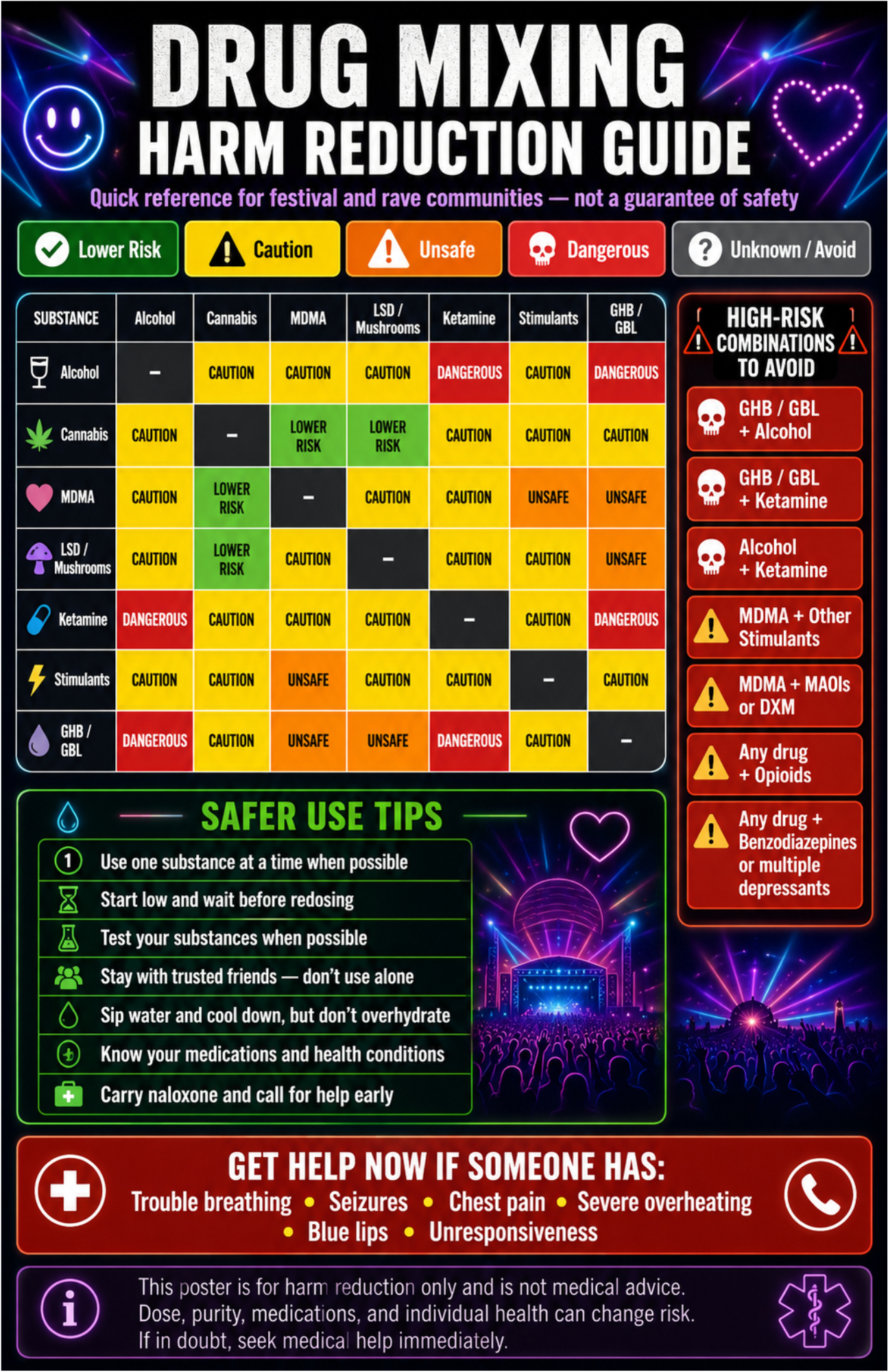
| Substance mixed with mushrooms | How the experience and risks can change |
|---|---|
| Cannabis or THC | Colours, patterns, and changes in the sense of self may feel more intense. THC can also cause a racing heart, anxiety, or paranoia. Someone who usually finds cannabis relaxing may be caught off guard during a trip, especially with an edible whose effects are still building. |
| Alcohol | Alcohol can affect balance and judgment before someone recognizes how intoxicated they are. If they become drowsy and vomit, choking becomes a concern. Heavy drinking can also suppress breathing. A person’s ability to describe what they’re seeing tells you little about how much alcohol is affecting them physically. |
| Ketamine | Ketamine is a dissociative anesthetic. A person may feel detached from their body or surroundings and have difficulty moving, speaking, or responding. Alongside the changes in perception caused by mushrooms, that can make it hard to recognize a fall, explain an injury, or ask for help. If alcohol, opioids, or other sedatives are also involved, heavy sedation and breathing problems become greater concerns. |
| Stimulants such as cocaine or amphetamines | Both mushrooms and stimulants can raise heart rate and blood pressure. A pounding heartbeat can become the focus of an anxious experience, while physical exertion or a hot environment can add strain. Chest pain, collapse, or severe overheating needs urgent medical attention. |
| MDMA | MDMA can raise body temperature and increase serotonin release. In a hot, crowded venue, someone who becomes confused or overheated may struggle to recognize what is happening or tell a friend. Other drugs and medications, particularly MAO inhibitors, can substantially change the risk. |
| Opioids or sedatives such as benzodiazepines | Sedation can make it harder for someone to stay awake, communicate, or protect their airway. Opioids can slow or stop breathing, especially alongside alcohol or other sedatives. Giving someone a borrowed pill to settle a frightening trip can introduce a serious new risk when nobody knows everything they have taken. |
| Another psychedelic, such as LSD | Changes in perception and emotion can overlap, and the substances can wear off at different times. Someone expecting to feel like themselves again when the mushrooms usually fade may remain disoriented for considerably longer. |
Why ketamine can be difficult for a friend to recognize
Picture two people sitting quietly with their eyes closed. One is listening to music and can open their eyes, answer a question, and say how they feel. The other has taken ketamine and is becoming increasingly difficult to wake. From across the room, they might look much the same.
Dissociation can feel like being far away from your body or from what’s happening around you. Ketamine also reduces the perception of pain. Someone who stumbles may have trouble recognizing that they are hurt or telling a friend where it hurts. Direct research on recreational ketamine and psilocybin together is limited, so there is no reliable way to predict how responsive a particular person will be.
For the friend sitting beside them, the most useful observations are simple. Can they respond when spoken to? Are they breathing normally? Are they becoming harder to wake? If someone cannot be woken or their breathing is slow, irregular, or abnormal, call 911 immediately. Assuming they are having an inward experience can cost valuable time.
Why cannabis can feel different during a trip
Cannabis is familiar enough that someone may reach for it almost automatically when they feel unsettled. During a psychedelic experience, though, the sensations they hope to ease may become more noticeable. A person who feels their heart speed up might begin paying close attention to every beat. A few minutes of uncertainty can feel much longer.
In a prospective survey of 321 people planning to use a psychedelic, greater cannabis use was associated with stronger visual effects and a greater sense that the usual boundary between oneself and the surroundings had softened or disappeared. The relationship with challenging experiences was more complicated. The survey included several psychedelics, and participants chose for themselves whether to use cannabis, so the findings cannot predict how an individual will respond.
What matters in the moment is that “cannabis usually calms me down” describes a previous experience. It offers little certainty about what cannabis will feel like when perception, attention, and the sense of time have already changed.
Prescription medications are part of the picture
A medication taken with breakfast can still matter that evening. Three examples show why the exact medication matters more than a broad label like “antidepressant” or “mood stabilizer.”
Lithium carries a serious seizure warning. Researchers examining online accounts found repeated reports of seizures in people who combined lithium with classic psychedelics. Those reports cannot tell us how often seizures occur across all users, but the severity of the events is reason to avoid the combination. Anyone prescribed lithium should continue taking it as directed and discuss psychedelic use with their prescriber.
Antidepressants can affect the experience in different ways. Some people taking SSRIs or SNRIs report weaker psychedelic effects. In a small controlled study, escitalopram reduced some unpleasant effects without eliminating the psychedelic experience. Assuming a medication will “block” mushrooms can lead someone to take more while the initial effects are still developing. Skipping or abruptly stopping an antidepressant can cause withdrawal symptoms or destabilize the condition it treats. A pharmacist or prescriber can review the specific medication.
MAO inhibitors deserve particular attention. Found in certain prescription medications and some ayahuasca preparations, MAO inhibitors interfere with the breakdown of serotonin and other chemicals. Combining one with a substance that releases substantial amounts of serotonin, such as MDMA, can cause dangerous serotonin toxicity. Warning signs can include repeated involuntary muscle jerking, marked stiffness, severe agitation, confusion, or overheating. Someone showing these signs after mixing substances needs urgent medical assessment.
When someone says, “I think something’s wrong”
If the person is awake, breathing normally, and frightened, it helps to have one calm, sober person stay with them. Move somewhere quieter if it’s safe. Speak simply and give them time to answer. “I’m here. Can you tell me what feels wrong?” gives them room to describe a physical symptom they might otherwise struggle to mention. Avoid giving them another substance to try to change how they feel.
Call 911 immediately if they are difficult to wake, breathing abnormally, having a seizure, experiencing chest pain, collapsing, or becoming severely overheated or rigid. If an opioid may be involved and their breathing is slow or absent, give naloxone if available and follow the dispatcher’s instructions. Stay with them even if they wake up.
In British Columbia, Poison Control is available 24 hours a day at 1-800-567-8911. You can call when the ingredients are uncertain or before symptoms appear. Have the packaging nearby if possible. Tell the responder what the person may have taken, roughly when, and what has changed since then.
Sometimes the most important detail is something only the person sitting beside them would know: “Ten minutes ago they could answer me. Now I can barely wake them.” You can make that call before you know which substance is responsible.
Sources and further reading
- Health Canada’s guides to psilocybin, ketamine, and cannabis, including their effects and risks. www.canada.ca
- A systematic review of human research on drug interactions involving classic psychedelics. pmc.ncbi.nlm.nih.gov
- A prospective survey examining how cannabis use relates to the intensity of psychedelic experiences. pubmed.ncbi.nlm.nih.gov
- Research on seizure reports involving lithium and classic psychedelics, and a clinical review of serotonin toxicity. pubmed.ncbi.nlm.nih.gov
- British Columbia guidance on poison exposure, alcohol poisoning, and responding to an overdose.