
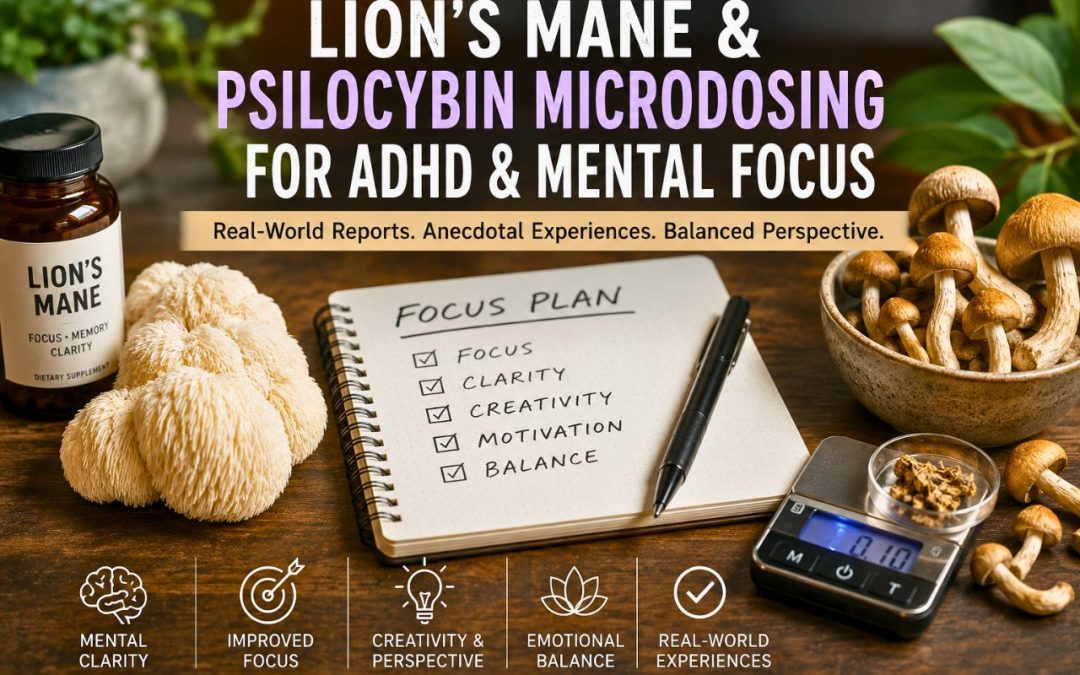
Can Lion’s Mane and Psilocybin Microdosing Help With ADHD and Mental Focus?
Interest in natural focus support has grown quickly over the last few years. More people are talking about Lion’s Mane mushroom, functional mushroom extracts, psilocybin microdosing, and the idea of using small, subtle routines to support attention, motivation and mental clarity.
One topic that comes up often is ADHD.
People with ADHD, or ADHD-like focus challenges, often describe a familiar cycle: difficulty starting tasks, jumping between ideas, procrastinating even when something matters, losing track of time, feeling mentally scattered, or needing pressure before the brain finally “switches on.” Because of this, many people look beyond traditional productivity advice and begin exploring tools that feel more natural, flexible or self-directed.
Two mushroom-related topics come up again and again in these conversations: Lion’s Mane and psilocybin microdosing.
Lion’s Mane is a non-psychedelic functional mushroom often discussed for brain health, memory and focus. Psilocybin microdosing refers to taking very small, non-intoxicating amounts of psilocybin mushrooms, with many people reporting subtle changes in mood, creativity, perspective and mental flexibility.
This article looks at the topic from an anecdotal standpoint. It focuses on what people commonly report in real-world experiences, while also being clear about the limits of current research. Personal reports can be valuable, but they are not the same as medical proof. ADHD is a real neurodevelopmental condition, and anyone dealing with significant symptoms should speak with a qualified healthcare professional before changing medication, stopping treatment or experimenting with new approaches.
For readers who are new to this topic, it may help to first understand what magic mushrooms are and how psilocybin affects the brain.
Why People With ADHD Are Interested in Lion’s Mane and Microdosing
A lot of people who talk about ADHD and mushrooms are not necessarily looking for a dramatic effect. In fact, many are looking for the opposite.
They are looking for something subtle.
Real-world reports often describe people wanting smoother focus, less mental noise, better emotional control, more motivation to begin tasks, and a calmer relationship with their own thoughts. Some describe traditional stimulants as helpful but too intense. Others say medication works for focus but can sometimes affect appetite, sleep, mood or personality. Some are not diagnosed with ADHD but still relate strongly to the daily experience of distraction, procrastination and mental overload.
This is where Lion’s Mane and microdosing enter the conversation.
Lion’s Mane is often described by users as a “background” support mushroom. People do not usually report feeling it in a dramatic way. Instead, they often describe it as something they notice over time: clearer thinking, better word recall, smoother concentration or a feeling of being more mentally organized.
Psilocybin microdosing is described differently. People often talk about mood, creativity, emotional flexibility and getting unstuck from repetitive thought patterns. Some say it helps them approach boring tasks with less resistance. Others report feeling more connected to what they are doing, more patient, or more able to see the bigger picture instead of getting trapped in frustration.
These reports are interesting, but they should be understood carefully. ADHD is complex. Focus is affected by sleep, stress, diet, screen use, hormones, trauma, anxiety, depression, exercise, environment and daily routine. When someone says “microdosing helped my ADHD,” it may mean many different things. It may mean they felt calmer. It may mean their mood improved. It may mean they were more motivated. It may mean they changed their routine at the same time. It may also include placebo effects, expectation, novelty or increased self-awareness.
That does not make the experience meaningless. It simply means it should be interpreted honestly.
Lion’s Mane for Mental Focus: What People Commonly Report
Lion’s Mane is one of the most talked-about functional mushrooms for cognitive support. Unlike psilocybin mushrooms, Lion’s Mane is not psychedelic and does not cause a trip. It is commonly used as a supplement, tea, capsule or extract by people interested in memory, mental clarity and long-term brain health.
From an anecdotal perspective, people often describe Lion’s Mane in a few main ways.
A Clearer, Cleaner Type of Focus
Many users describe Lion’s Mane as creating a cleaner mental state rather than a stimulated one. Instead of feeling pushed, wired or overly energized, people often say they feel slightly more clear-headed.
This is one reason Lion’s Mane appeals to people who are sensitive to caffeine or stimulants. Some users say coffee makes them anxious or scattered, while Lion’s Mane feels more even. Others combine Lion’s Mane with their morning routine and describe it as part of a steady focus stack rather than a quick fix.
A common theme is that Lion’s Mane does not feel like a sudden switch. People often report that they notice it most when they look back on their day and realize they stayed on task a little better, remembered words more easily, or felt less mentally foggy.
For readers interested in non-psychedelic mushroom support, Lion’s Mane is one of the most popular functional mushrooms for focus, clarity and cognitive wellness.
Better Word Recall and Mental Organization
Another common report is improved word recall. Some people say they feel less likely to lose their train of thought mid-sentence. Others report that ideas feel easier to organize, especially when writing, working, studying or having conversations.
This is especially interesting for people who describe ADHD as having “too many tabs open.” They may have plenty of ideas, but difficulty sorting them into a clear order. Lion’s Mane users sometimes report that thoughts feel less tangled and easier to follow.
Again, this is not guaranteed. Some people feel no noticeable change at all. Others may need consistent use before deciding whether it is helping. But among functional mushroom users, Lion’s Mane has developed a strong reputation as a gentle cognitive support option.
Less Brain Fog
Brain fog is not the same as ADHD, but the two can overlap in daily life. People who feel foggy may struggle with focus, memory, motivation and mental speed. Lion’s Mane is often discussed by people who feel mentally dull from poor sleep, stress, burnout or long workdays.
Anecdotally, some users say Lion’s Mane helps them feel more “online.” They may not feel stimulated, but they feel less cloudy. This is one reason Lion’s Mane is often used during workdays, study periods, creative projects or recovery from mental burnout.
Psilocybin Microdosing for ADHD and Focus: What People Report
Psilocybin microdosing is more complicated because it involves a psychedelic substance, legal restrictions vary by location, and the research is still developing.
Anecdotally, however, many people report using microdosing for focus, mood, creativity and emotional regulation. When ADHD is part of the conversation, the reports are usually less about becoming laser-focused and more about feeling less stuck.
That distinction matters.
Many people with ADHD do not lack intelligence or ideas. They struggle with task initiation, consistency, emotional friction, boredom tolerance and follow-through. Because of that, a tool that changes mood or perspective may indirectly affect focus, even if it is not acting like a traditional ADHD medication.
Feeling Less Stuck
One of the most common anecdotal reports is that microdosing helps people get started.
People describe staring at a task for hours, knowing what needs to be done but feeling unable to begin. Some say that on microdose days, the mental wall feels lower. The task still exists, but it feels less heavy. They may feel more willing to clean, write, organize, exercise, answer messages or complete small tasks they were avoiding.
This is often described as a reduction in resistance rather than a surge of energy.
Instead of “I became super focused,” the report is often closer to “I stopped arguing with myself and just started.”
Improved Mood and Patience
Another common theme is mood.
Some people report that microdosing helps them feel lighter, more patient or less reactive. For ADHD, this may matter because emotional regulation is often part of the experience. Frustration, overwhelm and rejection sensitivity can make focus harder. When mood feels more stable, tasks may feel less threatening.
People sometimes describe being able to pause before reacting, handle interruptions better, or return to a task after being distracted. This does not mean microdosing cures ADHD. It may simply mean the person feels less emotionally tangled, which can make focus easier.
More Creative Problem Solving
Microdosing is often discussed in creative communities. People report that it can help them see problems from new angles, make connections between ideas, or approach work with curiosity instead of pressure.
For ADHD minds, this may feel familiar. Many people with ADHD are already creative and fast-thinking. The challenge is often directing that creativity into useful action. Some microdosing reports suggest that people feel more able to work with their creative energy instead of being overwhelmed by it.
A person might feel more open to brainstorming, writing, designing, making music or solving practical problems. Others say it helps them step back and see which task actually matters, instead of reacting to every distraction.
Less Negative Self-Talk
A very important anecdotal theme is the way people talk to themselves.
Many people with ADHD carry years of frustration. They may have been called lazy, careless, forgetful or inconsistent. Over time, this can create a harsh inner voice. Some people who microdose report that they feel more compassionate toward themselves. Instead of spiraling into shame, they may be more able to reset and try again.
This can matter because shame often makes ADHD symptoms worse. When someone feels like they have already failed, it becomes harder to start. If microdosing helps a person soften that inner criticism, the benefit may come from emotional relief rather than direct attention enhancement.
This is one reason many anecdotal reports around microdosing sound emotional rather than purely cognitive.
Lion’s Mane vs Microdosing: Different Types of Support
Lion’s Mane and psilocybin microdosing are often talked about together, but people usually describe them very differently.
Lion’s Mane is typically described as steady, functional and non-intoxicating. People may use it as part of a daily wellness routine for mental clarity, memory support and focus.
Psilocybin microdosing is usually described as more mood-based, perspective-based and emotionally noticeable. People often talk about feeling more open, less stuck or more connected to what they are doing.
A simple way to understand the anecdotal difference is this:
Lion’s Mane is often reported as helping the mind feel clearer.
Microdosing is often reported as helping the mind feel less trapped.
That does not mean either one is guaranteed to work. It also does not mean they work the same way for everyone. Some people strongly prefer Lion’s Mane because it feels grounded and non-psychedelic. Others are more interested in microdosing because they are looking for emotional flexibility, creativity or a shift in perspective. Some people report using both, while others find that one is enough or neither is right for them.
Why Some People Combine Lion’s Mane and Microdosing
In real-world mushroom communities, Lion’s Mane and psilocybin microdosing are sometimes discussed together. The idea is that Lion’s Mane may support cognitive wellness, while microdosing may support mood, creativity and mental flexibility.
Anecdotally, people who combine them often say they are looking for balance. They may want the grounded, functional feel of Lion’s Mane alongside the subtle perspective shift they associate with microdosing.
Some users report that Lion’s Mane makes the routine feel more complete. Others say the combination feels smoother than microdosing alone. Some do not notice a difference. A few may find that combining too many things makes it harder to tell what is actually helping.
That last point is important.
When someone adds several supplements or lifestyle changes at the same time, it becomes difficult to know what is responsible for the effect. Was it Lion’s Mane? Was it microdosing? Was it better sleep? Was it journaling? Was it the excitement of trying something new? Was it taking more intentional breaks from screens?
Real-world experience is useful, but it can also be messy.
For this reason, people discussing these topics responsibly often emphasize tracking mood, focus, sleep, stress and productivity patterns over time. The goal is not to chase a dramatic feeling. The goal is to understand whether a routine is actually improving daily life.
What the Research Does and Does Not Prove
The anecdotal conversation is much stronger than the clinical evidence right now.
Lion’s Mane has some early human research suggesting possible cognitive and stress-related benefits, but the evidence is still limited. Studies are often small, and more research is needed before strong claims can be made.
Psilocybin microdosing has even more public interest, but controlled studies have produced mixed results. Some real-world surveys and naturalistic studies report improvements in mood, ADHD symptoms or emotional regulation, but placebo-controlled studies do not always show clear benefits beyond expectation.
This does not mean every personal report is false. It means the science has not fully caught up to the popularity of the topic, and some reported benefits may be influenced by placebo, mindset, routine changes, expectation or individual differences.
That is especially important for ADHD. A person may genuinely feel better while microdosing, but that does not automatically prove microdosing treats ADHD itself. It may be affecting mood, motivation, self-awareness or emotional regulation, which can indirectly affect focus.
A responsible takeaway is this:
People are reporting interesting experiences, but the evidence is not strong enough to call Lion’s Mane or psilocybin microdosing a proven ADHD treatment.
Why Lifestyle Still Matters for ADHD and Focus
One pattern that comes up often in real-world reports is that mushrooms seem to work best when they are part of a larger routine.
People who report the best results often also mention better sleep, exercise, cleaner eating, journaling, meditation, reduced alcohol, less screen time, more time outdoors, or using structure like calendars and task lists.
This matters because ADHD is not only about attention. It is also about environment.
A distracting environment can make symptoms worse. Poor sleep can make focus harder. Too much phone use can train the brain to seek constant novelty. Stress can make task initiation feel impossible. Skipping meals can affect mood and energy. Lack of movement can increase restlessness.
Lion’s Mane or microdosing may feel helpful for some people, but they are unlikely to replace the basics. The most consistent real-world improvements often come from combining internal support with external structure.
For example, someone may report better results when they use Lion’s Mane alongside a morning routine. Another person may say microdosing feels more useful when they plan their day ahead of time, set a clear intention, and avoid overstimulating environments.
Common Positive Reports
Across real-world discussions, people commonly report a few potential positives.
Some say Lion’s Mane helps them feel clearer, less foggy and more mentally organized. Some say it supports memory, word recall and steady concentration. Others describe it as a gentle addition to a morning routine without the sharp edge of caffeine.
With microdosing, people often report improved mood, more creativity, less procrastination, easier task initiation and a softer inner dialogue. Some say they feel less overwhelmed by boring tasks and more able to engage with the present moment.
For ADHD-related focus, the strongest anecdotal themes are not usually about becoming intensely productive. They are more often about reducing friction. People report feeling less blocked, less reactive and less trapped in avoidance.
That may be why the topic continues to grow. Many people are not looking for a miracle. They are looking for a small shift that helps them participate in their own life with less resistance.
Common Negative or Neutral Reports
Not every report is positive.
Some people try Lion’s Mane and notice nothing. Others report stomach discomfort, headaches, vivid dreams or feeling slightly off. Some people are sensitive to mushroom supplements in general, especially if the product quality is poor or the extract does not agree with them.
Microdosing can also produce unwanted effects. Some people report anxiety, irritability, emotional sensitivity, sleep disruption, distraction or feeling too introspective. Others say it makes them feel less productive because they become more interested in thoughts, music, nature or emotions than the task in front of them.
This is especially relevant for ADHD. A person hoping for focus may not benefit from something that increases openness or emotional awareness if they need structure and task completion. For some, microdosing may help them start. For others, it may simply give the mind more interesting places to wander.
Neutral reports are also common. Some people say they wanted microdosing to work but felt no clear difference. Others say the first few times felt interesting, but the benefits faded. This is one reason placebo-controlled research is important.
Real-world experiences are worth listening to, but they are not universal.
Safety, Medication and Mental Health Considerations
This topic needs a careful safety note.
ADHD medication, antidepressants, anxiety medication and other prescriptions can interact with mood, attention and perception. No one should stop or change prescribed medication without speaking to a healthcare professional.
People with a personal or family history of psychosis, bipolar disorder, severe anxiety or certain mental health conditions should be especially cautious around psychedelics. Even small amounts may not be appropriate for everyone. Legal status also varies depending on location, and psilocybin remains restricted in many places.
Lion’s Mane is non-psychedelic, but it can still affect people differently. Anyone with allergies, medical conditions, upcoming surgery, blood sugar issues or medication concerns should check with a professional before adding new supplements.
It is also important to avoid framing mushrooms as a cure. People deserve honest information, not exaggerated promises. ADHD can be challenging, and people looking for help are often tired of feeling misunderstood. That makes responsible education even more important.
So, Can Lion’s Mane and Microdosing Help With ADHD?
From an anecdotal standpoint, some people say yes.
People report that Lion’s Mane may support clearer thinking, better memory, less brain fog and steadier focus. People report that psilocybin microdosing may support mood, creativity, emotional flexibility and task initiation. Some people with ADHD or ADHD-like symptoms say these effects make daily life feel easier.
But from a scientific standpoint, the answer is not settled.
Lion’s Mane is promising but not proven as an ADHD treatment. Psilocybin microdosing has many positive personal reports, but controlled studies are mixed and do not yet prove reliable cognitive benefits. ADHD is complex, and what helps one person may not help another.
The most balanced answer is this:
Lion’s Mane and psilocybin microdosing are both being explored by people who want better focus and mental clarity, but they should be viewed as experimental or supportive topics rather than proven ADHD treatments.
For some people, Lion’s Mane may fit naturally into a wellness routine. For others, microdosing may feel like it changes their relationship with tasks, emotions or self-talk. But neither should replace medical care, healthy routines or professional guidance.
Final Thoughts
The growing interest in Lion’s Mane, psilocybin microdosing, ADHD and mental focus says something important: many people are looking for better ways to understand their minds.
They are not always looking to escape reality. Often, they are trying to function better inside it.
They want to start tasks without fighting themselves. They want to feel less scattered. They want to think clearly, follow through, regulate emotions and feel more connected to their own potential.
Real-world reports suggest that Lion’s Mane and microdosing may feel helpful for some people, especially when combined with better sleep, structure, movement, intention and self-awareness. But the evidence is still developing, and responsible education matters.
The best approach is curiosity without hype.
Listen to people’s experiences. Respect the science. Avoid miracle claims. Be honest about uncertainty. And remember that focus is not just about forcing the brain to work harder. Sometimes it is about creating the right conditions for the mind to feel safe, clear and ready to begin.