
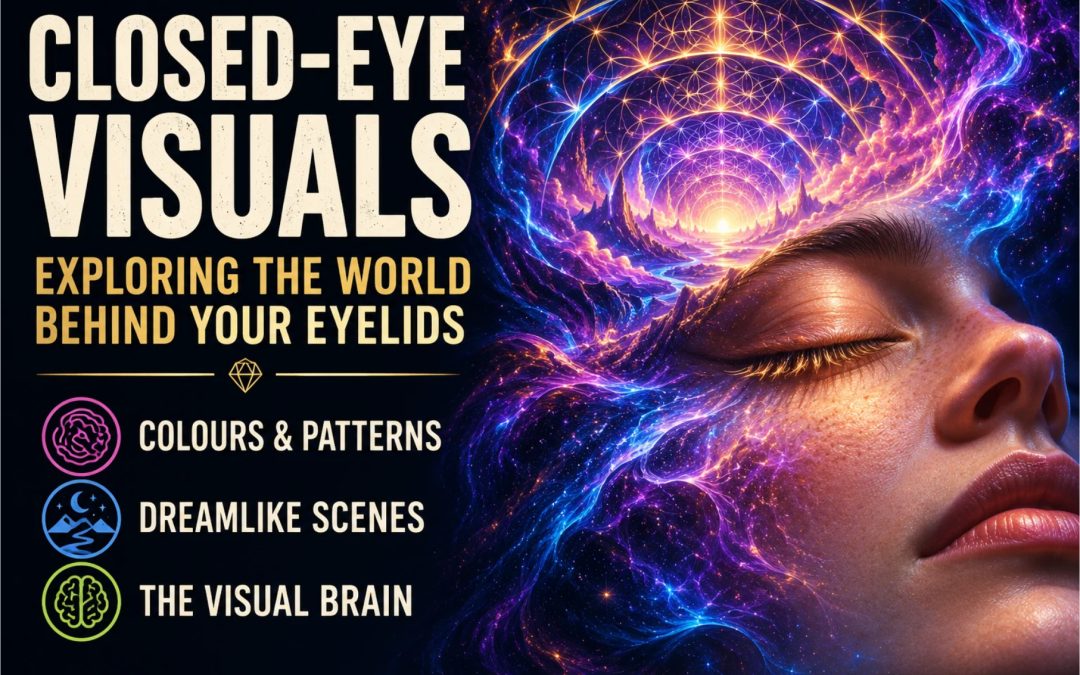
Imagine closing your eyes and seeing a thin gold line against the dark. It bends, branches, and folds into a pattern like stained glass. For a moment, one section looks like a face. By the time you try to make out whose face it is, you’re looking at colours again.
That’s one way to picture closed-eye visuals. During a psilocybin mushroom experience, people sometimes see colours, patterns, objects, or entire scenes while their eyes are shut. One of the strangest parts can be how little effort it takes. When you picture an apple on purpose, you’ve already decided what you’re going to see. With psychedelic imagery, the next image can catch you by surprise. pmc.ncbi.nlm.nih.gov
What do closed-eye visuals look like?
Researchers studying psilocybin often distinguish between elementary imagery and complex imagery. The words describe what appears in the image. A simple pattern can feel just as striking as a detailed scene. pmc.ncbi.nlm.nih.gov
| Type of imagery | What it might look like |
|---|---|
| Elementary imagery | A patch of violet that slowly expands, coloured lines crossing into a lattice, or a repeating pattern that seems to fold inward. |
| Complex imagery | A face with a recognizable expression, a landscape viewed from above, or a room that resembles somewhere you remember. |
Think of the difference between seeing a repeating diamond pattern and suddenly recognizing a kitchen floor like the one in your childhood home. The geometry may look similar. What changes is that the second image has become somewhere. Both kinds of imagery appear in accounts of psychedelic experiences. There’s no sequence you need to move through. pmc.ncbi.nlm.nih.gov
How can you see something with your eyes closed?
Closing your eyes takes the room out of view, but the parts of your brain involved in vision remain active. In a placebo-controlled study, researchers scanned 24 adults as they rested with their eyes closed after taking either psilocybin or a placebo. Afterward, participants described the imagery they had experienced. This let researchers compare what people saw with changes in how parts of the visual system communicated. pmc.ncbi.nlm.nih.gov
One interpretation is that psilocybin shifts the balance between incoming visual signals and feedback within the brain. That could help explain how an image becomes vivid with so little to look at. The study leaves a more personal question open. Why does one person see a shifting grid while someone else sees their grandmother’s kitchen? A brain scan can show changes in visual processing without telling us why a particular image appeared. pubmed.ncbi.nlm.nih.gov
What might you see when you close your eyes on mushrooms?
Sometimes it’s as simple as a patch of blue drifting across the darkness. Other times, an image has enough detail that you can pick out individual windows on a building or the expression on someone’s face. Researchers describe both geometric patterns and more complex imagery involving people, places, and objects. Here are a few examples to help picture that range. pmc.ncbi.nlm.nih.gov
- Colour with no clear shape. Imagine a pool of deep red spreading slowly across the dark. A thin orange edge appears where the red fades, like the last strip of light on the horizon after sunset.
- Patterns that fold into themselves. A row of green triangles might repeat from edge to edge. As the rows tilt, the flat pattern takes on depth. For a moment, it looks as though you’re looking down a tiled hallway.
- Shapes that resemble things in nature. A single bright line branches into thinner lines. At first it resembles the veins in a leaf. As the branches spread, the same shape starts to look like a river system seen from above.
- Faces that appear briefly. Two dark spots and a curved line might suddenly register as a smiling face. You may have just enough time to notice a raised eyebrow before the features soften and the face slips back into the pattern.
- An ordinary place in surprising detail. A scene might resemble a kitchen from years ago. What catches your attention could be something small, like afternoon light falling across the same yellow counter where you used to sit.
One detail that’s easy to miss in descriptions of closed-eye visuals is how much recognition changes the experience. A patch of colour can be interesting simply because it moves. The moment it resembles a familiar face or a place you miss, it can bring up a feeling, too. If you’re describing the experience afterward, “I saw yellow light on a counter and it reminded me of home” may come closer to what it felt like than “I saw a whole kitchen.”
Why does opening your eyes change the experience?
Picture looking at a wood-grain door and seeing the swirls appear to flow. The real door gives the effect a surface and a shape. Close your eyes, and that reference point disappears. A ribbon of colour might now seem to float in darkness, with no obvious size or distance. This is a practical difference between an open-eye distortion and closed-eye imagery. Psychedelic visual effects can occur in either state. pmc.ncbi.nlm.nih.gov
If the imagery feels unsettling, it’s okay to open your eyes, look at something familiar, and tell a trusted sober person what you’re experiencing. You can leave an uncomfortable image unexplored.
Does a vivid image mean something?
Suppose you see your grandfather sitting at his kitchen table. The most interesting part might be an ordinary detail, like the chipped mug he always used. If you want to reflect on it afterward, try writing down two things separately. What did I see? What did it bring up for me? “I saw his mug” describes the image. “I miss our Sunday mornings” describes what it meant to you.
That distinction leaves room for personal meaning without treating every detail as a fact about the past. It also leaves room for a purple spiral to simply be a purple spiral.
Can you have closed-eye visuals without mushrooms?
Yes. A brief spark or patch of light can be a phosphene, the perception of light without a corresponding light source. That’s one everyday example of how you can see something with your eyes shut. New flashes accompanied by a sudden increase in floaters, or a dark curtain across part of your vision, need urgent eye care. my.clevelandclinic.org
What makes closed-eye visuals so intriguing is that you can notice the moment colour turns into something recognizable. A few lines become a doorway. A patch of light becomes a face. Sometimes the detail worth remembering is the instant before that happens, when you’re still looking at a shape and wondering what, if anything, it will become.