
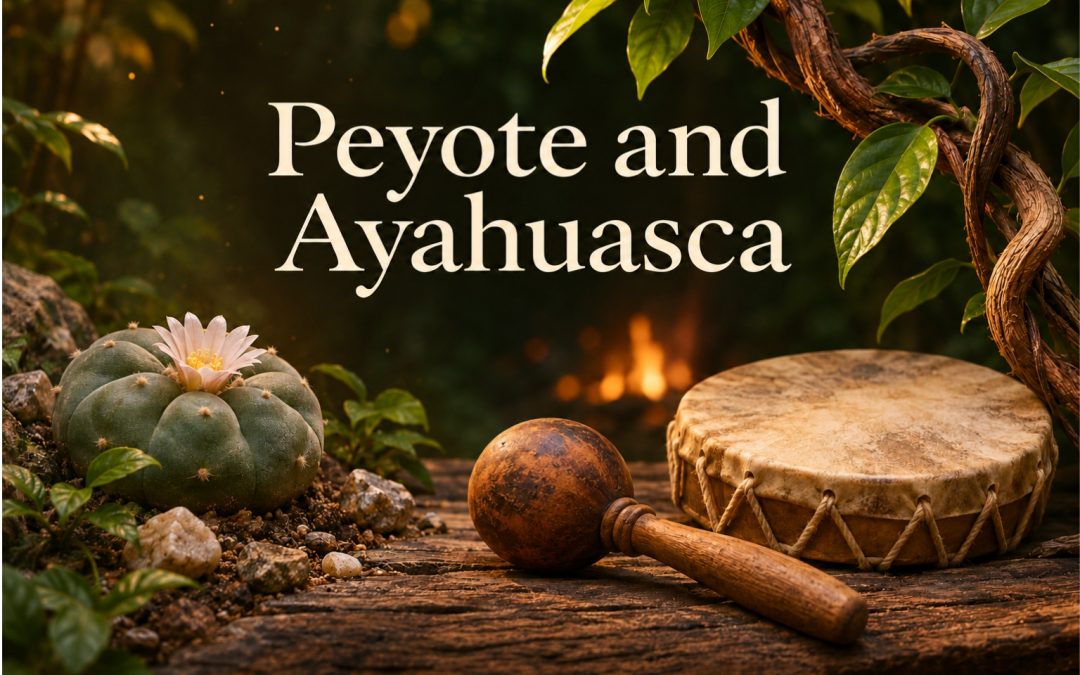
Peyote and Ayahuasca Ceremonies: Traditions and Personal Stories
What happens inside these gatherings, why people take part, and what firsthand experiences reveal about connection, reflection and belonging.
You might hear someone describe a ceremony as the night they finally forgave themselves. Someone else remembers the drum, the people who welcomed them, or the unfamiliar freedom of singing without feeling self-conscious.
Those descriptions invite questions. What actually happened? How much came from the plant, and how much came from the setting? What does “healing” mean to the person telling the story?
Peyote and ayahuasca ceremonies bring together powerful psychoactive substances and living cultural traditions. Understanding them means paying attention to the people, beliefs and relationships surrounding the experience.
Here, we explore both, followed by five firsthand accounts of each. These stories were selected for their positive reflections, including experiences that were physically or emotionally difficult. They show what particular people valued; they do not establish typical outcomes or prove that a ceremony treats an illness.
Peyote ceremonies: prayer, community and sacred responsibility
What is peyote?
Peyote is a small, spineless cactus, Lophophora williamsii, containing mescaline. Its effects can include changes in visual perception, time, emotion and bodily sensation. Nausea, vomiting, anxiety and increased heart rate or blood pressure can also occur. www.dea.gov
For communities that use it sacramentally, peyote has religious significance extending beyond those effects. Native American Church gatherings and the peyote traditions of the Wixárika people of Mexico have distinct histories and practices.
What does a peyote ceremony look like?
There is no single format.
In Half Moon ceremonies within the Native American Church, participants commonly gather overnight in a tipi around a fire and a crescent-shaped altar. A ceremonial leader, often called a roadman, guides the gathering through prayer, peyote songs, drumming and the ceremonial use of peyote. Tobacco also commonly accompanies prayer, while Christian elements vary between communities. Native American Church of Virginia Spirit Speaks Forum
In Cross Fire ceremonies, also called Big Moon ceremonies, the overnight gathering generally places greater emphasis on Christian teachings. A Bible may be displayed, prayers may invoke Jesus, and biblical readings or a sermon can accompany the ceremonial use of peyote. The arrangement of the altar and fire also differs from the Half Moon tradition, with practices varying between leaders and communities. Peyote Religion: A History jameswfemooney.com
In Wixárika peyote ceremonies associated with the pilgrimage to Wirikuta, participants travel through sacred landscapes, leave offerings and gather peyote, known as hikuri. Songs, prayers, music and ceremonial dancing connect the journey with ancestors, the agricultural cycle and the wellbeing of the community. These ceremonies belong to a wider cycle of religious responsibilities and relationships with the land. UNESCO
Why do people take part?
Prayer, guidance, healing and responsibility to family or community can all matter. In the stories below, the positive meaning often appears through ordinary human needs: feeling welcome, expressing gratitude, making peace with oneself or sharing food after a demanding night.
Peyote’s effects cannot be separated neatly from those relationships by reading a personal account.
Five firsthand peyote stories
These posts describe different gatherings and settings. Several do not name their nation or ceremonial lineage, so they should not be presented as five independently verified indigenous traditions.
1. A naming ceremony that turned apprehension into connection
In an October 2021 Reddit post, a visitor described attending a Native American Church naming ceremony at a mother’s invitation. Previous psychedelic experiences with other people had been uncomfortable, so they anticipated an intense night.
What surprised them was the ease they eventually felt. After initial anxiety and nausea, the singing helped their thoughts flow freely. Speeches, laughter and emotion filled the gathering. They described feeling love toward those present and compassion for their pain.
By morning, people they had only just met were hugging them and saying they were glad they had come. That welcome gives the account its emotional centre: someone who had struggled with group experiences found connection in this one.
The night also changed their understanding of a tradition practiced near where they had lived all their life. They learned that the roadman had been asked to choose the children’s names beforehand, and watched the girls awaken to receive them.
Their story brings together two discoveries: an unfamiliar community practice became personally meaningful, and being among others felt unexpectedly reassuring. reddit.com
Read “I attended a NAC ceremony for the first time”.
2. A Half Moon–based ceremony and finding meaning in everyday life
In an account published on Erowid in August 2020, Mads described attending a gathering based on the Half Moon tobacco ceremony. They initially felt anxious, but a conversation with the co-leader helped them feel more comfortable.
Participation began before the ceremony: Mads helped erect the tipi and practised chants and rattling. That evening, approximately 40 people gathered around a fire, with opportunities to sing accompanied by a water drum.
What stood out was a feeling of becoming grounded in their own life. Mads compared the experience to sitting on a grandfather’s lap, receiving guidance about what mattered and how to act on it.
Their central insight was practical: change begins with how you treat your parents, siblings, friends and yourself. They reflected on humility, compassion and humour, while recognising that respect can also involve being assertive.
The gathering ended with participants sharing words and placing flowers in a river. Five days later, Mads reported feeling good. This is one participant’s account of a Half Moon–based gathering; its description does not establish how closely it followed a particular community’s tradition. ‘Fold Your Hands and Show Respect’
In Recollections of the Peyote Road, published in 1983, George Morgan reflected on years of participating in Native American Church ceremonies after his first gathering at Wounded Knee in 1964.
He described appreciating both Cross Fire and Half Moon rituals, although Half Moon remained his preferred tradition. In his description of Cross Fire, a Bible rested beside the sacred altar, and the ceremonial leader read passages aloud and explained their meaning.
Across his experiences, Morgan remembered the songs as especially powerful. Voices, rattles and drumming created an atmosphere he associated with hope, peace and compassion.
What stayed with him extended beyond the ceremony. He felt grateful for the patience of the people who welcomed him, and described their humour, fellowship and teachings as influences on his everyday life.
His account also includes difficult periods. Its positive thread is the sense of belonging he developed over time—a spiritual community whose meaning continued after the firelit gatherings ended.
These reflections cover his broader ceremonial life, rather than one identifiable Cross Fire night. psychedelic-library.org
Read George Morgan’s “Recollections of the Peyote Road”.
4. A night around the fire that changed how one writer understood her ancestors
Tash Doherty described attending a ceremony in an open valley outside Oaxaca in March 2021. Mountains surrounded the gathering, and participants stayed around a central fire through the cold night.
Early on, she tied intentions into a red string: becoming less judgmental, finding direction and learning forgiveness. As people shared their struggles, the gathering became deeply emotional.
The turning point came when she reflected on her ancestors. She felt grief over languages and family stories she could no longer access, alongside gratitude for freedoms earlier generations had lacked.
Looking into the flames, she described imagining herself running across a landscape whose ashes contained ancestral words and messages. She interpreted this imagery as a call to write honestly and preserve what might otherwise be forgotten.
The night involved prolonged crying, cold and exhaustion, but also a feeling of being supported. Her account presents these insights as personal interpretations—not proof of ancestral communication or a description of every Wixárika ceremony. tashdoherty.com
Read Tash Doherty’s firsthand account.
5. A birthday ceremony that brought gratitude and forgiveness into focus
A February 2021 writer described joining a tipi ceremony in Mexico to honour a local chief’s birthday. The gathering continued from evening into the following day and included chants, blessings and restrictive rules about movement.
Their reflection focused on identity and guilt. They described encountering a clearer sense of themselves, considering how they wanted to be understood and recognising that repetitive thoughts could carry either supportive or painful emotions.
Gratitude and forgiveness became central. As the ceremony ended, they felt moved to thank the people, the fire and the tipi, linking that gratitude with a wish to release long-carried guilt.
They described the following hours as seeing the world with fresh eyes. The post does not establish how long that feeling lasted, and it does not identify the community’s specific nation.
Read “Peyote Report”. www.reddit.com
Ayahuasca ceremonies: what happens and why people participate
What is ayahuasca, and how does it work?
Ayahuasca refers to the Banisteriopsis caapi vine and to brews associated with it. A common preparation combines the vine with a DMT-containing plant, often Psychotria viridis. Ingredients and traditions vary.
The vine contains compounds that inhibit monoamine oxidase, an enzyme that normally breaks down swallowed DMT. This allows DMT to become orally active. Those same properties help explain why medication interactions matter.
Effects may begin after roughly 30–60 minutes and commonly last around four to six hours, with considerable variation. A ceremony can last longer than the main effects. psychedelics.berkeley.edu
What does an ayahuasca ceremony look like?
Again, there is no single format.
In some Amazonian and contemporary retreat settings, people gather at night in a ceremonial space, sit or lie in assigned places and drink the brew under a leader’s supervision. Periods of quiet may alternate with songs and individual attention.
In Shipibo practice, songs often called icaros have a central role in the healers’ work. A study of one Shipibo-led programme describes practitioners understanding their songs as tools for diagnosis, protection and healing. These descriptions reflect the practitioners’ spiritual and medical framework; they are not proof that an objectively measurable energy has been removed. PMC
In Santo Daime, communal prayers and hymns are central to religious practice. Participants help create the ceremony through their voices. Other gatherings include substantial instrumental music, movement or dancing. chlq
Why do people do it?
Within Amazonian traditions, ayahuasca can be connected with healing, knowledge, divination, relationships with the natural world and community life. In religious communities, it serves as a sacrament. ICEERS
Contemporary visitors may arrive with hopes of understanding emotional patterns, relationships or spiritual questions. The word “healing” can describe many things: feeling less alone, seeing a problem differently, reconnecting with faith or experiencing temporary relief.
Those meanings deserve to be understood on their own terms.
What might someone experience?
Accounts include vivid imagery, altered time, strong emotion, bodily sensations, fear, joy and perceived spiritual encounters. Some people experience little visual imagery.
Nausea, vomiting and diarrhoea can occur. Some traditions give these experiences a cleansing meaning, but vomiting does not demonstrate that toxins or trauma have left the body. psychedelics.berkeley.edu
A meaningful experience can be difficult. Difficulty alone does not establish that something beneficial is happening.
Five firsthand ayahuasca stories
1. Shipibo-led chanting and the freedom of letting go
In November 2012, Shroomery writer CaptainFuture described joining a friend at a Shipibo-led ayahuasca workshop in the Netherlands. More than 40 people gathered, creating a sense of community that became central to their experience.
The practitioners’ warmth and singing left a particularly strong impression. Their chants gave the gathering a character unlike the writer’s previous experiences with DMT or psilocin. Being surrounded by others added an emotional depth they struggled to put into words.
The night included difficult moments. CaptainFuture interpreted the practitioners’ guidance as helping the atmosphere move through distress toward love. Within themselves, they described an unusually deep opening of affection and connection.
Their clearest insight concerned the pressure of constantly wanting, needing and deciding how life should unfold. Letting go of those demands felt freeing. They associated that freedom with meeting each moment openly and responding to others with care.
The reflection they shared afterwards was about expressing that care: allowing affection to become something shared, rather than keeping it private. In their telling, the singing and community helped soften barriers between themselves and others.
This describes the writer’s spiritual understanding of the night, rather than a shared or guaranteed outcome for everyone present. Shroomery Message Board
Read “Shipibo Ayahuasca Ceremony”.
2. Santo Daime and discovering connection through song
In two July 31, 2008 Shroomery posts, shivak described a Santo Daime experience that brought peace and a renewed sense of connection. They had spent the previous two years practising meditation and believed this helped them approach the ceremony with less fear. They described their ego becoming quiet while they remained surprisingly clear-headed.
The religious language took adjustment. References to Jesus and Mary felt unfamiliar, but conversations revealed different interpretations among participants. Some understood the figures literally; others saw them as expressions of a shared divine love. That diversity gave shivak more room to find personal meaning.
Their relationship with the music also changed. Initially unconvinced about communal singing, they discovered that even humming unfamiliar melodies helped them participate. Singing became a way to focus intention and join others in prayer.
In a later post that day, they reported feeling refreshed, affectionate and more comfortable approaching strangers. They associated this openness with a reduced feeling of separation from others.
The personal insight was a connection between meditation and ceremony: allowing experience to unfold seemed to quiet resistance and make connection easier. These were immediate reflections; the posts do not establish how long those feelings lasted. Shroomery Message Board
Read shivak’s July 31 reflections.
3. A Huni Kuin gathering where music opened the door to joy
In December 2025, a Reddit writer returned from a two-day Huni Kuin-led gathering in the UK describing extraordinary happiness. Their account centred on an unexpected freedom to sing, dance and respond to music.
The ceremony began with chanting while participants sat or lay down. The writer found this opening overwhelming, describing feeling close to passing out. Later, the atmosphere changed as facilitators played multiple guitars and drums, creating a vibrant musical setting.
Seeing others moving and enjoying themselves became a memorable part of the experience. Dancing was something the writer ordinarily struggled with, yet here they found themselves joining in enthusiastically. They described feeling unusually receptive to the music, with different songs bringing different thoughts and emotions to the surface.
They also reported gaining more personal insight than expected, although they did not explain those insights. The clearest change they described was experiential: an activity that usually felt difficult became a source of pleasure and expression.
Their story leaves room for joy alongside reflection. For this participant, freely joining the music was itself a meaningful part of the gathering.
This was one event with visiting practitioners, rather than a description of every Huni Kuin ceremony. reddit.com
4. Visiting Yawanawá people in Acre: a demanding journey and a memorable welcome
In an April 2024 Reddit discussion, a visitor recalled travelling to Acre, Brazil, to participate in ayahuasca ceremonies with Yawanawá people. They described the experience as amazing, placing particular emphasis on how welcoming and supportive their hosts had been.
Reaching the community required considerable effort. The writer recalled taking three or four flights from Rio and explained that the flights were only the beginning of the journey. Looking back, they would have allowed extra days to accommodate possible delays or cancellations.
There were insects and other inconveniences, too. Yet their assessment was clear: the experience had been worth those difficulties.
The most revealing detail is what they chose to praise. Alongside their enthusiasm for the experience, they singled out the people who received them. Their account invites readers to consider hospitality as part of a ceremony’s meaning—the welcome and support surrounding participation, alongside whatever happens internally.
The visitor did not describe particular visions, personal revelations or lasting changes. Their contribution is a shorter, more grounded reflection: a challenging journey led to an experience they valued deeply, and the kindness of their Yawanawá hosts stood out when they told others about it. reddit.com
5. Colombian yagé, a sense of brotherhood and carrying the experience home
In May 2021, a Reddit writer described attending two weekend yagé gatherings in the mountains near Medellín during a three-month stay in Colombia. These were their first experiences with the brew, and the people surrounding the ceremonies left a strong impression.
They recalled a quiet sense of brotherhood among the organisers. Beautiful music, talented musicians, shared meals and constructive conversations with a leader they regarded as wise all contributed to feeling refreshed. Their appreciation extended beyond the ceremony itself to the human connections around it.
The weekend format suited their travel plans, but leaving felt abrupt. They described returning to ordinary life after a night that felt as momentous as dying and reaching heaven—a comparison expressing the experience’s intensity, rather than a literal event.
That contrast gives the account its deeper question: how do you carry something extraordinary into an ordinary day? The writer did not describe a detailed integration process or explain what was discussed with the leader. What they did convey was appreciation alongside a sense that the transition deserved more time.
Their story invites reflection on the space after a ceremony: time to absorb an experience, understand its significance and reconnect with everyday life. reddit.com
Read “First Ayahuasca Experience in Colombia”.
How do peyote and ayahuasca ceremonies compare?
| Aspect | Peyote | Ayahuasca |
|---|---|---|
| Psychoactive basis | Mescaline in the cactus | Commonly DMT-containing plants combined with MAO-inhibiting vine compounds |
| Settings discussed here | Native American Church gatherings, a Wixárika pilgrimage and Mexican community or retreat events | Shipibo-led, Santo Daime, Huni Kuin, Yawanawá and Colombian gatherings |
| Roles of sound | Prayer, songs, rattles and drumming feature prominently | Icaros, hymns, chanting or instrumental music, depending on the setting |
| Themes in these stories | Belonging, gratitude, forgiveness and peace | Connection, religious participation, expression, support and reflection |
| What stories cannot establish | Typical effects, lasting benefit or safety for another person | Typical effects, lasting benefit or safety for another person |
The overlap matters too. In both collections, writers repeatedly remember other people. Welcome, music, shared purpose and the return to ordinary life belong in the conversation alongside the substance.
These are themes in a small, deliberately positive selection—not evidence that peyote is always gentle or ayahuasca always overwhelming.
Safety, respect and what happens afterward
Both substances can be physically and psychologically demanding. Ayahuasca raises particular concerns about interactions with serotonergic medicines and other drugs because it contains MAO inhibitors. Do not stop prescribed medication to attend a ceremony without guidance from the prescriber. ICEERS
Calling an event traditional or spiritual does not replace consent, appropriate screening, boundaries or access to emergency care. Increasing the Safety of Ayahuasca Sessions
After an intense experience, integration means making sense of it in everyday life. That can involve rest, reflection, trusted support or professional help. A powerful feeling does not have to become an immediate major life decision.
Frequently asked questions
Are ayahuasca and peyote the same kind of experience?
They are different substances used in distinct traditions. Some personal themes overlap, but neither a plant name nor a ceremonial label reliably predicts how someone will feel.
Does everyone see visions?
No. The accounts here include peace, music, connection and movement without detailed visual descriptions. Vivid imagery is not a measure of the value of an experience.
Conclusion: listening to the whole story
The memorable details in these accounts are often simple: being welcomed, hearing a song differently, sharing breakfast or feeling able to move without embarrassment.
For these writers, those moments carried meaning. Their stories offer a human view of ceremonies that are too often reduced to a substance or a dramatic vision.
Understanding them well means keeping the whole picture in view: the community, its traditions, the person’s hopes, the difficult moments and what followed after the gathering ended.
There are many more ceremonies and traditions than we could explore here, each with its own history, meaning and community. Our focus on these examples does not lessen our respect and appreciation for those we have not discussed. We honour the diversity of these traditions and the people who preserve and share them, recognising that each deserves to be understood on its own terms.